
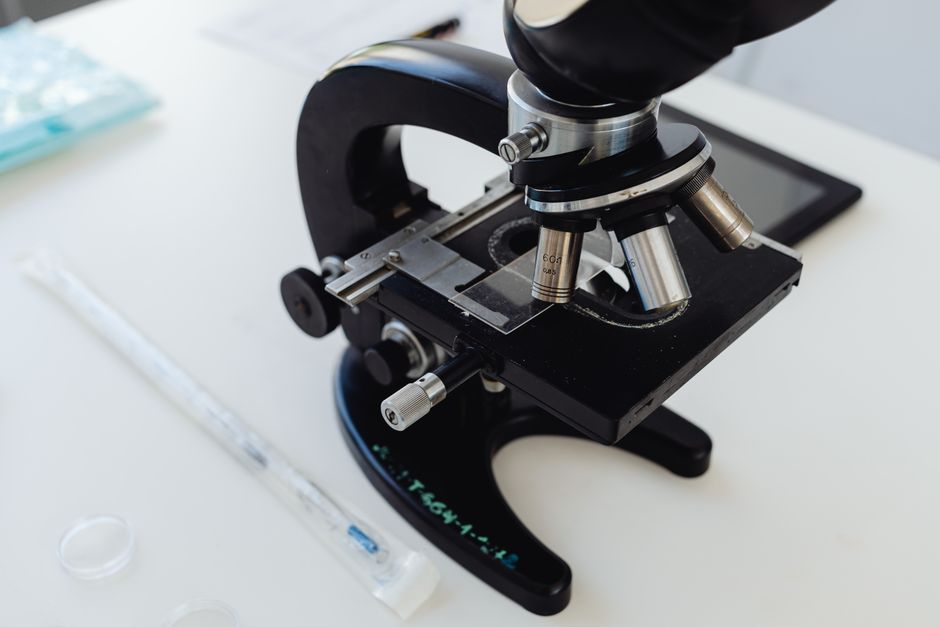
The nosepiece of a microscope holds the objective lenses and rotates to bring a different lens into position above the specimen. It is the part that lets you switch between low and high magnification without removing the slide. When you turn the nosepiece, you hear a click, and the selected objective lens locks into place directly over the light path.
What Is the Nosepiece and Where Is It Located?
The nosepiece sits at the lower end of the microscope arm, just above the stage where the slide rests. It is also called the revolving turret or objective turret. On most compound microscopes, it holds three to five objective lenses of different magnifying power.
Each objective lens screws into the nosepiece and points downward toward the specimen. The entire assembly rotates on a central pivot. This design keeps the lenses aligned with the optical path so the image stays centered when you change magnification.
How Does the Nosepiece Work?
Turning the nosepiece moves a different objective lens into the light path. The lenses are spaced evenly around the turret, and a spring-loaded detent mechanism stops the rotation at each lens position. That is the click you feel and hear.
The detent ensures the lens is centered over the specimen. If the lens is not fully clicked into place, the image will be off-center or partially dark. Most microscopes are parfocal, meaning the image stays nearly focused when you switch between objectives. The nosepiece makes this possible by keeping each lens at the correct working distance from the stage.
Why Is the Nosepiece Important for Magnification?
Each objective lens on the nosepiece has a different magnification, commonly 4x, 10x, 40x, and 100x. The eyepiece usually adds another 10x magnification. A 40x objective with a 10x eyepiece gives a total magnification of 400x.
Without the nosepiece, you would need to unscrew and reattach lenses to change magnification. That would be slow, and the lens could be dropped or contaminated. The nosepiece lets you change magnification in seconds while keeping the specimen in view.
The 100x lens, called the oil immersion objective, requires a drop of immersion oil between the lens and the slide. The nosepiece allows you to swing the lower-power lenses out of the way to apply the oil and then rotate the 100x lens into position.





What Happens When the Nosepiece Is Damaged or Misaligned?
A damaged nosepiece can cause several problems. If the detent mechanism wears out, the lens may not lock into place, and the image will drift or appear dark on one side. If the nosepiece is bent or dropped, the lenses may no longer be centered over the light path.
Misalignment can also cause the objective lens to hit the slide when you rotate the nosepiece. This is more likely with high-power lenses, which have a shorter working distance. Forcing the nosepiece when it will not turn can damage the lens, the slide, or the stage.
If the nosepiece feels gritty or stiff, do not force it. The problem may be dried grease or debris in the rotation mechanism. A microscope service professional can clean and lubricate it properly.
How to Use the Nosepiece Correctly
Always start with the lowest-power objective in place. Focus the image using the coarse focus knob, then fine-tune with the fine focus knob. When you are ready for higher magnification, rotate the nosepiece until the next lens clicks into place.
Use only the fine focus knob after switching to a higher-power lens. The coarse focus knob moves the stage too much at high magnification and can drive the lens into the slide.
Never rotate the nosepiece by gripping the objective lenses. Hold the knurled edge of the nosepiece itself. Gripping the lenses can loosen them, and your fingers can leave oil on the lens surface.
When you finish using the microscope, rotate the nosepiece so the lowest-power objective is facing down. This position keeps the high-power lenses safely away from the stage and reduces the risk of damage during storage.
What Is the Difference Between a Nosepiece and Other Microscope Parts?
The nosepiece is often confused with other parts of the microscope, but each has a distinct job.
- Eyepiece (ocular lens): The lens you look through at the top of the microscope. It magnifies the image formed by the objective lens.
- Objective lenses: The lenses attached to the nosepiece that provide the primary magnification.
- Stage: The flat platform that holds the glass slide.
- Focus knobs: The controls that move the stage or the body tube to bring the specimen into focus.
The nosepiece is the connector between the objective lenses and the body of the microscope. It is the mechanical part that makes multi-lens magnification practical.
What Does the Nosepiece Do on Digital and Stereo Microscopes?
Stereo microscopes, also called dissecting microscopes, have a nosepiece that works the same way. They typically hold two objectives with lower magnification, often 1x and 3x, or a single zoom lens system instead of a rotating turret.
Digital microscopes may not have a physical nosepiece at all. Some use a single fixed lens, and magnification is changed digitally in software. Others have a rotating turret similar to a compound microscope, but the image is sent to a screen instead of an eyepiece.
The function remains the same: selecting the right objective for the level of detail you need. The physical design simply adapts to the microscope type.
How to Clean and Maintain the Nosepiece
Keep the nosepiece free of dust and oil. Wipe the exterior with a soft, lint-free cloth. If immersion oil gets on the nosepiece, clean it off promptly. Oil can seep into the moving parts and attract dust.
Check the objective lenses regularly for smudges. Clean them with lens paper and a small amount of lens cleaner designed for optics. Never use paper towels or regular cloth, as they can scratch the lens coating.
Loose objective lenses are a common problem. If a lens wiggles in the nosepiece, tighten it gently by hand. Do not use pliers or tools, as they can crack the lens housing.
Frequently Asked Questions
Why does the nosepiece click when I turn it?
The click is a spring-loaded detent that locks the objective lens into the correct position over the light path. This ensures the lens is centered and the image is clear.
Can I turn the nosepiece while looking through the eyepiece?
Yes, but it is safer to watch from the side as you rotate it to make sure the lens does not hit the slide. This is especially important with high-power lenses that sit very close to the slide.
How many lenses are on a typical nosepiece?
Most compound microscopes have three to five objective lenses on the nosepiece. Common magnifications are 4x, 10x, 40x, and 100x.
What should I do if the nosepiece will not turn?
Do not force it. The rotation mechanism may need cleaning or lubrication, which a microscope technician should perform. Forcing it can damage the lenses or the alignment.
