

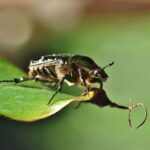
A kissing bug looks like a large, dark-colored beetle, typically between ½ and 1 inch long. It has a distinct cone-shaped head, six legs, and a flat, oval body. Most species are black or dark brown with red, orange, or yellow stripes along the edges of their abdomen. They are also called “assassin bugs” and are known for biting people on the face near the mouth.
What Does A Kissing Bug Look Like Exactly?
A kissing bug has a very specific shape. Its head is long and pointed, almost like a tiny cone. This is the easiest way to tell it apart from other common household bugs like cockroaches or stink bugs.
The body is flat and oval, which helps them hide in small cracks. They have six legs that are long and thin. Their antennae are straight and have four segments. The most striking feature is the color pattern. Most kissing bugs are dark brown or black with bright orange or red bands on the sides of their abdomen. These bands are visible when the wings are folded.
Size varies by species, but adults are usually between 0.5 and 1 inch long. Nymphs, or young kissing bugs, are smaller and lighter in color. They do not have wings yet, but they still have the cone-shaped head.
How Do You Tell a Kissing Bug From a Stink Bug or Cockroach?
People often confuse kissing bugs with stink bugs and cockroaches. The differences are clear once you know what to look for.
Kissing bug vs. stink bug: Stink bugs have a shield-shaped body that is wider and rounder. Kissing bugs have a narrow, cone-shaped head. Stink bugs are also a mottled brown or green color without the bright red or orange bands on the abdomen.
Kissing bug vs. cockroach: Cockroaches have a flat, oval body like a kissing bug, but their head is hidden under a shield-like plate called a pronotum. A kissing bug’s head sticks out clearly. Cockroaches also have long, spiny legs and are usually a uniform brown or reddish-brown. They do not have the red or orange markings on their abdomen.
The table below summarizes the key differences:
| Feature | Kissing Bug | Stink Bug | Cockroach |
|---|---|---|---|
| Body Shape | Flat, oval, elongated | Shield-shaped, wider | Flat, oval, may be longer |
| Head | Long, cone-shaped, visible | Small, triangular, visible | Hidden under pronotum |
| Color | Dark with red/orange bands | Mottled brown or green | Uniform brown or reddish |
| Antennae | Straight, 4 segments | Straight, 5 segments | Long, thin, many segments |
| Wings | Fold flat over back | Fold flat, create X pattern | Fold flat, sometimes longer than body |
Where Do Kissing Bugs Live in the United States?
Kissing bugs are most common in the southern United States. The CDC reports that they have been found in 28 states, with the highest numbers in Texas, Arizona, New Mexico, and California. They are also found in Florida, Louisiana, and other Gulf Coast states.
They live outdoors in places like woodpiles, under rocks, in rodent nests, and in dog houses. They are active at night and are attracted to light. Indoors, they hide in cracks in walls, under mattresses, behind headboards, and in piles of clothing or bedding.
Kissing bugs are most active during the warmer months. They can enter homes through gaps around windows, doors, and utility lines. Poorly sealed homes in rural areas are at the highest risk.




Do All Kissing Bugs Carry Chagas Disease?
No. Not every kissing bug carries the parasite that causes Chagas disease. The parasite is called Trypanosoma cruzi. Only a percentage of kissing bugs in the wild are infected.
Research published by the CDC shows that infection rates vary widely by location. In some areas of Texas, up to 50% of kissing bugs tested positive for the parasite. In other states, the rate is much lower. Even if a bug is infected, transmission to humans is not guaranteed. The parasite is spread through the bug’s feces, not its bite. The bug bites, then defecates near the wound. If the feces are rubbed into the bite or into the eyes or mouth, infection can occur.
This is a key point that is often missed in viral health posts. Finding a kissing bug in your home does not mean you have been exposed to Chagas disease. It does mean you should take the bug seriously and have it identified.
What Should You Do If You Find a Kissing Bug?
If you find a bug you suspect is a kissing bug, do not touch it with your bare hands. Use gloves or a plastic bag to collect it. Place the bug in a sealed container or a ziplock bag.
The CDC recommends that you do not crush the bug. This can release the parasite into the air or onto surfaces. Instead, preserve it for identification. You can contact your local health department or a university extension office. Many of these agencies can identify the bug for free. You can also mail the bug to the CDC’s Division of Parasitic Diseases and Malaria for testing if you live in a high-risk area.
If you or a family member has been bitten, watch for symptoms. Symptoms of Chagas disease include fever, swelling at the bite site, swollen lymph nodes, and fatigue. These symptoms usually appear 1 to 2 weeks after the bite. Most people have no symptoms at all in the early stage. If you have been bitten and live in a high-risk area, see a doctor. Blood tests can confirm infection.
How Can You Prevent Kissing Bugs From Entering Your Home?
Prevention is the most effective strategy. Kissing bugs enter homes through cracks and gaps. Sealing these entry points is the first line of defense.
- Seal cracks and gaps around windows, doors, and the foundation with caulk or weatherstripping.
- Install screens on all windows and doors. Repair any holes.
- Remove woodpiles, rock piles, and debris from around the house. These are common hiding spots.
- Keep outdoor lights off at night or switch to yellow “bug lights” which attract fewer insects.
- Move pet beds and animal enclosures away from the house.
- Store firewood at least 20 feet from the house and off the ground.
Pest control companies can also treat the exterior of your home with insecticides. This is most effective when done before the warm season when kissing bugs become active. Indoor foggers are not recommended because they can cause the bugs to scatter deeper into the home.
Common Misconceptions About Kissing Bugs
There is a lot of misinformation online about kissing bugs. One common claim is that kissing bugs are an invasive species that is spreading rapidly across the country. This is not accurate. Kissing bugs are native to the Americas and have been present in the southern United States for centuries. Their range is not expanding dramatically, though better surveillance may make them seem more common.
Another widespread myth is that a kissing bug bite always leads to Chagas disease. As discussed earlier, this is false. The majority of people bitten by an infected kissing bug do not develop the disease. The CDC estimates that fewer than 300,000 people in the United States have Chagas disease, and most of those cases were acquired in Latin America, not domestically.
Some people also believe that kissing bugs are the same as “assassin bugs.” Assassin bugs are a larger family of insects that includes kissing bugs. All kissing bugs are assassin bugs, but not all assassin bugs are kissing bugs. The cone-nosed assassin bugs are the ones that bite humans and can carry Chagas.
Frequently Asked Questions
Can a kissing bug bite kill you?
Death from a kissing bug bite is extremely rare in the United States. The risk comes from Chagas disease, which can cause heart problems years after infection, but most people never develop symptoms.
What attracts kissing bugs to homes?
Kissing bugs are attracted to light and to the carbon dioxide that humans and pets breathe out. They also come near homes looking for rodent nests, which are their natural food source.
How long do kissing bugs live?
Kissing bugs can live for 1 to 2 years. They go through several nymph stages before becoming adults. Adults can survive for several months without feeding.
Should I have my home tested for kissing bugs?
Routine testing is not necessary. If you live in a high-risk state and find multiple bugs, contact your local health department for guidance. They may recommend an inspection or testing of the bugs.
