
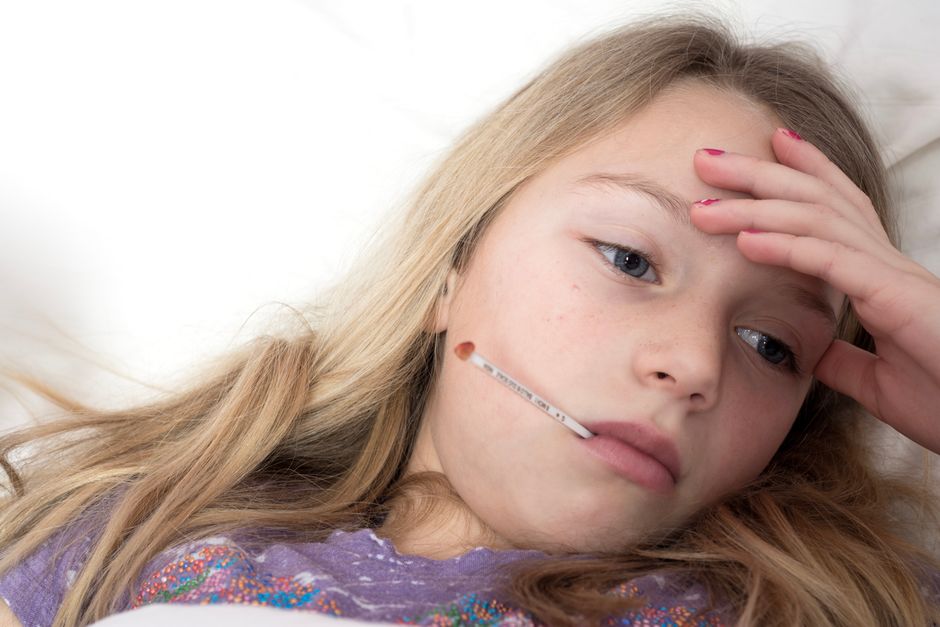
A fever is your child’s body fighting an infection. Most fevers in children are caused by viral illnesses and resolve on their own within a few days. You should worry when a fever reaches 104°F (40°C) or higher, lasts more than three days, or is accompanied by serious symptoms like difficulty breathing, a stiff neck, or a rash that does not fade when pressed. For infants under 3 months old, any temperature of 100.4°F (38°C) or higher requires immediate medical attention.
What Causes Fever In Children And When To Worry?
Fever is not an illness. It is a sign that the immune system is working. When the body detects viruses or bacteria, the brain raises the body’s internal thermostat. This higher temperature makes it harder for germs to multiply and helps immune cells work faster.
Most fevers in children come from common viral infections. These include colds, flu, croup, and stomach bugs. Ear infections, urinary tract infections, and strep throat are common bacterial causes. Vaccinations can also cause a mild fever for a day or two. Teething causes a slight temperature rise at most — not a true fever.
What Temperature Counts As A Fever In Children?
A child has a fever when their temperature reaches 100.4°F (38°C) or higher. The most accurate reading comes from a rectal thermometer in infants and toddlers. For older children, an oral reading is reliable. Ear and forehead thermometers are convenient but less precise.
Normal body temperature varies throughout the day. It is typically lower in the morning and higher in the late afternoon. A reading of 99°F (37.2°C) is not a fever. It is within the normal range.
When Should Parents Worry About A Fever?
Age matters more than the number on the thermometer. For babies under 3 months old, any fever of 100.4°F (38°C) or higher is an emergency. Their immune systems are not mature enough to fight off serious bacterial infections. Call your pediatrician or go to the emergency room immediately.
For children between 3 and 6 months, a fever of 102°F (38.9°C) or higher warrants a call to the doctor. For children older than 6 months, the height of the fever matters less than how the child looks and acts.
- Seek medical care if the fever lasts more than three days
- Seek medical care if the fever reaches 104°F (40°C) or higher
- Seek medical care if the child is unusually drowsy, irritable, or confused
- Seek medical care if the child has trouble breathing or is breathing faster than normal
- Seek medical care if a stiff neck accompanies the fever
- Seek medical care if a rash appears that does not blanch when you press on it
- Seek medical care if the child shows signs of dehydration — dry mouth, no tears when crying, or no wet diaper for 8 hours
Trust your instincts. If your child looks seriously ill, call a doctor regardless of the temperature reading.





What Is A Febrile Seizure And Is It Dangerous?
A febrile seizure is a convulsion triggered by a rapid rise in body temperature. It affects about 2 to 5 percent of children between 6 months and 5 years of age. These seizures look frightening but are rarely harmful.
During a febrile seizure, a child may lose consciousness, shake, roll their eyes, or vomit. The episode typically lasts less than five minutes. Most children recover fully with no lasting effects. Febrile seizures do not cause brain damage and are not the same as epilepsy.
If your child has a seizure lasting more than five minutes, call 911. For shorter seizures, contact your pediatrician. The first febrile seizure should always be evaluated by a doctor to rule out a more serious infection like meningitis.
How Should Parents Treat A Child’s Fever At Home?
Fever itself does not always need treatment. If your child is eating, drinking, and playing relatively normally, you can let the fever run its course. The goal of treatment is comfort, not a normal temperature reading.
Acetaminophen (Tylenol) is safe for children older than 2 months. Ibuprofen (Motrin or Advil) is safe for children older than 6 months. Use the dosing schedule on the package based on your child’s weight — never their age alone. Do not alternate medications unless your pediatrician specifically instructs you to do so. This practice increases the risk of dosing errors.
Never give aspirin to a child or teenager. Aspirin during a viral illness has been linked to Reye’s syndrome, a rare but life-threatening condition that causes swelling in the brain and liver damage.
Keep your child well-hydrated. Offer fluids frequently — breast milk, formula, water, or oral rehydration solutions. Dress the child in light clothing and keep the room at a comfortable temperature. Sponging with lukewarm water can provide temporary comfort but does not treat the underlying cause. Avoid cold baths and alcohol rubs. These cause shivering, which can actually raise body temperature.
When Is A Fever Actually Helping?
Fever is part of the body’s defense system. Research shows that a moderate fever helps the immune system clear infections more efficiently. Some studies suggest that suppressing fever with medication may prolong certain viral illnesses, though the evidence is not definitive.
This does not mean you should never treat a fever. If your child is miserable, in pain, or unable to sleep, medication is appropriate. The point is that a fever of 101°F (38.3°C) in an otherwise healthy 3-year-old is not an emergency. It is a normal immune response that will resolve on its own.
What Myths About Childhood Fevers Should Parents Ignore?
Many parents worry that a high fever will cause brain damage. This is not true. Fevers caused by infection rarely exceed 105°F (40.6°C) even without treatment. The body’s internal thermostat prevents the temperature from rising to dangerous levels. Brain damage from heat occurs only with external overheating — like a child left in a hot car — not from an infection-driven fever.
Another common myth is that fever is dangerous because it can “keep going up.” In reality, the brain’s thermostat has a ceiling. A fever will not spiral out of control on its own.
Some parents believe that how high the fever climbs tells you how sick the child is. This is not reliable. A child with a mild cold can spike to 103°F (39.4°C), while a child with a serious infection may run only a low-grade fever. Behavior and other symptoms matter more than the number.
When Should A Fever Lead To An Emergency Room Visit?
Go to the emergency room immediately if your child has any of the following:
- Age under 3 months with any fever of 100.4°F (38°C) or higher
- Difficulty breathing, including grunting, flaring nostrils, or chest retractions
- Blue or gray lips, tongue, or skin
- A stiff neck with the fever
- A seizure that lasts longer than five minutes
- A rash that does not fade when you press a glass against it
- Extreme lethargy — the child is hard to wake or unresponsive
- Signs of severe dehydration, including no wet diaper for 8 hours or a sunken soft spot on the head
These symptoms can indicate bacterial meningitis, sepsis, or pneumonia. They require immediate evaluation by a medical professional.
How Long Should A Fever Last Before Calling The Doctor?
Most viral fevers last two to three days. If the fever persists beyond three days, contact your pediatrician. A fever that resolves and then returns after several days can signal a secondary bacterial infection like an ear infection or pneumonia.
Call your doctor sooner if the fever is accompanied by ear pain, a sore throat, pain with urination, or a new cough that worsens. These symptoms may point to a bacterial infection that requires antibiotics.
Frequently Asked Questions
What temperature is too high for a child with a fever?
A temperature of 104°F (40°C) or higher is cause for concern in any child. For infants under 3 months old, any fever of 100.4°F (38°C) or higher requires immediate medical evaluation.
How long is too long for a child to have a fever?
A fever lasting more than three days warrants a call to your pediatrician. A fever that goes away and then returns after several days also needs medical evaluation.
Should I wake my child to give fever medicine?
No. Sleep is more important than a temperature reading. If your child is sleeping comfortably, let them rest. Give medication when they wake up if they still have a fever and appear uncomfortable.
Can a child have a fever from teething?
Teething can cause a slight temperature rise, but not a true fever. A temperature above 100.4°F (38°C) is unlikely to be caused by teething alone and should be evaluated for another cause.
