
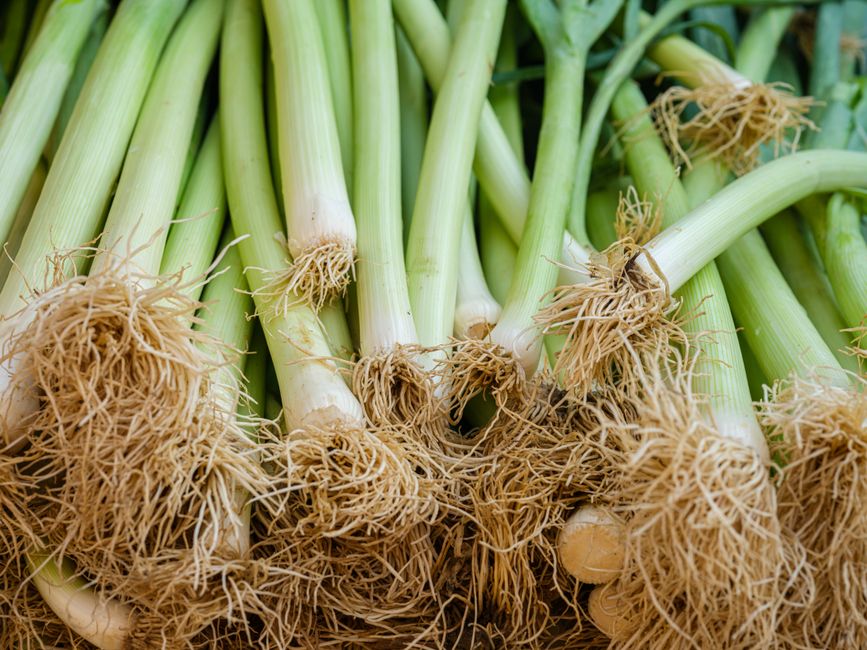
Leeks look like oversized green onions, but they are a distinct vegetable with their own flavor, history, and nutritional profile. They are the edible stalks of Allium porrum, a plant in the same family as onions, garlic, chives, and shallots. People have grown and eaten leeks for thousands of years, and they remain a staple in soups, stews, and savory dishes across Europe and beyond.
What Are Leeks Vegetables?
A leek is a vegetable that belongs to the genus Allium, often called the onion family. Unlike onions, leeks do not form a large round bulb. Instead, they grow as a thick, tightly layered stalk that transitions from white at the base to light green and then dark green at the top.
The white and light green parts are the most commonly eaten. They have a mild, sweet, onion-like flavor that becomes softer and sweeter when cooked. The dark green leaves are tougher and more fibrous, though they are often used to flavor stocks and soups before being removed.
Leeks are biennial plants, meaning they take two years to complete their life cycle if left in the ground. In the first year, they grow the stalk that people harvest and eat. If not harvested, they flower in the second year and produce seeds.
What Do Leeks Taste Like and How Are They Used?
Leeks taste like a gentler, sweeter version of onion. The raw white part has a mild bite, but cooking transforms it into something soft and almost buttery. This is why leeks work well in dishes where you want onion flavor without the sharpness.
Common uses include:
- Potato leek soup, a classic in French and British cooking
- Sautéed as a base for soups, stews, and sauces
- Roasted whole or in halves as a side dish
- Added to quiches, tarts, and savory pies
- Used raw in salads when sliced very thin
One practical note: leeks trap dirt between their layers as they grow. Rinsing them properly matters. A common method is to slice them first, then swish the pieces in a bowl of water so grit falls to the bottom.
Are Leeks Nutritious?
Leeks provide several vitamins and minerals, though they are not a nutritional powerhouse in large amounts. A typical serving is modest in calories and contributes fiber, vitamin K, vitamin A (from beta-carotene in the green parts), vitamin C, and small amounts of manganese, folate, and iron.
Like other allium vegetables, leeks contain organosulfur compounds. These are the same broad class of compounds found in garlic and onions. Laboratory research has explored whether these compounds have anti-inflammatory or other biological effects. However, laboratory findings do not automatically translate into health benefits in humans. The evidence for specific disease-prevention effects from eating leeks is limited.
What is well established is simpler: leeks are a low-calorie vegetable that can help add volume, flavor, and fiber to meals. That matters for overall diet quality, even without any special health claims.





Leeks vs Onions vs Scallions: What Is the Difference?
These three vegetables are related but not interchangeable. The table below summarizes the main differences.
| Vegetable | Shape | Flavor | Typical Use |
|---|---|---|---|
| Leek | Thick layered stalk, no large bulb | Mild, sweet when cooked | Soups, stews, roasting |
| Onion | Round bulb | Sharp raw, sweet when cooked | Wide range of cooking |
| Scallion (green onion) | Thin stalk with small bulb | Mild, fresh | Garnishes, stir-fries, salads |
Leeks and scallions are sometimes confused because both are long and green. The key difference is size and structure. Leeks are much thicker and develop a broad, layered white base. Scallions stay thin and are usually eaten whole, including the green tops.
How Do You Clean and Cook Leeks?
Cleaning is the step most people get wrong. Because leeks grow up through soil, dirt and sand get trapped between the layers. Cutting them first and then washing is more effective than rinsing the whole stalk.
Here is a straightforward method:
- Trim off the root end and the tough dark green tops.
- Slice the remaining stalk lengthwise, then crosswise into pieces.
- Submerge the pieces in a bowl of cold water and agitate with your hands.
- Let them sit briefly so grit settles, then lift the leeks out rather than pouring them out.
For cooking, the white and light green parts are best for sautéing and soups. The dark green tops are too fibrous to eat directly in most dishes but can be simmered in stock for flavor and then discarded.
Sautéing leeks in fat over medium heat until soft is a common starting step for many recipes. They brown quickly if the heat is too high, which can make them bitter.
Are There Any Health Concerns With Leeks?
For most people, leeks are a safe and ordinary food. There is no established pattern of harm from eating them in normal amounts.
One consideration is that leeks, like other allium vegetables, contain fermentable carbohydrates called fructans. People with irritable bowel syndrome or other digestive conditions that respond to FODMAPs may find that leeks trigger symptoms. This is a real and documented issue for some people, not a general concern.
Leeks also contain vitamin K, which can interact with blood-thinning medications like warfarin. People taking these medications are often advised to keep vitamin K intake steady rather than avoid it. Anyone on such medication should talk to their clinician about diet rather than making changes on their own.
There is no clinical guidance suggesting leeks need to be avoided during pregnancy or breastfeeding. They are a normal food. As with any produce, washing before eating is sensible.
Why Are Leeks Associated With Wales?
Leeks are a national symbol of Wales, worn on St. David’s Day. The association is old and its exact origin is not fully settled. One common story links it to a battle in which Welsh soldiers wore leeks to distinguish themselves from enemies. Whether that story is literally true is uncertain.
What is clear is that the leek has been tied to Welsh identity for centuries, appearing in literature and heraldry. It is also a practical crop that grows well in cool, damp climates, which describes much of Wales.
How Should You Store Leeks?
Leeks keep well if stored properly. Whole leeks can be wrapped loosely and kept in the refrigerator, where they typically last one to two weeks. They should not be washed before storing, since moisture speeds spoilage.
Once cut, leeks should be refrigerated in a sealed container and used within a few days. Cooked leeks keep in the refrigerator for a few days as well, following standard food safety practice for cooked vegetables.
Leeks can also be frozen. Blanching them briefly before freezing helps preserve texture, though frozen leeks are best used in cooked dishes rather than eaten raw.
Do Leeks Have Any Proven Health Benefits?
No specific health benefit from eating leeks has been proven in large human trials. This is worth stating plainly because allium vegetables are frequently marketed with broad health claims.
What the evidence does support is general and not unique to leeks: eating more vegetables is associated with better health outcomes in large population studies. Leeks can be part of that pattern. They are not a treatment, a cure, or a substitute for medical care.
Some research on allium vegetables as a group has explored associations with certain health outcomes, but these studies are observational and cannot show cause and effect. The honest position is that leeks are a healthy food in the context of an overall diet, and claims beyond that are not supported.
Frequently Asked Questions
Are leeks vegetables or herbs?
Leeks are vegetables, specifically the edible stalk of the Allium porrum plant. They are used as a main ingredient or flavor base rather than a garnish herb.
Can you eat leeks raw?
Yes, the white and light green parts can be eaten raw, usually sliced thin because they are firm and fibrous. The dark green tops are too tough to eat raw and are better used for stock.
Are leeks the same as green onions?
No, they are different vegetables in the same family. Leeks grow much thicker with a broad layered base, while green onions stay thin and are typically eaten whole.
Do leeks need to be cooked before eating?
No, they do not need to be cooked, though cooking softens their texture and sweetens their flavor. Raw leeks are safe to eat when washed properly.
