
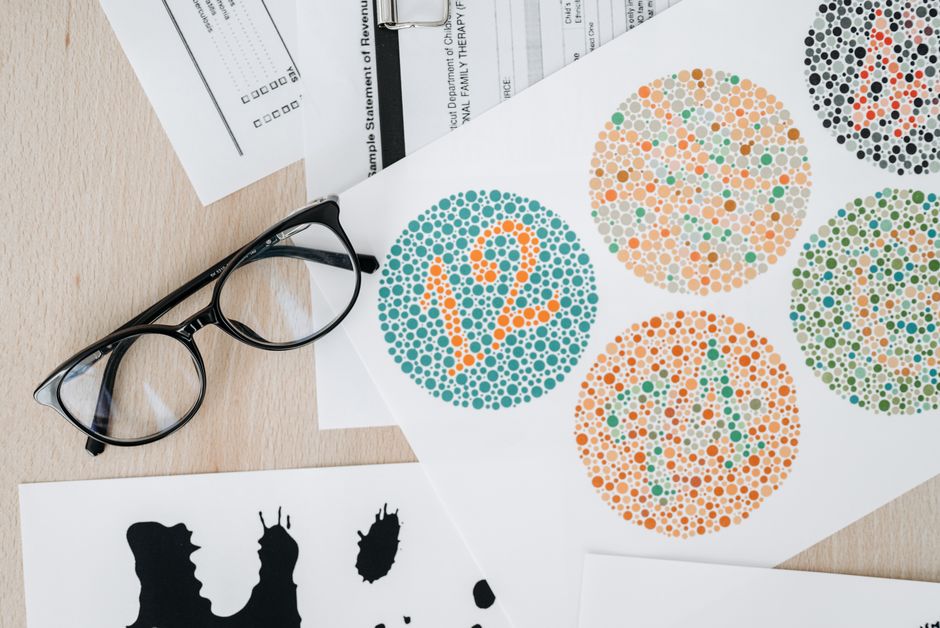
The Ishihara Color Vision Test is the most widely used screening test for red-green color blindness worldwide. It uses a series of plates filled with colored dots, where numbers or shapes are hidden within the pattern. People with normal color vision can see the numbers clearly, while those with red-green color deficiency see a different number or no number at all.
How Does the Ishihara Test Actually Work?
The test works by exploiting a specific flaw in how color-deficient eyes process light. The plates are designed with two types of dots: primary colors and “confusion colors.” These confusion colors are chosen specifically because they look identical to people with red-green color deficiency but distinctly different to everyone else.
In the most common plate design, the background dots are one color and the number dots are another. The colors are selected so they fall on the same “confusion line” for deficient eyes. For someone with normal trichromatic vision, the contrast is obvious. For someone with deuteranopia or protanopia, the two colors merge into a single flat field.
This is not a test of how well you see color. It is a test of whether your eyes can distinguish between two specific wavelengths of light that most people can separate easily.
What Do the Different Plates Test?
The full Ishihara test contains 38 plates, but clinical versions commonly use 14 or 24. Each plate serves a specific purpose.
The first plate is always a demonstration plate. It shows the number 12 and is visible to everyone, regardless of color vision. This confirms the person understands the task and that the lighting conditions are adequate.
Plate 2 through 17 are transformation plates. These show one number to people with normal vision and a different number to people with red-green deficiency. They are designed to distinguish between normal vision and deficiency.
Plates 18 through 21 are vanishing plates. People with normal vision see a number, but those with color deficiency see nothing. These plates are particularly useful for identifying the severity of the deficiency.
The final group includes hidden digit plates and classification plates. These help determine whether the deficiency is protan (red-weak) or deutan (green-weak). This distinction matters because it affects how a person perceives the world and may influence career counseling.
Who Should Take the Ishihara Test?
Color vision screening is routine in several situations. Pediatricians often screen children during regular checkups, though the timing varies. Many schools include color vision testing in their health screenings.
Occupational screening is common in specific fields. Pilots, electricians, police officers, firefighters, and military personnel typically require normal color vision. In these professions, distinguishing colored wires, signals, or lights can be a genuine safety issue.
Adults who have never been tested may choose to take the test out of curiosity or because they suspect they see colors differently. Some people live decades without knowing they have a color vision deficiency. They may have adapted so well that they never noticed the difference.
If you have a family history of color blindness, testing is more important. The most common forms of red-green color blindness are inherited through the X chromosome, which means the pattern of inheritance is specific and predictable.



What Do Your Results Mean?
The Ishihara test does not give you a percentage of color vision. It gives you a classification. The results typically fall into one of three categories: normal color vision, red-green deficiency, or total color blindness.
Normal color vision means you correctly identified all or nearly all of the plates. Red-green deficiency means you missed a specific pattern of plates that aligns with protan or deutan deficiency. Total color blindness, also called achromatopsia, is extremely rare and affects about 1 in 30,000 people.
It is important to understand that the Ishihara test only screens for red-green deficiencies. It does not test for blue-yellow color vision problems. Blue-yellow deficiency, also called tritanopia, is much rarer and requires a different test called the Farnsworth-Munsell 100 Hue Test.
The test also cannot tell you the severity of your deficiency in precise terms. It can indicate whether your deficiency is mild, moderate, or severe based on how many plates you miss, but it does not measure the actual degree of color discrimination loss.
Are There Limitations to the Ishihara Test?
Yes, the test has real limitations that matter for accurate diagnosis. The most significant is that the test depends heavily on lighting conditions. The plates are calibrated for daylight illumination, approximately 6500 Kelvin. Under warm indoor lighting or fluorescent lights, results can shift.
The test also assumes the person being tested has normal visual acuity. If you cannot clearly see the shapes of the dots due to uncorrected nearsightedness or farsightedness, you may miss numbers for reasons unrelated to color vision.
Another limitation is that the test cannot reliably detect mild deficiencies. Some people with very mild color vision deficiency can pass the Ishihara plates but still struggle with real-world color discrimination tasks. Conversely, some people who fail the Ishihara test may function perfectly well in daily life because their deficiency is mild.
Certain medications and medical conditions can affect color vision temporarily. Some anti-seizure medications, erectile dysfunction drugs, and certain antibiotics are known to cause transient color vision changes. If you recently started a new medication and are concerned about your results, discuss this with your doctor.
Can Color Blindness Be Treated or Corrected?
There is no cure for inherited color blindness. The genetic condition that causes red-green deficiency is present from birth and does not change over time. No medication, supplement, or surgical procedure has been shown to restore normal color vision in clinical trials.
Color-correcting glasses and contact lenses are marketed heavily online. These products work by filtering specific wavelengths of light to enhance the contrast between red and green. Some users report meaningful improvements in color discrimination while wearing them.
The evidence on these products is mixed. Some studies show measurable improvements in performance on color vision tests, while others show minimal benefit. The glasses do not give you normal color vision. They change the way colors appear, and the effect varies significantly between individuals.
If you are considering color-correcting glasses, it is worth trying them before purchasing. Many companies offer trial periods. Be aware that the glasses are not covered by insurance and can cost several hundred dollars.
When Should You See a Doctor?
If you suddenly develop color vision problems as an adult, you should see a doctor. Sudden color vision loss is different from having it your whole life. It can be a symptom of underlying conditions such as cataracts, optic nerve damage, or retinal disease.
If you have always had color vision deficiency, there is usually no medical urgency. However, an eye exam can confirm the diagnosis and rule out other conditions. An ophthalmologist or optometrist can perform a complete color vision evaluation that goes beyond the Ishihara screening.
Children who fail a school screening should see an eye care professional for a comprehensive evaluation. Early diagnosis helps with school accommodations and career planning. It also helps parents understand why their child may struggle with certain tasks like identifying colored worksheets or matching socks.
Some research suggests that color vision deficiency may be associated with other visual conditions, though the evidence is not conclusive. A full eye exam is the best way to get a complete picture of your visual health.
How to Take the Test at Home
Online Ishihara tests exist, but results should be interpreted with caution. The accuracy of an online test depends entirely on your screen’s color calibration. A poorly calibrated monitor or phone screen can produce false failures or false passes.
If you take an online test, use a screen that you know displays colors accurately. Sit in a well-lit room. Avoid taking the test in the dark or under colored lighting. Even under ideal conditions, an online test is a screening tool, not a diagnosis.
A formal test with a professional uses physical plates printed with precise inks under controlled lighting. This is the gold standard and the only method that should be used for official purposes like pilot licensing or military service.
If you take an online test and fail, do not assume you are color blind. Schedule an appointment with an eye care professional for a proper evaluation. If you pass an online test but have always suspected you see colors differently, mention it to your doctor anyway.
Frequently Asked Questions
How long does the Ishihara test take?
The full test takes about 5 minutes. The screening version with 14 plates takes less than 2 minutes.
Can women be color blind?
Yes, but it is much less common. About 1 in 12 men have red-green color blindness, while only about 1 in 200 women do.
Is the Ishihara test accurate?
It is highly accurate for detecting moderate to severe red-green color blindness. It is less reliable for mild cases and does not test for blue-yellow color deficiency.
Can color blindness get worse over time?
Inherited color blindness is stable and does not worsen. If your color vision changes as an adult, see a doctor because it may indicate another eye condition.
