

Yes, yellow mold is real, and it usually belongs to common indoor genera like Aspergillus, Penicillium, or Cladosporium, none of which are inherently “toxic black mold.” The color alone tells you almost nothing about risk. What matters is the species, how much mold is present, whether spores are becoming airborne, and who is breathing them. Removal follows the same principles as any indoor mold: fix the moisture source, contain the area, and clean or discard affected material safely.
If you are staring at a yellow patch on a wall, a windowsill, or a piece of old bread, you are not alone in wondering what it is. This guide covers what yellow mold actually is, when it becomes a health concern, how to remove it, and when to call a professional instead of reaching for a spray bottle.
What Is Yellow Mold and What Causes It?
Yellow mold is a color description, not a scientific category. Many mold species produce yellow, mustard, or creamy colonies depending on the surface they grow on and the stage of growth. Some molds shift color as they mature, starting pale and darkening over time.
The most common indoor molds that can appear yellow include Aspergillus species, Penicillium species, and Cladosporium. Serpula lacrymans, a wood-decay fungus sometimes called “yellow mold” in the UK, is a different organism entirely and is primarily a structural problem, not a common indoor air-quality issue.
What all mold needs is the same:
- Moisture — from leaks, condensation, high humidity, or flooding
- An organic food source — drywall paper, wood, dust, fabric, cardboard
- Moderate temperatures — most indoor molds grow well between roughly 60°F and 80°F
- Time — visible growth typically appears within a few days to weeks of a moisture problem
Mold does not grow on dry surfaces. If you see yellow mold, there is a moisture source somewhere, and finding it matters more than the color of the growth.
Is Yellow Mold Dangerous to Your Health?
There is no evidence that yellow mold is more dangerous than mold of any other color. The color of a mold colony is not a reliable indicator of toxicity. Some black molds are relatively harmless, and some yellow or green molds can produce mycotoxins under certain conditions.
Health effects from indoor mold exposure generally fall into a few categories:
- Allergic reactions — sneezing, runny nose, itchy eyes, coughing, and skin irritation. This is the most common and best-documented effect.
- Asthma aggravation — mold exposure can trigger or worsen asthma symptoms in sensitized people. This is well established in the clinical literature.
- Respiratory irritation — especially with large amounts of airborne spores in enclosed spaces.
- Infections — rare in healthy people, but a genuine concern for those who are severely immunocompromised. Aspergillus can cause invasive disease in certain high-risk patients, such as those with prolonged low white blood cell counts or on certain immunosuppressive therapies.
People at higher risk from mold exposure include infants, older adults, people with asthma or allergies, and anyone with a weakened immune system. If you fall into one of these groups and you have visible mold in your home, treating it as a priority is reasonable.
One point that gets lost in the noise: “toxic mold syndrome” as a distinct diagnosis is not recognized in mainstream clinical medicine. Mycotoxins can be harmful in high-dose exposures, but the idea that ordinary household mold causes a specific, well-defined multi-system illness is not supported by strong evidence. Symptoms people report are real, but attributing them to mold requires careful evaluation.
How Do You Know If It Is Actually Mold?
Most yellow growth on indoor surfaces is mold, but a few things can look similar. A quick check helps:
- Mold usually has a fuzzy, powdery, or velvety texture
- It often spreads in irregular patches, not neat circles
- It may smell musty or earthy
- It grows in areas with moisture — corners, under sinks, near windows, on damp drywall
Efflorescence — a white or pale mineral deposit on concrete or masonry — can be mistaken for mold. It is a salt deposit left behind by water evaporating through the surface. It feels crusty or powdery, not fuzzy, and does not grow.
If you are unsure, a small dab of household bleach on a hidden spot can help. Mold typically lightens or disappears; efflorescence stays. This is a rough field test, not a lab result.
Testing is rarely necessary for a homeowner. The CDC and EPA have both taken the position that you do not need to identify the species of mold to decide whether to remove it. If you see mold, remove it and fix the moisture. Species testing is mainly useful for research, litigation, or unusual medical situations.



How Should You Remove Yellow Mold Safely?
Small mold patches — under about 10 square feet — can usually be handled by a careful homeowner. Anything larger, or mold inside HVAC systems, wall cavities, or sewage-contaminated areas, is a job for a professional.
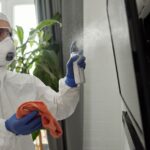
Before you start, protect yourself:
- Wear an N95 respirator, not a dust mask
- Use goggles that seal around the eyes
- Wear gloves and clothing you can wash or discard
- Keep children, pets, and anyone with asthma or immune problems out of the area
Steps for removal:
- Fix the water source first. Cleaning mold without stopping the moisture guarantees it returns.
- Seal off the work area with plastic sheeting if you can.
- Ventilate — open windows, use a fan blowing outward, or run a HEPA air scrubber.
- Scrub non-porous surfaces (tile, glass, metal, sealed wood) with a detergent solution or a diluted bleach solution. Follow label directions on any cleaning product.
- Discard porous materials that are moldy — drywall, ceiling tiles, carpet, insulation, cardboard. These cannot be reliably cleaned.
- Bag debris in sealed plastic before removing it from the area.
- Dry the area thoroughly within 24 to 48 hours if possible.
Never mix bleach with ammonia or other cleaners. The fumes can be dangerous.
After cleaning, run a dehumidifier and keep indoor humidity below 50% if you can. That single step prevents most regrowth.
When Should You Call a Professional?
Hire a mold remediation professional when:
- The affected area is larger than about 10 square feet
- Mold is inside walls, under flooring, or in the HVAC system
- The moisture came from sewage or floodwater
- You or a family member has asthma, a compromised immune system, or a known mold allergy
- You have tried to remove it and it keeps returning
Remediation companies vary widely in quality and price. Look for one that follows established industry standards for containment and removal, and be cautious of companies that push expensive air testing or “mold detox” protocols. The goal is simple: remove the mold, dry the area, fix the moisture. No test result changes that plan.
How Do You Prevent Yellow Mold From Coming Back?
Prevention comes down to moisture control. Mold cannot grow without water, so every step that reduces moisture reduces mold risk.
- Fix leaks promptly — even small drips under sinks or around windows
- Run exhaust fans in bathrooms and kitchens
- Keep indoor humidity between 30% and 50% when possible
- Use a dehumidifier in basements and other damp spaces
- Improve airflow behind furniture and in closets
- Dry wet materials within 24 to 48 hours
- Clean gutters and check for roof leaks seasonally
If you live in a humid climate, a dehumidifier is often the single most useful tool. If you live in a dry climate, watch for condensation around windows and pipes, which is a common hidden source.
Does Yellow Mold Mean There Is Toxic Black Mold Too?
No. Different molds can grow side by side, but seeing yellow mold does not mean Stachybotrys chartarum — the mold often called “black mold” — is present. Stachybotrys requires very wet, cellulose-rich material and grows slowly. It is not typically found on dry surfaces or minor condensation spots.
The concern about black mold is also often overstated. While Stachybotrys can produce mycotoxins, the evidence that it causes a distinct human illness at typical indoor exposure levels is limited. The general principle still holds: any mold in a home should be removed, regardless of color.
Frequently Asked Questions
Is yellow mold more dangerous than black mold?
No. Color does not determine how dangerous a mold is. Risk depends on the species, the amount of exposure, and the health of the person breathing it.
Can I remove yellow mold myself?
Yes, if the patch is small — roughly under 10 square feet — and on a non-porous surface. Larger areas, mold inside walls, or mold in HVAC systems should be handled by a professional.
What kills yellow mold permanently?
Nothing kills mold permanently if moisture remains. Cleaning removes the growth, but fixing the water source and keeping humidity below 50% is what prevents it from returning.
Does yellow mold cause breathing problems?
It can in some people, especially those with asthma or mold allergies. Symptoms typically include coughing, sneezing, and nasal irritation, and they usually improve once the mold is removed.
