
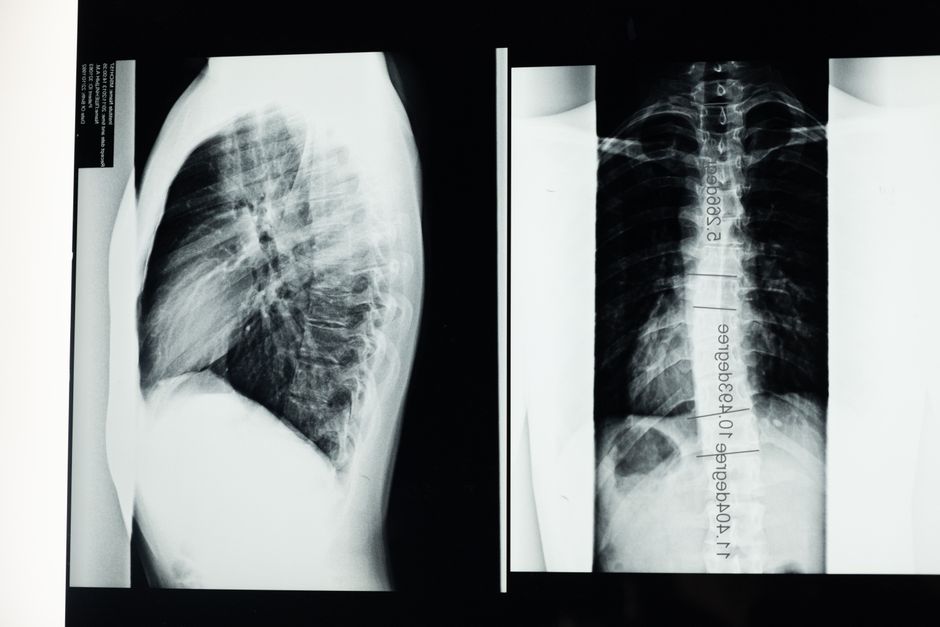
Scoliosis is a sideways curve of the spine that measures at least 10 degrees. The short answer is yes — scoliosis can be genetic, meaning it runs in families, and it can also be hereditary, passed down through generations. Most cases of scoliosis in children and teens have a strong genetic link, though the exact inheritance pattern is not simple. Research shows that around 30% of people with idiopathic scoliosis have a close family member with the condition.
What Is the Difference Between Genetic and Hereditary Scoliosis?
These two terms are often used as if they mean the same thing. They do not. Genetic means the condition involves changes in your DNA. Hereditary means it is passed from parent to child through genes. All hereditary conditions are genetic, but not all genetic conditions are hereditary. Some genetic changes happen spontaneously and are not inherited.
For scoliosis, the distinction matters. When a child develops scoliosis and no one else in the family has it, that is a genetic case that is not hereditary. When multiple family members across generations have scoliosis, that is a hereditary pattern. The most common form — adolescent idiopathic scoliosis — appears to be both genetic and hereditary in many cases.
Studies of twins help clarify this. Research published in the Journal of Bone and Joint Surgery found that if one identical twin has scoliosis, the other has a 73% chance of also having it. For fraternal twins, that number drops to 36%. This tells us genes play a major role, but they are not the whole story.
Is Scoliosis Genetic Or Hereditary for Most People?
For the majority of scoliosis cases, the answer is both. About 80% of scoliosis cases are classified as idiopathic, meaning the cause is unknown. But “unknown” does not mean random. Large family studies and twin studies have confirmed that idiopathic scoliosis clusters in families.
Researchers have identified several genes linked to scoliosis. These include genes involved in how the spine forms, how connective tissue works, and how the nervous system develops. No single gene causes scoliosis. Instead, multiple genes each contribute a small amount of risk. This is called polygenic inheritance.
The American Academy of Orthopaedic Surgeons states that a child with a parent or sibling who has scoliosis has a 20% to 30% higher chance of developing it themselves. That is a real risk, but it also means 70% to 80% of close relatives will not develop scoliosis. The genetic link is strong, but it is not a guarantee.
What Are the Known Genetic Causes of Scoliosis?
Research has found several genes that are consistently linked to scoliosis. A 2021 study published in Nature Communications identified 53 genetic variants associated with adolescent idiopathic scoliosis. These variants are common in the general population, but having more of them increases risk.
Some of the key genes include:
- LBX1 — This gene is involved in nervous system development and is one of the most consistently linked to scoliosis
- GPR126 — This gene plays a role in how the spine forms during growth
- BMP2 — This gene is involved in bone formation and growth
- CHL1 — This gene helps guide nerve cells during development
Each of these genes only adds a small amount of risk. A person can have several of these variants and never develop scoliosis. Conversely, someone with no known genetic variants can still develop it. This is why genetic testing for scoliosis is not yet useful for predicting who will get it.
There are also rare genetic syndromes that include scoliosis as a feature. These include Marfan syndrome, Ehlers-Danlos syndrome, and neurofibromatosis. In these cases, scoliosis is part of a broader genetic condition. But these account for a small fraction of all scoliosis cases.




Can Scoliosis Skip a Generation?
Yes, scoliosis can appear to skip a generation. This happens because the inheritance pattern is not simple dominant or recessive. Since multiple genes are involved, a grandparent might pass down several risk variants to a parent, who passes them to a child, even if the parent never developed a noticeable curve.
This is called incomplete penetrance. A person can have the genetic risk factors but never develop the condition. The factors that trigger scoliosis in someone with genetic risk are not fully understood. Hormonal changes during growth spurts may play a role. So might differences in how the nervous system communicates with the spine.
There is also a concept called genetic anticipation. Some research suggests that scoliosis may appear at a younger age or become more severe in each successive generation. The evidence for this is not strong yet. As of 2026, no large study has confirmed that anticipation occurs in scoliosis families.
How Do Environment and Growth Affect Genetic Risk?
Genes are not destiny. Even when scoliosis runs in a family, environmental and developmental factors determine whether a curve actually develops. This is why one sibling can have a severe curve while another has a straight spine, even though they share the same genes.
Growth rate is one factor. Children who go through rapid growth spurts are at higher risk for curve progression. The spine grows fastest during the adolescent growth spurt, and this is when scoliosis most often appears. Girls are about seven times more likely than boys to have curves that need treatment. This sex difference is likely driven by hormonal and growth factors interacting with genetic risk.
Other factors that may influence scoliosis development include:
| Factor | How It May Affect Scoliosis Risk |
|---|---|
| Growth rate | Faster growth during puberty increases risk of curve development and progression |
| Hormonal changes | Estrogen and growth hormone may influence spine growth and curve formation |
| Nervous system function | Differences in how the brain and spine communicate may contribute to curve development |
| Physical activity | No strong evidence that activity level causes or prevents scoliosis |
| Posture and backpack use | No evidence that these cause scoliosis, though they may affect pain in existing curves |
It is important to separate what causes scoliosis from what makes it worse. Poor posture does not cause scoliosis. Carrying a heavy backpack does not cause scoliosis. These are myths that have been repeated so often they are treated as fact. The evidence does not support them.
When Should Families With Scoliosis Get Screened?
The Scoliosis Research Society recommends that children be screened for scoliosis at ages 10, 12, and 14. This is especially important if a parent or sibling has scoliosis. The screening is simple. It involves the Adam’s forward bend test, where the child bends forward at the waist and the examiner looks for asymmetry in the rib cage or lower back.
If a curve is found, an X-ray will confirm the diagnosis. The curve is measured using the Cobb method, which calculates the angle of the curve. Curves under 10 degrees are not considered scoliosis. Curves between 10 and 25 degrees are mild. Curves between 25 and 40 degrees are moderate. Curves over 40 degrees are severe.
Early detection matters because treatment is most effective when started early. Bracing can prevent curve progression in growing children with moderate curves. The effectiveness of bracing was confirmed by a 2013 study published in the New England Journal of Medicine, which found that bracing significantly reduced the need for surgery.
If you have scoliosis yourself, tell your doctor if you have children. They can monitor your child during growth spurts. Most children with a family history of scoliosis will never need treatment. But the ones who do benefit greatly from early detection.
Common Misconceptions About Scoliosis and Genetics
One common misconception is that scoliosis is always inherited from a parent. As discussed, many cases are genetic but not hereditary. A child can be the first person in a family to have scoliosis due to new genetic changes. This is called a de novo mutation.
Another misconception is that if scoliosis runs in your family, you will definitely get it. The risk is elevated, but most people with a family history never develop a curve that needs treatment. The genetic risk is real but modest for most individuals.
A third misconception is that genetic testing can tell you if your child will get scoliosis. As of 2026, there is no clinical genetic test that can predict scoliosis with any useful accuracy. The genes involved are too many, and each contributes too little risk. Genetic testing for scoliosis remains a research tool, not a clinical one.
Finally, some people believe that scoliosis is caused by carrying heavy backpacks, sleeping on the wrong mattress, or having poor posture. None of these have any scientific evidence behind them. These myths persist because they offer a simple explanation for a complex condition. But they are not true, and believing them can delay proper screening and treatment.
Frequently Asked Questions
Can scoliosis be caused by bad posture?
No, bad posture does not cause scoliosis. Scoliosis is a structural curve of the spine, not a result of how you sit or stand.
Is scoliosis more common in girls or boys?
Scoliosis is about equally common in both sexes, but girls are about seven times more likely to have curves that progress and need treatment.
Does scoliosis always get worse over time?
No, many curves stay stable and never progress. Progression is most common during growth spurts in adolescence and after age 50 in adults.
Can scoliosis be passed from father to son?
Yes, scoliosis can be passed from father to son, though the inheritance pattern is complex and involves multiple genes from both parents.
