
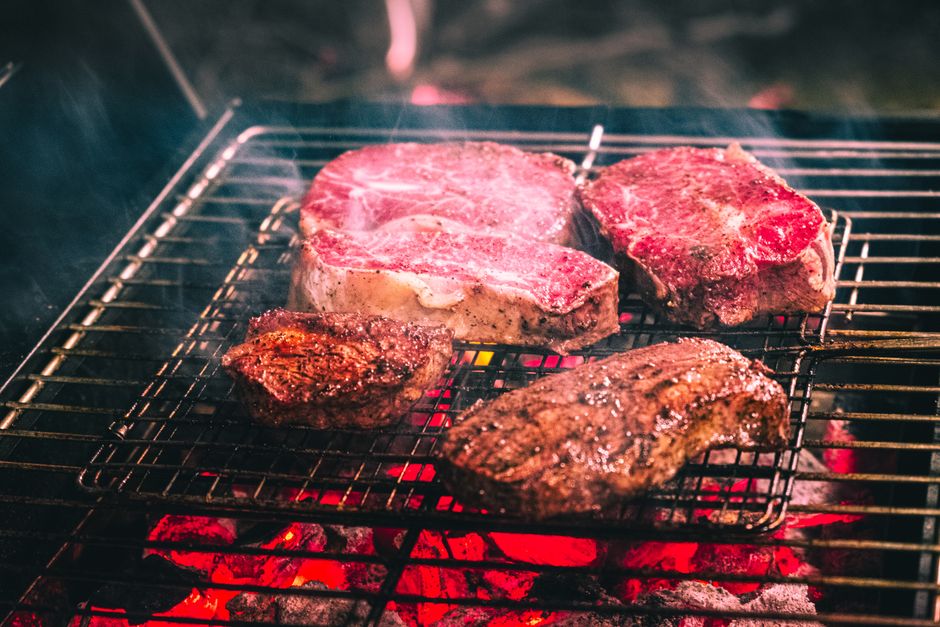
Medium rare meat is safe only when the meat has been handled properly and cooked to a temperature that kills harmful bacteria. For whole cuts of beef, lamb, and pork, that internal temperature is 145°F (63°C) followed by a three-minute rest. Ground meat is different — it must reach 160°F (71°C) because bacteria get mixed throughout during grinding. Poultry is never safe medium rare and must reach 165°F (74°C).
What Does “Medium Rare” Actually Mean in Temperature Terms?
Medium rare is a doneness level, not a single temperature. For beef steaks and roasts, medium rare generally falls between 130°F and 135°F (54°C to 57°C) after resting. The meat is warm red in the center, soft to the touch, and still holds a fair amount of moisture.
That range matters because it sits below the temperature the USDA identifies as the minimum for safe cooking of whole cuts. The agency’s guidance for whole cuts of beef, pork, veal, and lamb is 145°F (63°C) with a three-minute rest. The rest period is not a suggestion. During those three minutes, the surface temperature continues to kill bacteria while the meat’s internal temperature equalizes.
Here is the part many people miss. The USDA temperature for whole cuts is lower than the temperature for ground meat for a specific biological reason, not because the agency is more relaxed about steaks. On a whole cut, bacteria live almost entirely on the surface. When you sear that surface, you kill them. Inside the muscle is essentially sterile in a healthy animal.
Grinding changes that. When meat is ground, surface bacteria get folded into the center of the patty. Now the inside needs to reach a killing temperature too. That is why ground beef has a higher safety threshold than a steak, even though both come from the same animal.
Is Medium Rare Safe? It Depends on the Type of Meat
The safety of medium rare cooking depends almost entirely on which meat you are cooking and how it was processed. The same doneness level that is acceptable for a steak can be risky for a burger.
| Meat Type | Safe Minimum Internal Temp | Is Medium Rare Safe? |
|---|---|---|
| Whole beef (steak, roast) | 145°F (63°C) + 3-min rest | Yes, within USDA guidance |
| Whole pork (chops, loin) | 145°F (63°C) + 3-min rest | Yes, within USDA guidance |
| Whole lamb | 145°F (63°C) + 3-min rest | Yes, within USDA guidance |
| Ground beef, pork, lamb | 160°F (71°C) | No — ground meat needs higher heat |
| Poultry (chicken, turkey, duck) | 165°F (74°C) | No — never safe medium rare |
| Fish and seafood | 145°F (63°C) | Varies — see below |
The pork guidance is worth pausing on. For years, pork was cooked to 160°F or higher out of concern for a parasite called Trichinella. That concern has largely faded in the US commercial pork supply. Current USDA guidance sets whole pork at the same 145°F threshold as beef and lamb, with the same three-minute rest. Some people still prefer pork more well-done for texture reasons, which is a personal choice, not a safety requirement.
Why Ground Meat Is the Real Risk
Ground meat is where medium rare becomes genuinely dangerous. A medium rare burger might look and taste better to some people, but the internal temperature of a medium rare burger typically lands around 130°F to 135°F — well below the 160°F needed to kill bacteria that have been mixed throughout the meat.
The bacteria of concern in ground beef is most often E. coli, particularly a strain called O157:H7. This bacterium lives in the intestines of cattle and can contaminate meat during processing. On a steak, it stays on the surface and dies when you sear. In ground beef, it can end up in the middle of the patty. Eating a burger that has not reached 160°F means you may be eating live E. coli.
E. coli O157:H7 infection can cause severe bloody diarrhea, abdominal cramps, and in some cases a serious complication called hemolytic uremic syndrome, which damages the kidneys. Children under 5, older adults, and people with weakened immune systems are at highest risk. For these groups, the consequences of a medium rare burger can be severe.
Some restaurants offer burgers cooked to order at lower temperatures. This practice carries real risk. If a restaurant does this, it is making a choice that departs from USDA guidance. Some establishments use irradiated or otherwise treated beef to reduce that risk, but this is not universal.





What About Whole Cuts — Is There Still Any Risk?
Whole cuts cooked to 145°F with a rest are considered safe under USDA guidance, but “safe” is not the same as “zero risk.” Several factors can change the picture.
Meat that has been mechanically tenderized — a process that uses needles or blades to break up tough fibers — can push surface bacteria into the interior. The USDA requires that mechanically tenderized beef be labeled as such. If you are cooking mechanically tenderized steak, the interior may not be sterile, and the 145°F guidance with rest becomes more important, not less.
Blade-tenderized and needle-tenderized products are common in some grocery stores and restaurant supply chains. The label should say so. If you are not sure, cooking to a higher temperature is the conservative choice.
Another factor is the condition of the meat before you cook it. Meat that has been left at room temperature for too long, or that has passed its use-by date, carries a higher bacterial load. Cooking to the correct temperature still kills bacteria, but proper storage and handling reduce the starting load.
How to Cook Medium Rare Safely
If you want medium rare meat and want to reduce risk, the approach is straightforward. Use a digital instant-read thermometer. Guessing by color or touch is unreliable. The color of cooked meat can be affected by factors like pH, packaging, and whether the meat was frozen, so a brown interior does not always mean it is done, and a pink interior does not always mean it is undercooked.
Insert the thermometer into the thickest part of the meat, avoiding bone, fat, and gristle. For a steak, that means the center. For a roast, the center of the thickest section. Wait for the reading to stabilize.
For whole cuts, pull the meat when it reaches 145°F and let it rest for at least three minutes. The temperature will continue to rise slightly during the rest — this is called carryover cooking. If you pull at 145°F, the final temperature may be a few degrees higher, which is fine.
For ground meat, cook to 160°F. There is no safe medium rare burger unless the meat has been treated to eliminate pathogens, which is not something you can verify at home.
For poultry, cook to 165°F. This includes chicken, turkey, duck, and goose. Poultry can carry Salmonella and Campylobacter, and these bacteria are not just on the surface. Poultry should never be cooked medium rare.
What About Fish and Seafood?
Fish is a different category. The USDA safe minimum internal temperature for fish is 145°F (63°C). However, some fish is commonly eaten raw or nearly raw — sushi, sashimi, ceviche, and rare tuna steaks. The safety of this depends on the fish being frozen to a specific temperature to kill parasites, or being farm-raised in a way that minimizes parasite risk.
The FDA guidance for parasite control in fish intended for raw consumption is freezing at -4°F (-20°C) or below for seven days, or -31°F (-35°C) or below for 15 hours. This is not something a home freezer typically achieves. If you are eating raw fish, it should come from a supplier that follows these protocols.
For people who are pregnant, older, or immunocompromised, the CDC recommends avoiding raw fish entirely. Cooked fish should reach 145°F.
Who Should Avoid Medium Rare Meat Entirely?
Some groups face higher risk from foodborne illness and should avoid medium rare meat, including whole cuts cooked to 145°F. TheCDC identifies these groups as:
- Children under 5 years old
- Adults over 65
- Pregnant women
- People with weakened immune systems from conditions like diabetes, kidney disease, cancer, or HIV
- People taking immunosuppressive medications
For these groups, the consequences of a foodborne infection can be more severe. A healthy adult might recover from a mild case of food poisoning in a few days. A person with a compromised immune system may develop a serious systemic infection. The CDC recommends that these groups cook meat to well-done temperatures and avoid raw or undercooked animal products.
Pregnant women face an additional concern: Listeria monocytogenes. This bacterium is rare but can cause miscarriage, stillbirth, and serious illness in newborns. It is more common in processed deli meats and unpasteurized dairy than in whole cuts of beef, but the general principle holds — during pregnancy, cooking meat thoroughly is the safer choice.
What About the “Rest” Period — Does It Really Matter?
The three-minute rest is part of the USDA guidance for whole cuts, and it is not just about juiciness. During the rest, the surface temperature remains high enough to continue killing bacteria. The rest also allows the internal temperature to equalize, so the reading you took is more representative of the whole cut.
Some people skip the rest because they want to eat immediately. For safety, the rest is worth keeping. For flavor, it also helps — resting allows juices to redistribute, so the meat is less likely to dry out when you cut it.
Does Cooking Method Change the Risk?
Cooking method matters less than internal temperature. A steak cooked sous vide at 130°F for a long time may be safe if the time-temperature combination is sufficient to kill bacteria, but this requires specific equipment and knowledge. A steak cooked on a grill to 130°F and eaten immediately is riskier because it has not reached the USDA minimum.
Sous vide cooking can pasteurize meat at lower temperatures if held long enough. For example, holding beef at 130°F for a sufficient time can achieve the same bacterial reduction as reaching a higher temperature briefly. However, the time required depends on the thickness of the meat and the target pathogen. This is not a technique to improvise without understanding the science.
For most home cooks, the simplest safe approach is to use a thermometer and follow the USDA temperature guidelines. Medium rare is achievable within those guidelines for whole cuts. For ground meat and poultry, it is not.
Frequently Asked Questions
Is medium rare steak safe to eat?
Yes, whole-cut steak cooked to 145°F (63°C) with a three-minute rest is considered safe under USDA guidance. Medium rare steak typically reaches 130°F to 135°F, which is below that threshold, so it carries some risk unless the meat was handled properly and the surface was seared.
Can you get food poisoning from medium rare steak?
It is possible, though the risk is lower than with ground meat because bacteria on whole cuts are mostly on the surface. Mechanically tenderized steak, which has been needled or bladed, can push surface bacteria inside and carries higher risk.
Is medium rare burger safe?
No. Ground beef must reach 160°F (71°C) to be considered safe because bacteria are mixed throughout the meat during grinding. A medium rare burger typically reaches only 130°F to 135°F, which is not hot enough to kill E. coli and other harmful bacteria.
Is pork safe to eat medium rare?
Yes, whole pork chops and roasts cooked to 145°F (63°C) with a three-minute rest are considered safe under current USDA guidance. The old concern about Trichinella in pork has largely been addressed in the US commercial supply, though some people still prefer pork more well-done for texture.
