
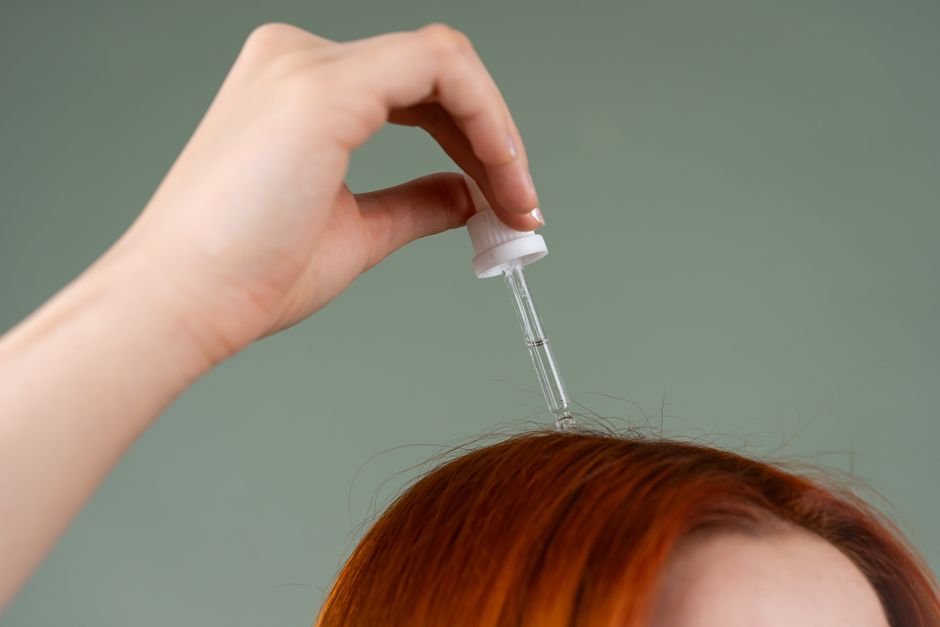
Mayonnaise is a food, not a hair product, and no clinical research supports it as a treatment for hair loss or damaged hair. What it can do is coat the hair shaft with oil and protein, which may make hair feel softer and look shinier for a short time. That effect is cosmetic and temporary, and it is not the same as repairing hair or regrowing it.
Is Mayonnaise Healthy For Your Hair?
There is no strong evidence that mayonnaise improves hair health in any lasting way. The idea comes from its ingredients, not from studies on hair.
Mayonnaise is mostly oil, egg yolk, and acid, usually vinegar or lemon juice. Egg yolk contains protein and fat. Oil coats things. Acid tightens the outer layer of the hair shaft, called the cuticle, at least on the surface. So when someone massages mayonnaise into their hair and rinses it out, the hair can feel smoother and look less frizzy.
That is a real physical effect, but it is superficial. It sits on top of the hair. It does not enter the shaft and rebuild broken bonds. It does not reach the follicle, which is the living structure under the scalp where hair actually grows. No clinical trial has shown that mayonnaise regrows hair or treats a diagnosed hair disorder.
The confusion usually comes from mixing up two different things: making hair feel better and making hair healthier. Mayonnaise can do the first. There is no evidence it does the second.
What Is Mayonnaise Actually Made Of?
Standard mayonnaise is an emulsion of oil, egg yolk, and an acid, with salt and sometimes sugar. The oil is usually soybean or another vegetable oil. The egg yolk is what holds the oil and water together.
That combination is why mayonnaise behaves like a heavy conditioner. The oil is a fat. Fats coat the hair. The egg yolk adds a small amount of protein. The acid lowers the pH, which can flatten the cuticle slightly and make hair reflect more light.
What mayonnaise does not contain is anything that acts on the follicle. It has no drug, no hormone, and no compound shown to change the hair growth cycle. It is food. It behaves like food when you put it on your head.
Can Mayonnaise Repair Damaged Hair?
Mayonnaise cannot repair damaged hair in the structural sense. Hair is not living tissue once it leaves the follicle, and it cannot heal itself.
Hair damage happens in two main ways. The cuticle can lift and chip, which makes hair feel rough. Or the cortex, the inner layer, can lose moisture and protein, which makes hair weak and prone to breaking. Mayonnaise can temporarily smooth the cuticle and add a layer of oil that slows water loss. That is why hair feels better after a mayonnaise mask.
What it cannot do is replace lost protein inside the cortex or reconnect broken chemical bonds. A product that does that is a different category entirely, usually one built around specific bonding ingredients. Mayonnaise is not that.
So the honest framing is this: mayonnaise can improve how damaged hair feels and looks for a day or two. It does not undo the damage. The difference matters, because people often keep using a home remedy long after they should have seen a doctor about actual hair loss.



Does Mayonnaise Help With Hair Growth?
No. There is no evidence that applying mayonnaise to the scalp increases hair growth.
Hair growth happens in the follicle, below the skin surface. What reaches the follicle from the outside is limited. A thick oil like mayonnaise mostly sits on the scalp and the hair. It does not deliver anything the follicle uses to build new hair.
Hair loss has many causes, and they are not treated the same way. Some common ones include:
- Androgenetic alopecia — pattern hair loss driven by genetics and hormones
- Telogen effluvium — shedding after stress, illness, surgery, or major life change
- Alopecia areata — an autoimmune condition
- Nutritional deficiencies — such as low iron or low vitamin D
- Thyroid disorders — which can affect the hair cycle
- Medications — some drugs list hair loss as a side effect
These have different causes and different treatments. Some respond to prescription medication. Some resolve on their own. Some need a blood test to identify. None of them are addressed by mayonnaise.
If you are losing hair, the useful step is to find out why. A doctor can usually narrow it down with a short history and, when needed, lab work.
What Are the Risks of Putting Mayonnaise in Your Hair?
For most people, a mayonnaise hair mask is low risk. It is not sterile, though, and that matters for some.
Mayonnaise contains raw egg. Raw egg can carry Salmonella bacteria. If any gets in your mouth, or on your hands and then into your mouth, there is a small risk of foodborne illness. The risk is higher for people who are pregnant, young children, older adults, and anyone with a weakened immune system. This is a food safety issue, not a hair issue, but it is real.
Other things to know:
- It is messy and hard to rinse out completely.
- Left in too long, it can leave hair greasy and weighed down.
- It can clog a shower drain over time.
- Some people react to an ingredient with scalp irritation or itching.
- If you have a scalp condition, a food product is not the right approach.
The egg risk is the one most people do not think about. If you use mayonnaise on your hair, keep it away from your mouth and wash your hands afterward.
How Does Mayonnaise Compare to Regular Conditioner?
A standard conditioner is formulated for hair. Mayonnaise is formulated for eating. That difference shows up in how each one performs.
Conditioners are built with ingredients that target the hair surface in specific ways. They often use lighter oils and compounds that rinse cleanly and do not leave heavy residue. Mayonnaise is much heavier and does not rinse as easily.
That does not make mayonnaise useless. Some people find it works as an occasional deep treatment, especially on very dry or coarse hair. It is just not a substitute for a product designed for the job, and it is not better than one.
| Feature | Mayonnaise | Standard Conditioner |
|---|---|---|
| Designed for hair | No | Yes |
| Rinses cleanly | Often leaves residue | Formulated to rinse out |
| Raw egg (Salmonella risk) | Yes | No |
| Repairs hair structure | No | No — smooths surface only |
| Promotes hair growth | No | No |
Notice the fourth row. Neither mayonnaise nor a standard conditioner repairs hair in the structural sense. Conditioners smooth the surface too. The difference is that they are made to do that cleanly and safely, without raw egg.
Should You Try a Mayonnaise Hair Mask?
If you want softer, shinier hair for a day and you are not in a high-risk group for foodborne illness, a mayonnaise mask is unlikely to hurt you. It is also unlikely to do much beyond that.
If you are trying to fix hair loss, thinning, or a scalp problem, mayonnaise is the wrong tool. Those need a diagnosis, and often a treatment that works at the follicle.
The simplest way to think about it: mayonnaise is a decent temporary conditioner and a poor medicine. It can make hair feel better. It cannot make hair healthier in any way that lasts.
Frequently Asked Questions
Does mayonnaise make hair grow?
No. There is no evidence that mayonnaise applied to the scalp increases hair growth, because it does not reach the follicle where hair is made.
Can mayonnaise repair damaged hair?
No. Mayonnaise can temporarily smooth the hair surface and add shine, but it cannot rebuild broken bonds or replace lost protein inside the hair shaft.
Is it safe to put mayonnaise in your hair?
For most people it is low risk, but mayonnaise contains raw egg, which can carry Salmonella bacteria.
Is mayonnaise better than conditioner for hair?
No. Mayonnaise is not designed for hair, leaves more residue, and carries a raw egg risk that conditioner does not.
