
Cleaning small amounts of mold yourself is safe for most healthy adults, provided the mold covers a small area and sits on a hard, non-porous surface. The U.S. Environmental Protection Agency and the Centers for Disease Control and Prevention both advise that homeowners can handle minor cleanup themselves. Larger growth, mold in heating and cooling systems, mold on porous materials, or mold after a flood or sewage leak calls for professional help.
What matters most is where the mold is, how much there is, and who lives in the home. People with asthma, mold allergies, or weakened immune systems face higher risk. This guide explains what the official guidance actually says, where the real limits are, and which popular cleanup methods have no evidence behind them.
How Do You Know If It Is Safe To Clean Mold Yourself What To Know First
Two factors decide whether you can clean mold yourself: the size of the affected area and the type of surface it is growing on. The EPA’s guidance for mold remediation in homes and schools states that cleanup of moldy areas smaller than about 10 square feet can usually be done by the occupant. That is roughly a 3-by-3-foot patch — smaller than a standard sheet of plywood.
Surface type matters just as much. Mold sends root-like structures, called hyphae, into the material it grows on. On glass, tile, metal, or sealed countertops, the mold sits on the surface and wipes away. On drywall, ceiling tile, carpet, upholstery, and wood, the growth extends inside. Cleaning the visible mold on those materials often leaves living mold behind, and the material may need to be removed and replaced.
Here is a point many people miss: dead mold can still trigger allergic reactions and asthma symptoms. Killing mold is not the same as removing it. The goal is physical removal, not just making it look gone.
Call a professional when any of these apply:
- The mold covers more than about 10 square feet, or you cannot tell how far it spreads.
- Mold is inside heating, ventilation, or air conditioning ducts or equipment.
- Mold grew after a flood, sewage backup, or long-standing leak inside walls.
- Mold is on porous materials like drywall, carpet, or ceiling tile.
- Anyone in the home has a weakened immune system, severe asthma, or a documented mold allergy.
- The building is a school, workplace, or rental property where occupants are not the ones doing the work.
What Health Risks Does Mold Exposure Actually Pose?
Mold exposure is linked to allergic reactions and asthma symptoms. That link is well established. For people who are sensitized to mold, inhaling spores can cause sneezing, runny nose, red eyes, and skin rash. In people with asthma, mold exposure can trigger coughing and wheezing.
Some people develop hypersensitivity pneumonitis, an immune reaction in the lungs, after repeated exposure to certain molds in damp buildings. This is uncommon but serious and requires medical evaluation.
Invasive mold infections are a different matter. They occur almost entirely in people with severely weakened immune systems, such as those receiving chemotherapy or organ transplants. Healthy adults are not generally at risk of invasive mold infection from household mold.
A widely repeated claim is that household mold causes serious neurological harm or chronic inflammatory illness in otherwise healthy people. The evidence for that is limited and contested. Some patients report symptoms, and some researchers have proposed links, but large, well-controlled human studies have not confirmed a causal relationship. That does not mean symptoms are not real. It means the cause is not established.
Mold does not need to be toxic to be a problem. The most consistent health effects come from allergy and irritation, not from “toxic mold” in the sense the term is often used online.
What Should You Wear And Do Before You Start Cleaning?
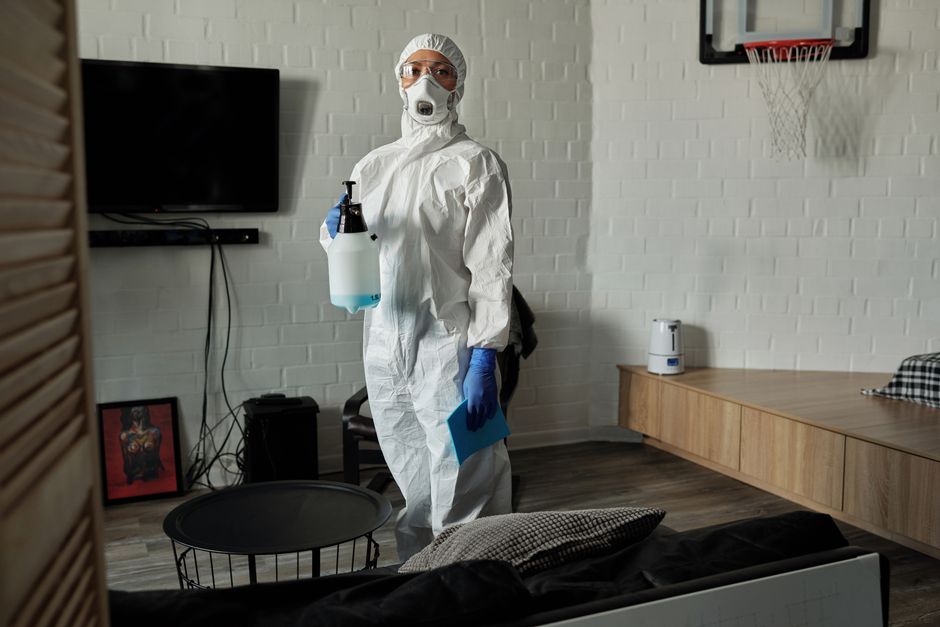
Protecting yourself is the first step, and it is where many people cut corners. The EPA recommends an N-95 respirator, which filters fine particles including mold spores. A dust mask or cloth face covering does not seal tightly and offers less protection.
Wear goggles without side vents to keep spores out of your eyes, and gloves that cover your hands and forearms. If you have asthma or a mold allergy, consider having someone else do the cleaning, or at minimum talk to your doctor first.
Prepare the space before you touch anything:
- Fix the water source first. Cleaning mold without stopping the moisture guarantees it returns.
- Keep people with asthma, allergies, or weakened immune systems, plus pets, out of the area until cleanup is finished and the space is dry.
- Open windows and use a fan to move air outside, not into other rooms.
- Avoid running central air conditioning or heating during cleanup, since it can spread spores through the system.
- Do not dry-brush or dry-vacuum moldy surfaces. That launches spores into the air.




What Actually Works To Remove Mold?
For hard surfaces, the standard approach is detergent and water. Scrub the surface, then dry it completely. The EPA’s guidance emphasizes removing mold rather than killing it, and it notes that a detergent solution is generally adequate for hard surfaces.
Bleach is widely used and widely misunderstood. It can lighten mold stains and kill mold on non-porous surfaces, but it does not reach hyphae that have grown into porous materials, and it does not prevent regrowth. Never mix bleach with ammonia or with vinegar — the combinations can release dangerous gases.
Vinegar is a popular home remedy. Some laboratory studies show it can inhibit certain molds, but there is no strong evidence that vinegar outperforms detergent and water for cleaning mold in a real home. No clinical evidence currently confirms vinegar as a reliable mold treatment.
Ozone generators are marketed as mold eliminators. The EPA and other health agencies warn that ozone is a lung irritant and that these devices should not be used in occupied spaces. They are not a recommended mold solution.
After cleaning, dry the area fully within 24 to 48 hours of any water event. Mold needs moisture to grow, so drying is the single most important step for prevention. If you cannot dry a porous material quickly, it usually needs to be discarded.
Why Does Mold Keep Coming Back?
Mold returns because the moisture was never fixed. This is the most common reason cleanup fails. Mold spores are present in nearly all indoor air, and they will grow wherever there is ongoing dampness, high humidity, or a slow leak.
Common hidden sources include a dripping pipe inside a wall, a leaky roof, condensation on cold surfaces, and a bathroom or basement with poor ventilation. If mold keeps reappearing in the same spot, the water source is still active.
Keep indoor humidity in check. The EPA suggests keeping indoor humidity below about 60 percent, ideally between 30 and 50 percent, to discourage mold growth. Use exhaust fans in bathrooms and kitchens, vent clothes dryers outside, and fix leaks promptly.
If you have cleaned an area thoroughly, dried it completely, and mold still returns within weeks, treat that as a signal to look for a hidden moisture problem rather than cleaning again.
When Should You Call A Professional?
Call a professional when the size, location, or material involved puts the job beyond routine household cleanup. The EPA’s 10-square-foot threshold is a practical dividing line, not a hard rule. If the mold is hidden behind walls or under flooring and you cannot see the full extent, a professional assessment is the safer choice.
Professional remediation typically involves containment to keep spores from spreading, removal of porous materials, and drying equipment. For mold related to sewage or floodwater, professional cleanup is the standard recommendation because of contamination risk, not just mold.
Some states license or certify mold remediation contractors. Ask about training, containment practices, and whether they will address the moisture source. A contractor who cleans mold without fixing the underlying water problem is solving half the issue.
If you are a renter, report mold to your landlord in writing. In many states, landlords have a legal duty to address conditions that affect health and safety.
Frequently Asked Questions
Can I clean small mold patches myself?
Yes. The EPA advises that mold affecting less than about 10 square feet on a hard surface can usually be cleaned by the occupant. Use detergent and water, wear an N-95 respirator, and dry the area completely afterward.
Does bleach kill mold for good?
Bleach can kill mold on non-porous surfaces and lighten stains, but it does not reach mold that has grown into drywall or wood. It also does not stop mold from returning if the moisture source remains.
Is mold dangerous to healthy adults?
For most healthy adults, household mold causes irritation or allergic symptoms rather than serious illness. Invasive mold infections occur almost entirely in people with severely weakened immune systems.
Why does mold keep coming back after I clean it?
Mold returns when the underlying moisture problem is not fixed. Ongoing leaks, high humidity, or condensation will allow mold to regrow even after thorough cleaning.
