
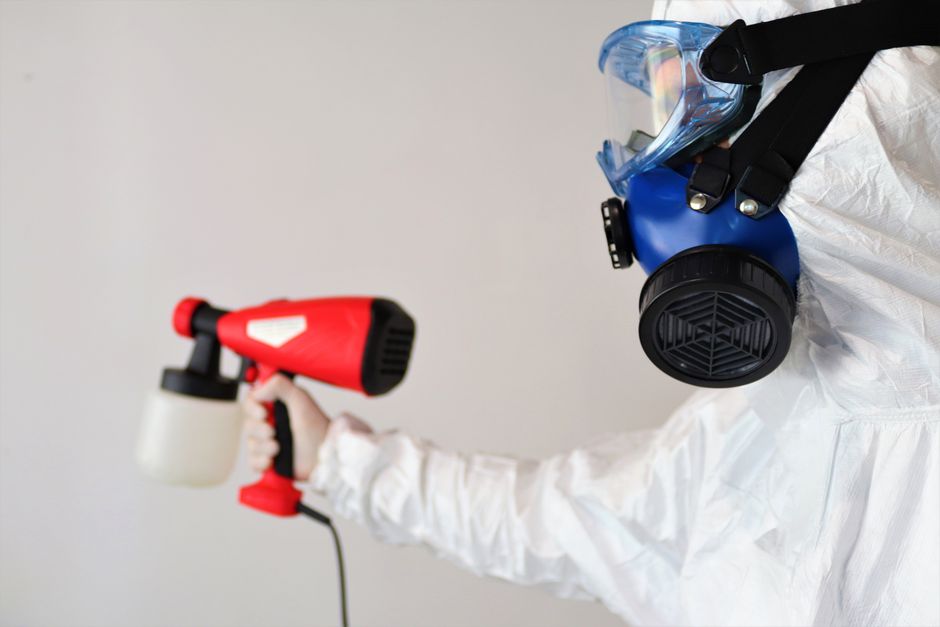
Air filters can remove mold spores from the air, but the answer comes with an important catch: they only capture spores that are already floating. They do nothing about mold growing on your walls, carpet, or behind the drywall. That distinction matters because the source is the problem. An air filter is a tool for managing airborne particles, not a treatment for a mold problem in your home.
Mold releases tiny reproductive cells called spores into the air. These spores are small enough to stay suspended for long periods and small enough to travel deep into the lungs when inhaled. A filter with the right rating can trap a meaningful share of them. But the filter has to be the right type, installed correctly, and running consistently. And even then, it addresses the symptom, not the cause.
How Do Air Filters Actually Capture Mold Spores?
Air filters work by forcing air through a mesh of fibers. Particles get trapped in three main ways. Large particles slam into the fibers directly. Mid-sized particles get pulled into the fibers by the airflow curving around them. The smallest particles bounce around randomly and stick to the fibers through electrostatic attraction.
Mold spores generally range from about 1 to 20 micrometers in diameter, depending on the species. For context, a human hair is roughly 70 micrometers wide. That size range puts most mold spores squarely in the zone where mechanical filters work well. High-efficiency particulate air filters, known as HEPA filters, are tested to capture at least 99.97 percent of particles at 0.3 micrometers. That 0.3 micrometer figure is the hardest size to catch, and filters that perform well there also perform well on both larger and smaller particles.
So the physics is on your side. A HEPA filter in a properly sealed system will capture mold spores that pass through it.
The problem is what never passes through it.
Why Doesn’t an Air Filter Solve a Mold Problem?
Mold grows where there is moisture. A leaky pipe, a damp basement, a bathroom with poor ventilation, a roof leak that soaks the ceiling — these create the conditions mold needs. Once mold is growing on a surface, it releases spores continuously. An air filter can only remove spores that happen to circulate through the unit.
Think of it this way. If you have a running faucet flooding your kitchen, a mop can remove water from the floor. But the floor stays wet as long as the faucet runs. An air filter is the mop. The moisture problem is the faucet.
There is also a practical limitation. Most portable air purifiers are designed to clean the air in one room. They do not create a vacuum that pulls spores from inside walls or from the surface of moldy drywall. Spores release when disturbed — when you walk on contaminated carpet, when air blows across a moldy surface, when humidity changes. The filter only catches what reaches it.
No air filter can remove mold spores that are settled on surfaces or growing inside building materials. That requires fixing the moisture source and physically removing the mold.
Which Type of Air Filter Removes Mold Spores Best?
Not all filters are equal. The table below compares common options.
| Filter Type | Typical Particle Capture | Notes |
|---|---|---|
| Basic fiberglass furnace filter | Captures larger particles only | Protects equipment, not people. Poor choice for spore removal. |
| Pleated HVAC filter (MERV 8–11) | Moderate particle capture | Better than fiberglass. May not capture the smallest spores efficiently. |
| High-MERV HVAC filter (MERV 13+) | High particle capture | Effective but can restrict airflow in systems not designed for it. |
| HEPA filter (portable unit) | At least 99.97% at 0.3 micrometers | Most effective for room air. Requires a sealed unit to work as rated. |
HEPA filters are the standard for particle removal in room air. MERV ratings apply to HVAC filters, and higher MERV means finer filtration. But there is a tradeoff. A filter that catches more particles also restricts airflow more. Some home heating and cooling systems cannot handle a high-MERV filter without reduced performance or added strain on the blower motor.
If you want HEPA-level filtration, a standalone portable air purifier with a true HEPA filter is usually the more straightforward option. Check that the unit is sealed properly. A HEPA filter that lets air bypass around its edges is not delivering HEPA performance.



What About Ozone Generators and “Mold-Killing” Air Purifiers?
Some devices are marketed as killing mold in the air. Ozone generators are one example. They produce ozone gas, which can react with mold and other organic material. But ozone is a lung irritant. The U.S. Environmental Protection Agency has stated that ozone generators are not effective at removing mold and other biological pollutants at concentrations that do not pose a health risk. At levels high enough to affect mold, ozone can harm human health.
Other devices use ultraviolet light or photocatalytic oxidation. Some UV systems can damage mold spores and other microorganisms under certain conditions, but the conditions required for meaningful reduction in a real room are not well established. The evidence for these devices reducing mold spores in actual indoor environments is limited. No large human trials have confirmed health benefits from these devices in home settings.
Ionizers and electrostatic precipitators are another category. They charge particles and collect them on plates. Some can remove particles from the air, but they may produce small amounts of ozone as a byproduct, and their long-term health effects are not well studied.
If your goal is removing mold spores from the air, a HEPA filter is the option with the clearest evidence behind it. Not because marketing says so, but because the filtration standard is measurable and testable.
Does Running an Air Purifier Help With Mold Allergies or Symptoms?
If you are allergic to mold, reducing airborne spores in your breathing zone can reduce exposure. Some studies suggest that air filtration can lower airborne particle levels and may reduce allergy symptoms in some people. The evidence is not uniform across all studies, and results vary depending on the filter type, room size, and how long the unit runs.
What is clear is that air filtration does not treat mold allergy itself. It reduces exposure to one trigger. If mold is growing in your home, the filter is working against a continuous source. It may help reduce airborne spore levels in the room where it operates, but it will not eliminate the source.
For people with mold allergies or asthma triggered by mold, the most effective approach is removing the mold and fixing the moisture problem. Air filtration can be a useful addition, not a replacement.
What Actually Removes Mold From a Home?
Fixing the moisture source comes first. Without that step, mold returns. This means repairing leaks, improving ventilation, reducing indoor humidity, and drying wet materials within 24 to 48 hours when possible. The EPA recommends keeping indoor humidity below 60 percent, ideally between 30 and 50 percent.
For small areas of mold on hard surfaces, cleaning with appropriate products and drying thoroughly can work. For larger areas — generally, the EPA suggests professional help for mold covering more than about 10 square feet — containment and professional removal may be needed to avoid spreading spores during cleanup.
Porous materials like drywall, carpet, and insulation that have been soaked and grown mold often cannot be cleaned effectively. They usually need to be removed and replaced.
Air filtration fits into this picture as a supporting measure. It can help reduce airborne spores during and after cleanup. It can help maintain lower airborne particle levels in a space that is already dry and mold-free. It cannot substitute for fixing the underlying problem.
How Should You Use an Air Purifier If You Have Mold?
Place the unit in the room where you spend the most time, or where mold is present. Keep doors and windows closed while it runs so it is not fighting outdoor air. Run it continuously or for as long as the manufacturer recommends for your room size.
Replace or clean the filter on schedule. A clogged filter loses effectiveness and can strain the motor. If the filter has been running in a moldy environment, handle it carefully when changing it — spores can be disturbed during removal.
Do not rely on an air purifier as your only response to a mold problem. Use it alongside moisture control and mold removal, not instead of them.
Frequently Asked Questions
Do air filters remove mold spores from the air?
Yes, HEPA and high-MERV filters can capture mold spores that pass through them. But they only remove spores that are already airborne, not mold growing on surfaces.
What MERV rating removes mold spores?
Higher MERV ratings capture smaller particles more effectively, and MERV 13 or higher is generally needed for fine particle removal. Check that your HVAC system can handle the airflow restriction before upgrading.
Can a HEPA filter get rid of mold in my house?
No. A HEPA filter removes airborne spores but does not kill mold or remove it from surfaces and building materials. The moisture source must be fixed and the mold physically removed.
Are ozone generators safe for mold removal?
No. The EPA has stated that ozone generators are not effective at removing mold at concentrations that do not pose a health risk, and ozone is a lung irritant.
