
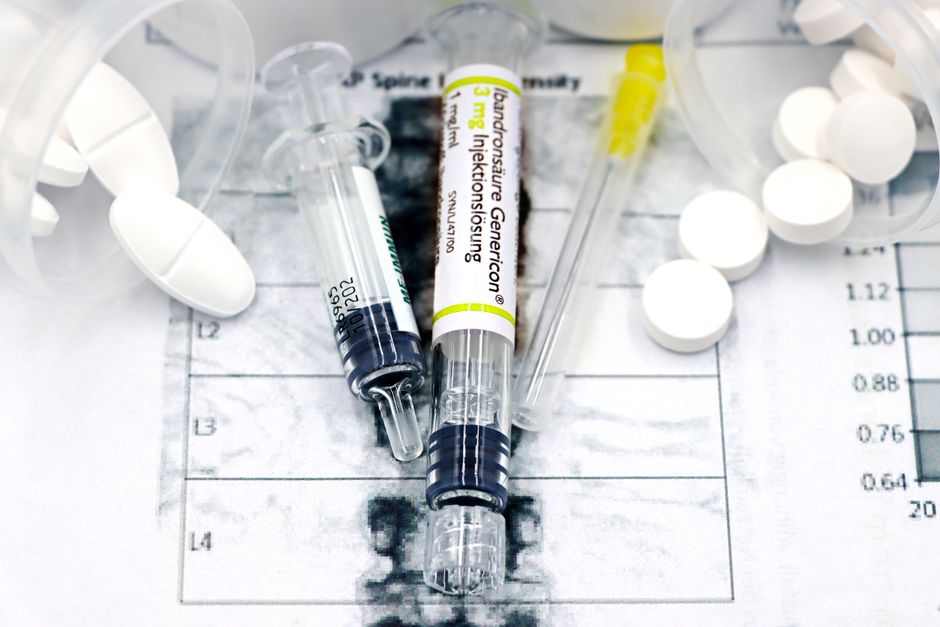
Evenity is not a bisphosphonate. It is a monoclonal antibody that works through a completely different biological pathway. The confusion is understandable because both types of drugs treat osteoporosis and both are given to reduce fracture risk. But their chemistry, their dosing, and how they affect bone are not the same.
Is Evenity A Bisphosphonate?
No. Evenity is a brand name for romosozumab, and it belongs to a drug class called sclerostin inhibitors. Bisphosphonates are a separate class that includes alendronate (Fosamax), risedronate (Actonel), ibandronate (Boniva), and zoledronic acid (Reclast).
The two classes share a goal — lowering fracture risk in people with osteoporosis — but they achieve it through opposite starting points. Bisphosphonates slow down bone breakdown. Evenity briefly increases bone formation while also reducing breakdown. That difference matters for how each drug is used and when.
Evenity is given as a monthly injection under the skin, usually for 12 months. Bisphosphonates are available as weekly or monthly pills, or as intravenous infusions given every few months to once a year, depending on the specific drug.
How Does Evenity Work Differently From Bisphosphonates?
Bone is constantly being remodeled. Old bone is removed by cells called osteoclasts, and new bone is laid down by cells called osteoblasts. In healthy bone, these two processes stay in balance.
In osteoporosis, the balance tips toward removal. More bone is broken down than rebuilt, and bone density and structure decline over time.
Bisphosphonates work by attaching to bone mineral and interfering with osteoclasts. They slow the rate at which bone is broken down. This reduces bone loss and lowers fracture risk, but it does not directly stimulate new bone formation.
Evenity takes a different route. It binds to and inhibits a protein called sclerostin. Sclerostin normally puts the brakes on bone formation. By blocking it, Evenity releases that brake. The result is a short-term increase in bone-building activity alongside a decrease in bone breakdown.
This dual action is why Evenity is classified as an anabolic — meaning bone-building — therapy, while bisphosphonates are classified as antiresorptive, meaning they slow bone loss.
Why the distinction matters
The mechanism affects how these drugs are sequenced. Evenity is typically used for a limited period, and treatment is generally followed by an antiresorptive drug such as a bisphosphonate to maintain the gains. Without that follow-up, the bone density gained during Evenity treatment tends to decline.
Bisphosphonates, by contrast, are often used as first-line therapy and can be taken for several years. Some patients stay on them longer depending on their fracture risk and how they respond.
Are Evenity and Bisphosphonates Used the Same Way?
No. Their dosing schedules, treatment durations, and typical places in a treatment plan differ.
| Feature | Evenity (romosozumab) | Bisphosphonates |
|---|---|---|
| Drug class | Sclerostin inhibitor (monoclonal antibody) | Antiresorptive |
| How it is given | Monthly subcutaneous injection | Oral pills or intravenous infusion |
| Typical duration | 12 months | Several years, varies by drug and patient |
| Primary action | Increases bone formation and reduces breakdown | Reduces bone breakdown |
| Follow-up needed | Yes — usually an antiresorptive after 12 months | May be continued or paused based on risk |
Evenity is generally reserved for patients at very high risk of fracture, including those who have already had a fragility fracture or who have severe osteoporosis. It is not typically the first drug tried for everyone with low bone density.
Bisphosphonates are more commonly used as initial treatment because they have a longer track record, are available in less expensive generic forms, and can be taken orally at home.





What Are the Risks of Evenity Compared to Bisphosphonates?
Both drug classes carry a boxed warning about a rare but serious complication called osteonecrosis of the jaw. This is a condition where bone in the jaw fails to heal, often after a dental procedure. It is uncommon with either class but is a recognized risk.
Evenity carries an additional boxed warning. In clinical trials, a small number of patients experienced serious cardiovascular events, including heart attack and stroke. Because of this, Evenity is generally not recommended for patients who have had a heart attack or stroke in the past year. Clinicians weigh this risk against the fracture risk for each patient.
Bisphosphonates have their own set of concerns:
- Oral bisphosphonates can irritate the esophagus if not taken with a full glass of water while sitting upright.
- Long-term use has been associated with atypical femur fractures — rare breaks in the thigh bone that occur with little or no trauma.
- Some patients experience muscle or joint pain.
- Kidney function needs to be checked before intravenous bisphosphonates are given.
Evenity can cause injection-site reactions and, in some patients, joint pain or headache. These are generally mild.
Neither drug is safe for everyone. People with low blood calcium levels should not start either type of treatment without correcting that first. Evenity and bisphosphonates both require adequate calcium and vitamin D intake to work properly.
Can You Take Evenity and a Bisphosphonate Together?
Not at the same time as a starting combination. The typical approach is sequential: Evenity first for 12 months, then a bisphosphonate to hold onto the bone density gained.
This sequence is supported by clinical trial data. In one large study, postmenopausal women who took Evenity followed by alendronate had higher bone density than those who took alendronate alone. The transition matters because Evenity’s bone-building effect is temporary. Once the drug is stopped, bone turnover begins to shift back, and without follow-up treatment, much of the benefit can be lost.
Some clinicians may use other antiresorptive drugs — such as denosumab — as the follow-up instead of a bisphosphonate. The choice depends on the patient’s history, kidney function, and other factors. This is a decision made with a prescribing clinician, not a fixed rule.
Which Drug Is Right for You?
That depends on your fracture risk, your medical history, and your preferences. There is no single right answer for everyone with osteoporosis.
Evenity is generally considered when fracture risk is very high and a faster, stronger bone-building effect is needed. Bisphosphonates are often the starting point for most other cases because of their established safety profile, lower cost, and convenience.
Some patients cannot take bisphosphonates — for example, because of kidney problems or esophageal issues — and may need a different option. Others may not be candidates for Evenity because of cardiovascular history.
The decision should involve a conversation about your individual risks, including your fracture risk, your heart health, your dental health, and how you feel about injections versus pills. No drug is risk-free, and the goal is to match the treatment to the person.
Does Evenity Build Bone While Bisphosphonates Only Preserve It?
That is a useful simplification, but not entirely accurate. Bisphosphonates do allow some bone formation to continue because bone remodeling is a coupled process — when osteoclasts slow down, osteoblasts also slow down, but the net effect is reduced bone loss rather than gain.
Evenity does stimulate new bone formation directly by blocking sclerostin. This is a genuine difference in mechanism. Whether that translates into a meaningful advantage in fracture reduction for every patient is still being studied. Some trials have shown fewer fractures with Evenity compared to a bisphosphonate in certain high-risk groups, but the evidence is not uniform across all populations.
The bottom line is that Evenity and bisphosphonates are not the same drug class, not the same mechanism, and not interchangeable. They are tools used at different points in osteoporosis treatment, often in sequence rather than as alternatives.
Frequently Asked Questions
Is Evenity the same as Fosamax?
No. Evenity is romosozumab, a sclerostin inhibitor given as a monthly injection. Fosamax is alendronate, a bisphosphonate taken as a weekly pill. They are different drugs from different classes.
Can you switch from Evenity to a bisphosphonate?
Yes, and this is a common approach. After 12 months of Evenity, treatment is usually followed by a bisphosphonate or another antiresorptive drug to maintain bone density gains. The switch should be guided by a prescribing clinician.
Does Evenity have the same side effects as bisphosphonates?
Not exactly. Both carry a rare risk of osteonecrosis of the jaw. Evenity also carries a boxed warning for serious cardiovascular events, which bisphosphonates do not. Bisphosphonates have their own risks, including esophageal irritation and, with long-term use, atypical femur fractures.
Is Evenity stronger than bisphosphonates for osteoporosis?
Evenity builds bone while bisphosphonates mainly slow bone loss, so Evenity can produce larger increases in bone density over 12 months. Whether that always translates to fewer fractures for every patient is still being studied, and the choice depends on individual risk factors.
