
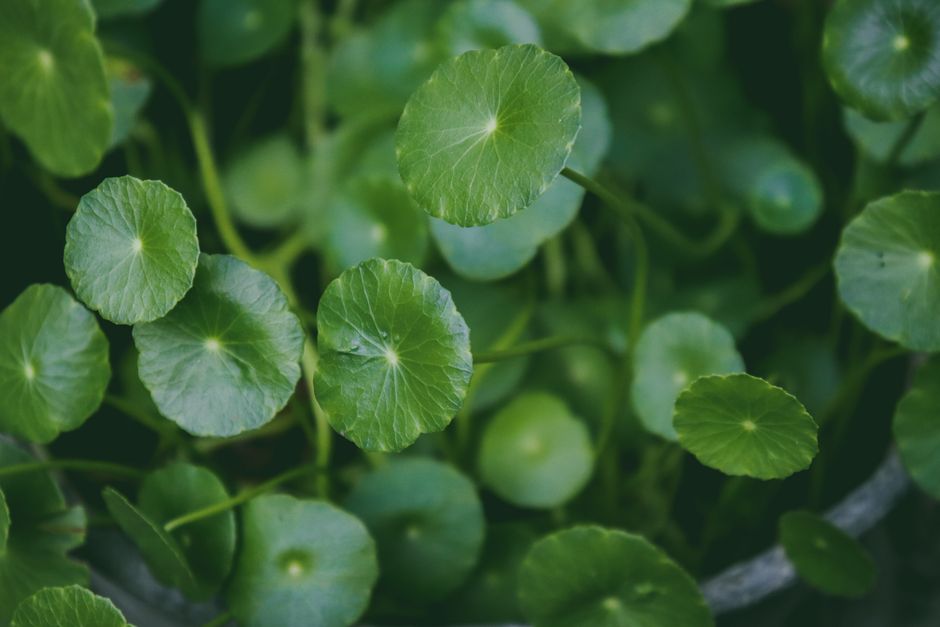
Centella asiatica is a small, leafy plant that has been used in traditional medicine across Asia for centuries. Today it shows up in creams, serums, and supplements, often under the name “cica.” For skin, some human studies suggest it may help with wound healing and scar formation. For safety, topical use is generally well tolerated, but oral use raises more questions, including a real concern about liver toxicity.
What Is Centella Asiatica?
Centella asiatica is a low-growing, creeping plant native to wetlands across Asia. It goes by several names: gotu kola, Indian pennywort, Asiatic pennywort, and tiger grass. In Korean skincare it is usually called cica.
The plant has a long history in Ayurvedic and traditional Chinese medicine, where it was used for wound healing, skin conditions, and other complaints. Modern interest centers on a group of compounds called triterpenoids, which include asiaticoside, madecassoside, asiatic acid, and madecassic acid. These are the molecules most researchers focus on when they study the plant’s effects on skin.
You will find it in two main forms. Topically, it appears in creams, gels, and patches. Orally, it is sold as capsules, tablets, and teas. The two routes behave very differently in the body, and they carry different risk profiles. That distinction matters more than most product labels let on.
Is Centella Asiatica Good For Skin?
Some human studies suggest it can help with wound healing and scar formation, particularly when applied to the skin. The strongest evidence is not for general “anti-aging” or glow, but for specific uses like surgical wounds, burn scars, and small skin injuries.
The compounds in centella appear to influence collagen production and the remodeling of tissue during healing. That is a plausible mechanism, and it lines up with what the plant was traditionally used for. But biological plausibility is not the same as proven clinical benefit, and the quality of the human trials varies a lot.
Several small trials have looked at topical centella for wound healing after surgery or for scar reduction. Results have generally been positive, but many of these studies were small, and some had design limitations. Larger, well-controlled trials are limited. So the honest position is: there is some evidence, mostly for wound healing and scars, and it is not overwhelming.
For everyday concerns like fine lines, uneven tone, or general hydration, the evidence is much thinner. Centella is often included in products alongside other ingredients, which makes it hard to isolate its effect. If a product contains centella plus niacinamide plus hyaluronic acid, you cannot credit the centella for what you see.
What Does the Research Actually Show?
The research picture is mixed, and it depends heavily on what you are measuring.
- Wound healing: Some small human trials suggest faster healing and better scar appearance with topical centella. Evidence is encouraging but not definitive.
- Scar formation: A few studies indicate improvement in scar size or appearance, particularly after surgery or burns. Sample sizes are typically small.
- Eczema and psoriasis: Some studies suggest benefit, but the evidence is limited and inconsistent.
- Anti-aging and wrinkles: Little to no strong human evidence supports this specific claim.
- Oral supplements for skin: Very limited evidence. Most skin research uses topical preparations.
A recurring problem is that many studies use different extracts, different concentrations, and different delivery methods. Centella is not one standardized ingredient. A study using a purified madecassoside extract is not the same as a study using a whole-plant tincture. This makes it hard to draw broad conclusions.
One clarification worth making: centella is not the same as the “cica” marketing label implies. Cica products vary enormously in how much actual centella extract they contain, and there is no universal standard for what counts as a meaningful amount. A product can list centella and still contain very little of it.




Is Centella Asiatica Safe?
Topical centella is generally well tolerated. The most common side effects are minor and local: redness, itching, or irritation at the site of application. These usually resolve when you stop using the product.
Allergic contact dermatitis has been reported, though it appears uncommon. If you have sensitive skin or a history of reactions to plant-based ingredients, patch testing on a small area first is a reasonable precaution.
Oral centella is a different situation. There are documented case reports of liver toxicity associated with oral centella products, including some cases of hepatitis. These reports are not numerous, but they are serious enough that oral use deserves caution. The evidence does not establish how common this is or what dose triggers it.
No clinical guidelines currently exist for using oral centella in pregnancy or breastfeeding. Because of the liver concern and the absence of safety data, oral use during pregnancy and breastfeeding is generally not advised. If you are pregnant, breastfeeding, or managing a liver condition, talk to a clinician before taking it in any form.
There is also a question of interactions. Centella may affect how the body processes certain medications, though the research here is limited. If you take prescription drugs, particularly ones that are hard on the liver, that is worth discussing with a doctor or pharmacist.
How Does It Compare to Other Skin Ingredients?
Centella is often grouped with soothing, barrier-supporting ingredients. Here is how it stacks up against a few common ones, based on the strength of available evidence.
| Ingredient | Main Claimed Use | Strength of Evidence |
|---|---|---|
| Centella asiatica | Wound healing, scars | Some evidence, small trials |
| Niacinamide | Tone, barrier support | Reasonably well studied |
| Hyaluronic acid | Hydration | Well established for moisture |
| Retinoids | Fine lines, acne | Strong evidence |
| Vitamin C | Brightening, antioxidant | Moderate evidence |
If your goal is reducing fine lines, retinoids have far more supporting evidence than centella. If your goal is hydration, hyaluronic acid is well established. Centella’s strongest case is for wound healing and scar management, not general anti-aging.
That does not make centella useless. It means the claims should match the evidence. A soothing ingredient that may support healing is a reasonable thing to use. A “miracle” anti-aging ingredient it is not.
How Should You Use It?
If you want to try topical centella, a few practical points apply.
- Patch test on a small area of skin first, especially if your skin is sensitive.
- Follow the product’s directions. There is no established standard dose for topical centella, so more is not better.
- Be skeptical of products that list centella far down the ingredient list. That usually means the amount is small.
- If you notice redness, itching, or swelling, stop using it.
For oral centella, the picture is less clear. Because of the liver toxicity reports and the lack of dosing standards, this is not something to start casually. If you are considering it for a specific reason, that is a conversation to have with a clinician who knows your health history.
No clinical guidelines currently exist for centella dosing in children. It should not be given to children without medical guidance.
What Are the Main Takeaways?
Centella asiatica has a real but modest evidence base for skin. The best-supported uses are wound healing and scar improvement, mostly with topical products. For anti-aging, brightening, or general “glow,” the evidence is weak.
Topical use is generally well tolerated, with irritation being the main concern. Oral use carries a documented, if uncommon, risk of liver toxicity, and it should be approached with caution. This is not a supplement to take lightly or without reason.
The gap between what centella can plausibly do and what has been proven in human trials is real. It is a reasonable ingredient to use, especially if your skin tolerates it. It is not a proven cure for much of anything, and the marketing around it often runs well ahead of the science.
Frequently Asked Questions
Is Centella asiatica good for your skin?
Some human studies suggest it may help with wound healing and scar formation, mainly when applied topically. Evidence for anti-aging or general brightening is much weaker.
Is Centella asiatica safe to take orally?
There are documented case reports of liver toxicity linked to oral centella, so it carries real risk. Topical use is generally better tolerated, but oral use should be discussed with a clinician first.
Can you use Centella asiatica every day?
Topical centella is commonly used daily in skincare products and is generally well tolerated. If you notice irritation, stop using it and let your skin recover.
Is Centella asiatica the same as cica?
Yes, “cica” is a common marketing name for Centella asiatica in skincare. Products labeled cica vary widely in how much actual centella extract they contain.
