
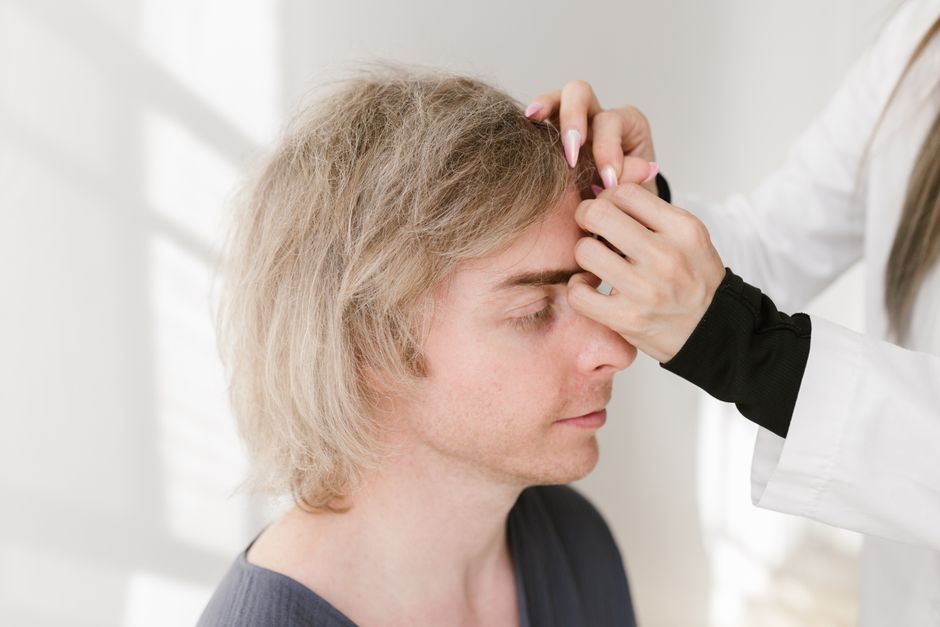
A widow’s peak is a V-shaped hairline that points down toward the middle of the forehead. It is largely genetic, but it does not follow a simple one-gene pattern like eye color. Inheritance involves several genes and varies from family to family, which is why two parents without a widow’s peak can still have a child who has one.
The trait is common and harmless. It is simply a shape the hairline takes as hair follicles are patterned during development. What follows explains how that patterning works, what the genetics do and do not tell us, and why some of the popular claims about widow’s peaks are not supported by evidence.
What Actually Causes a Widow’s Peak?
A widow’s peak is set by where hair follicles form along the front of the scalp. During early development, the skin of the scalp is patterned so that hair grows in some areas and not others. The boundary between the two creates the hairline you see for life.
The shape comes from the underlying tissue, not from the hair itself. Hair follicles are built in the skin before birth, and their placement is directed by signaling between cells in the developing embryo. A widow’s peak reflects a slightly lower point of hair-bearing skin at the center of the forehead compared with the sides.
This is why the trait shows up early and stays stable. You are not “growing” a widow’s peak in the way you grow hair length. The pattern is laid down before you are born. Hair loss later in life can change how a hairline looks, but that is a separate process from the inherited shape itself.
Is A Widows Peak Genetic And How Is It Inherited?
Yes, a widow’s peak is genetic, but the inheritance is more complicated than the version taught in many classrooms. For decades, textbooks described a widow’s peak as a simple dominant trait — one gene, one version passed down, and the trait appears. That model does not hold up.
When researchers actually looked at families and at the genetics of hairline shape, the picture turned out to be polygenic. That means many genes each contribute a small effect, and the final hairline is the combined result. This is the same kind of inheritance seen in height or skin tone — lots of small inputs adding up.
Because of this, the old rule that “one parent with a widow’s peak means the child will have one” is not reliable. A child can inherit a mix of gene variants from both parents and end up with a hairline that matches neither parent exactly. Two parents without a widow’s peak can have a child with one, and two parents with one can have a child without.
There is one useful clarification here. The single-gene dominant model for widow’s peak was repeated in genetics textbooks for years, and it still appears online. It has not held up under closer study. Treat any source that presents it as a simple dominant trait with caution.
Can You Inherit a Widow’s Peak If Neither Parent Has One?
Yes. This is one of the clearest signs that the trait is not controlled by a single dominant gene. If a widow’s peak were caused by one dominant version of one gene, then a child could only have it if at least one parent also had it.
In reality, hairline shape depends on many gene variants working together. Each parent passes down a combination, and the child’s hairline reflects the total. A child can end up with a V-shaped point even when both parents have a straight or rounded hairline.
This does not mean genetics plays no role. It means the genetics are additive and spread across many genes rather than switched on by one. The trait still runs in families on average, but individual outcomes are not predictable from the parents’ hairlines alone.




Does a Widow’s Peak Mean Anything for Your Health?
A widow’s peak on its own is not a sign of any disease. It is a normal variation in hairline shape, like attached versus detached earlobes or the direction your hair whorls. It does not indicate a health problem and does not need any evaluation.
There is a separate and often confused topic. Some genetic conditions are associated with distinctive facial and hairline features, and a widow’s peak can appear among those features. But in those cases the widow’s peak is one small part of a much larger picture that includes other physical signs and developmental findings. A widow’s peak by itself does not suggest any of these conditions.
This is where a lot of online content goes wrong. Lists of “widow’s peak meaning” sometimes link the trait to conditions that have nothing to do with an ordinary hairline. If a person has only a V-shaped hairline and no other symptoms, there is no medical concern to investigate.
Why Do Some People Lose Their Widow’s Peak Over Time?
The inherited shape of the hairline does not change, but the visible hairline can. Hair loss is the usual reason. The most common cause in both men and women is pattern hair loss, which is driven by hormones and genetics and affects where hair thins along the front and top of the scalp.
When hair recedes at the temples, a central point of hair can remain, and the widow’s peak can look more pronounced. In other patterns of loss, the front hairline thins more evenly and the point becomes less obvious. Either way, the change is from hair loss, not from the inherited hairline shape shifting.
Pattern hair loss is common and treatable, and it is worth seeing a clinician if you notice a change in your hairline. Sudden hair loss, patchy loss, or loss with scalp symptoms such as itching or redness has other possible causes and should be checked rather than assumed to be ordinary pattern loss.
How Reliable Are Home Genetics Tests for Hairline Traits?
Consumer DNA tests that report on physical traits are not a reliable way to predict a widow’s peak. These tests typically look at a limited set of genetic markers, and hairline shape is influenced by many genes, most of which these tests do not capture well.
Even a test that reports a “likely” hairline trait is giving a statistical estimate, not a certainty. The result can conflict with what you actually see in the mirror, and the mirror is the more accurate source. For a visible, harmless trait like this, there is no clinical reason to test for it.
The same caution applies to using genetics to predict other appearance traits. The science of polygenic traits is real and advancing, but the predictive power of consumer tests for individual physical features remains modest. A report is not a diagnosis.
What Should You Take Away From All This?
A widow’s peak is a normal inherited hairline shape. It is genetic, it is polygenic, and it does not follow the simple dominant pattern many people were taught. It carries no health meaning on its own.
If you have one, it is simply part of how your hairline formed. If your child has one and neither parent does, that is expected under polygenic inheritance and is not a cause for concern. If your hairline changes later in life, that is worth a conversation with a clinician about hair loss, not about genetics.
Frequently Asked Questions
Is a widow’s peak dominant or recessive?
Neither, in the simple textbook sense. Hairline shape is polygenic, meaning many genes each contribute a small effect, so it does not follow a single dominant or recessive pattern.
Can a widow’s peak skip a generation?
Yes, it can appear in a child when neither parent has one. Because the trait depends on many gene variants combining, a child’s hairline is not predictable from the parents’ hairlines alone.
Is a widow’s peak a sign of anything medical?
No. A widow’s peak by itself is a harmless variation in hairline shape and does not indicate any health condition.
Can you be born with a widow’s peak?
Yes. The hairline pattern is set before birth as hair follicles form in the skin, so the shape is present from early life.
