
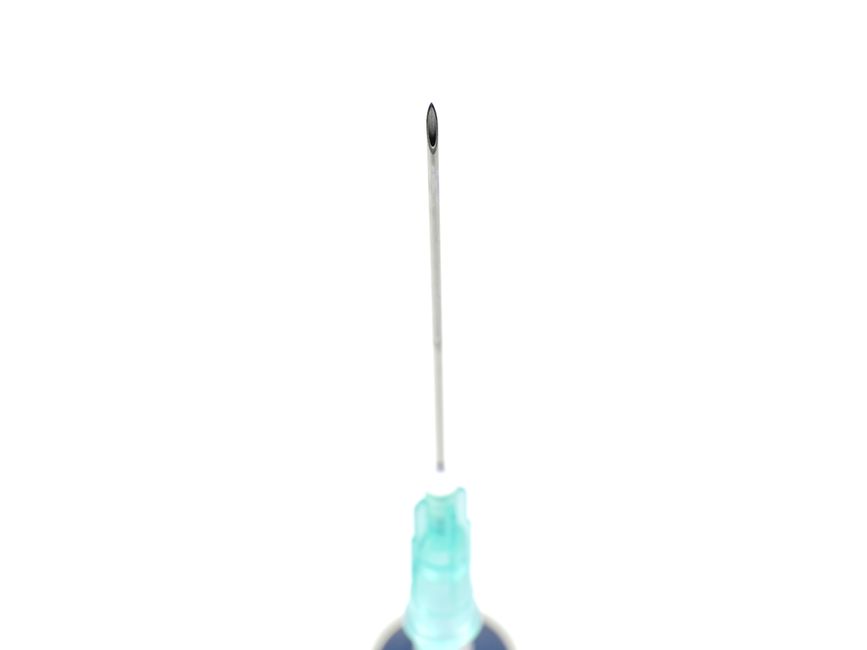
Most people injecting testosterone use a drawing needle between 18 and 21 gauge to pull the oil from the vial, then switch to a thinner 23 to 25 gauge needle for the actual injection. The injection needle is usually 1 to 1.5 inches long for intramuscular shots into the thigh or buttock, or 0.5 to 1 inch for subcutaneous shots into belly fat. Needle length matters as much as gauge, and getting both right makes the injection easier and less painful.
What Gauge Needle Should You Use To Inject Testosterone?
Gauge measures the thickness of the needle. A lower number means a thicker needle. An 18 gauge needle is wide and sturdy. A 25 gauge needle is thin and fine. That reversed scale trips people up constantly.
Testosterone is a thick, oil-based medication. It does not flow easily through a narrow needle. That is why the process usually uses two different needles.
- Drawing up the dose: 18 to 21 gauge. Thicker needles let the oil move quickly into the syringe.
- Injecting: 23 to 25 gauge. Thinner needles cause less tissue damage and less discomfort.
Some people draw and inject with the same needle, often a 23 gauge. It works, but it takes longer to fill the syringe, and the needle tip dulls slightly after piercing the rubber stopper. A dulled needle hurts more going into skin. This is why the two-needle method is standard practice in clinics.
There is no single correct gauge. The right choice depends on your injection method, your body size, and where you inject.
Does Needle Length Matter More Than Gauge?
Length determines whether the medication reaches the right tissue. Gauge determines comfort and flow. Both matter, but a needle that is too short can put the dose in the wrong place entirely.
Intramuscular injections need to reach muscle. Subcutaneous injections need to reach the fat layer just under the skin. If an intramuscular needle is too short, the oil may sit in fat tissue instead of muscle. That changes how fast the drug is absorbed.
| Injection Type | Typical Needle Length | Common Sites |
|---|---|---|
| Intramuscular (IM) | 1 to 1.5 inches | Thigh, buttock, shoulder |
| Subcutaneous (SubQ) | 0.5 to 1 inch | Belly, upper thigh |
Body size affects this too. A person with more fat over the injection site often needs a longer needle to reach muscle. A thinner person may do well with a shorter one. This is a general principle, not a rule that fits everyone.
Testosterone absorption differs between IM and SubQ routes. Both are used in clinical practice. Neither has been shown to be clearly superior for all patients in large head-to-head trials, though some studies suggest SubQ produces steadier blood levels with fewer peaks and troughs. The evidence is still developing.
What Size Needle Do You Need for Subcutaneous Testosterone Injections?
Subcutaneous injections use shorter, thinner needles. Common choices are 25 to 27 gauge, with a length of 0.5 to 1 inch. The needle goes into the fat layer, not the muscle.
This method has grown more popular because many people find it less painful and easier to do at home. The needle is smaller, and the injection site — usually the belly — is easy to reach.
One tradeoff: because the needle is thinner, drawing the oil up can be slow. Many people use a separate, thicker needle to fill the syringe, then swap to the fine needle for injection. Some testosterone products come in vials designed for SubQ use. Others are labeled only for intramuscular injection.
Check your product’s instructions. Not every testosterone formulation is approved for subcutaneous use, even though the practice is increasingly common.





How Do You Draw Up and Inject Testosterone Step by Step?
Good technique reduces pain and lowers the risk of infection. The steps are straightforward once you have done them a few times.
- Wash your hands thoroughly with soap and water.
- Clean the vial top with an alcohol swab and let it dry.
- Attach the larger drawing needle to the syringe.
- Pull back the plunger to draw air equal to your dose, then inject that air into the vial.
- Turn the vial upside down and draw the oil slowly.
- Swap to the smaller injection needle and push out any air bubbles.
- Clean the injection site with an alcohol swab and let it dry completely.
- Insert the needle, pull back slightly to check for blood, then inject slowly.
- Withdraw the needle and press a clean gauze pad on the site.
Injecting too fast can cause soreness. Pushing the oil in over several seconds tends to be more comfortable than forcing it in quickly.
Never reuse a needle. A used needle is dull, not sterile, and raises the risk of infection and tissue damage. Dispose of it in a sharps container.
Does Needle Gauge Affect Pain and Absorption?
A thinner needle generally causes less discomfort going in. That is the main reason people prefer 25 gauge over 23 gauge for injection. But thinner is not always better.
If the needle is too thin for the oil, pushing the plunger becomes hard. You may have to press so firmly that the syringe jerks, which can cause more pain than a slightly thicker needle would have. A 25 gauge is a reasonable middle ground for most people. A 27 gauge may work for some formulations but can be difficult with thicker oils.
Needle gauge has little effect on how well your body absorbs testosterone. Absorption depends mainly on the injection route — muscle versus fat — and on your individual physiology. The gauge affects comfort and technique, not the drug’s effectiveness.
One point worth knowing: the rubber stopper on a vial dulls a needle every time you push through it. If you draw and inject with the same needle, you are injecting with a slightly blunted tip. This is a small effect, but it is real.
What Happens If You Use the Wrong Needle Size?
Using a needle that is too short for an intramuscular injection can leave the oil in fat tissue. This may slow absorption and cause a lump at the site. It does not usually cause harm, but it can affect how steady your testosterone levels stay.
Using a needle that is too thin can make the injection very difficult. If you cannot push the plunger, you may not deliver the full dose. That matters, because dosing accuracy is part of keeping levels stable.
Using a needle that is too thick causes more pain and more tissue trauma. Repeated injections with an overly thick needle can lead to scar tissue buildup at the site over time.
None of these problems are emergencies in most cases, but they are avoidable. Getting the right needle size from the start makes the whole process smoother.
Where Can You Get the Right Needles?
Pharmacies carry injection needles and syringes, and many sell them without a prescription depending on state law. Your prescribing clinician can also specify the exact needle size on your prescription, which is often the simplest approach.
Buying needles online is common, but quality varies. Needles sold for medical use should carry clear labeling and meet safety standards. Avoid any supplier that cannot confirm this.
If you are unsure what size to use, ask your clinician or pharmacist. They can match the needle to your specific testosterone product and injection method. This is not a decision to guess at, because the right size depends on the drug, the route, and your body.
Frequently Asked Questions
What gauge needle do you use to inject testosterone?
Most people inject with a 23 to 25 gauge needle, after drawing the oil up with an 18 to 21 gauge needle. The thinner injection needle causes less discomfort.
Can you use the same needle to draw and inject testosterone?
You can, but the needle dulls slightly after piercing the rubber stopper, which can make the injection more painful. Using two separate needles is standard practice.
What size needle is used for subcutaneous testosterone injections?
Subcutaneous injections typically use a 25 to 27 gauge needle that is 0.5 to 1 inch long. The needle goes into the fat layer, usually in the belly.
Does needle size affect how well testosterone works?
Needle gauge has little effect on absorption, which depends mainly on whether you inject into muscle or fat. Needle length matters more, because it determines whether the dose reaches the right tissue.
