
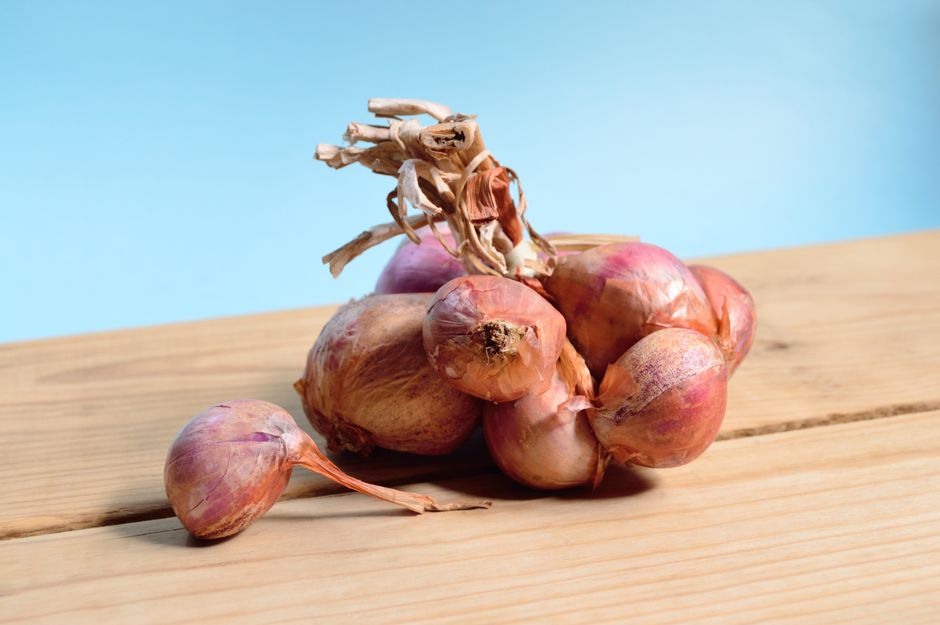
Yes, a shallot is an onion. Not a distant relative or a substitute — it belongs to the same species as the common yellow onion, Allium cepa. Shallots are simply a different variety within that species, the same way a Granny Smith and a Red Delicious are both apples.
That answer surprises people because shallots look and behave so differently. They are smaller, milder, and shaped more like a garlic bulb than a baseball. But botany and cooking use different sorting systems, and the confusion usually comes from mixing them up.
Is A Shallot An Onion Scientifically?
Yes, and the classification is not close. Shallots and yellow onions share the same genus, the same species, and the same basic plant structure.
Both grow underground as bulbs made of layered, fleshy leaves wrapped in a papery skin. Both produce tall green stalks and round flower heads if left to bolt. Cut either one open and you find the same concentric rings stacked from the center outward.
Botanists group shallots under Allium cepa, variety aggregatum. The common onion is Allium cepa, variety cepa. That single word difference — the variety — is the entire botanical gap between them.
This is worth pausing on, because it explains a lot. A shallot is not a different vegetable that happens to taste oniony. It is an onion, full stop, just bred over centuries for a smaller bulb and a gentler flavor.
Is A Shallot An Onion Or Garlic?
A shallot is an onion, not garlic. The confusion is understandable because a shallot’s shape — clustered bulbs in a papery wrapper — looks a lot like garlic.
The mistake comes from appearance, not biology. Garlic is a separate species entirely, Allium sativum. It splits into distinct cloves with hard inner skins, while a shallot’s sections are softer and less individually wrapped.
Taste settles the question. Garlic delivers a sharp, pungent bite that lingers. Shallots taste mild and sweet, closer to a red onion with the edge softened. If you have ever wondered which one you were holding, the smell alone usually tells you.
How shallots, onions, and garlic compare
| Feature | Shallot | Common onion | Garlic |
|---|---|---|---|
| Species | Allium cepa | Allium cepa | Allium sativum |
| Bulb structure | Clustered sections | Single large bulb | Distinct hard cloves |
| Flavor strength | Mild, sweet | Moderate to sharp | Strong, pungent |
| Typical use | Raw, delicate sauces | Cooking, base flavor | Seasoning, aromatics |
Why Do Shallots Taste Milder Than Onions?
The mildness comes down to sulfur compounds, and the difference is real but not absolute.
When you cut into any allium, you break cell walls and release an enzyme that converts stored sulfur compounds into the sharp, eye-stinging chemicals we associate with onions. Shallots contain lower concentrations of these precursor compounds than most common onions. Fewer precursors means less bite once the knife hits the board.
Shallots also carry more sugar relative to their pungency. That balance is why they taste sweeter and gentler, and why they brown beautifully in a pan without turning harsh.
One practical note: the milder flavor is not a fixed number. Growing conditions, soil sulfur content, and how long a shallot has been stored all shift the intensity. A shallot that has sat in a pantry for months will taste sharper than a fresh one.





Can You Substitute Shallots For Onions?
Yes, and the swap works in both directions. The main thing to adjust is quantity, because the two differ in size and strength.
When replacing onion with shallot, use more of them. A single shallot is much smaller than a medium onion, so one-for-one rarely matches. When replacing shallot with onion, use less, since onion brings a stronger flavor that can dominate a delicate dish.
Where the substitution matters most:
- Raw uses — vinaigrettes, salads, and garnishes favor shallots, which add flavor without an aggressive bite.
- Long cooking — onions hold up better in soups and braises, where shallots can soften into nothing.
- Quick sautés — either works, though shallots cook faster and can scorch if you are not watching.
- Pickling — shallots pickle into a milder, more delicate result than onion.
The texture difference is the part people overlook. Shallots break down more quickly under heat. In a dish that cooks for an hour, they may disappear entirely, which changes the final texture even when the flavor still reads as onion.
Are Shallots And Scallions The Same Thing?
No. Shallots and scallions are different plants, though they get confused constantly.
A scallion, also called a green onion, is harvested young before it forms a large bulb. You eat the whole thing — white base and green tops. A shallot is grown to full maturity and harvested for its bulb, which is the part you use.
They do share onion lineage. Scallions typically come from Allium fistulosum or from young common onions, depending on the type. So scallions are onion-family plants too, just at a different stage and often a different species.
This is one of those cases where everyday language and botany drift apart. In a grocery store, “onion” means the big round bulb. In a botany text, it means an entire species that includes shallots, and sometimes scallions too.
Does The Difference Matter For Health?
All alliums — shallots, onions, garlic, scallions — contain similar sulfur-based compounds and flavonoids, and research has linked diets rich in these vegetables to various health outcomes. But the evidence is mostly observational, and it does not single out shallots as superior.
Shallots do contain some of the same beneficial compounds found in onions, including quercetin, a flavonoid studied for its antioxidant properties. Whether shallots deliver a meaningful health advantage over onions is not established. No strong clinical evidence currently confirms that choosing shallots over onions changes health outcomes.
What is well established is simpler: alliums are nutritious vegetables, low in calories, and a reasonable part of a varied diet. Treat shallots as one option among them rather than a special case.
Watch for marketing that frames shallots as a “superfood” superior to onions. The compounds overlap heavily, and no human trials have shown shallots outperform onions for any health endpoint.
How To Tell A Shallot From A Small Onion
Size alone will not do it, because small onions and large shallots can look similar. Shape and structure are the reliable tells.
A shallot has a tapered, teardrop shape and often grows in clusters, so you may see two or three bulbs joined at the base inside one wrapper. A small onion is rounder and stands alone as a single bulb.
Cut it open if you are still unsure. A shallot separates into distinct sections, each with its own thin skin, similar to a garlic bulb but softer. A small onion is one unified bulb with continuous rings.
The papery skin color varies for both — shallots run from copper to gray, onions from yellow to red to white — so color is not a dependable guide.
Frequently Asked Questions
Is a shallot an onion or a type of garlic?
A shallot is an onion, belonging to the same species as common onions. Garlic is a separate species, which is why shallots and garlic differ in both structure and flavor.
Can I use a shallot instead of an onion in a recipe?
Yes, shallots work as an onion substitute in most recipes. Use more of them than you would onion, since shallots are smaller and milder.
Why do shallots taste sweeter than regular onions?
Shallots contain lower levels of the sulfur compounds that create onion pungency, along with relatively more sugar. That combination produces a milder, sweeter flavor.
Are shallots healthier than onions?
No strong evidence shows shallots are healthier than onions. Both contain similar sulfur compounds and flavonoids, and the research on alliums is largely observational.
