
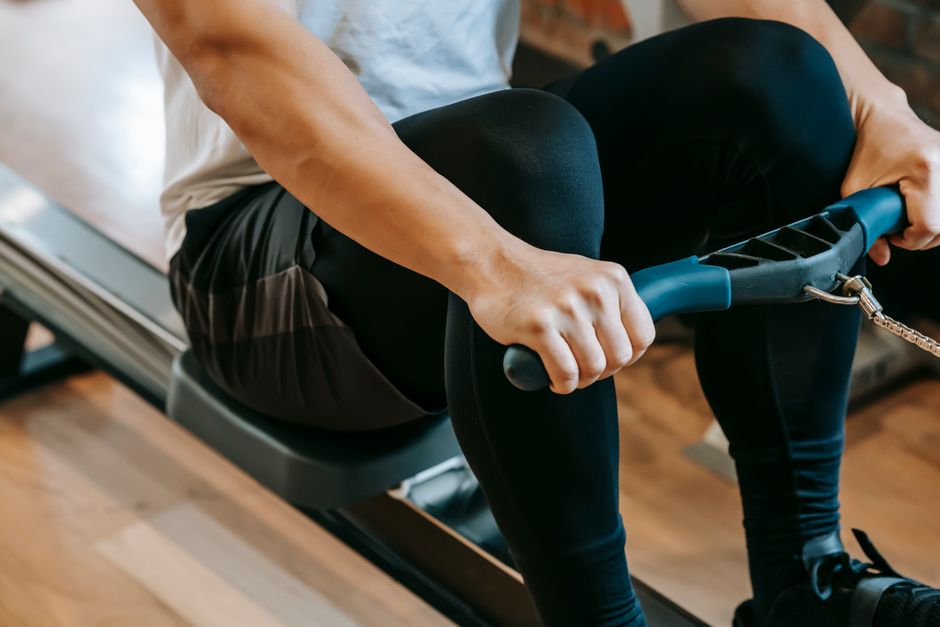
If you want one piece of exercise equipment that works your whole body and burns serious calories at the same time, a rowing machine is one of the best options you can pick. Research shows that rowing engages about 86% of your muscles during each stroke, including your legs, back, arms, and core. It also provides a low-impact workout that is easier on your joints than running or jumping, making it a strong choice for people of all fitness levels.
What Muscles Does a Rowing Machine Work?
A proper rowing stroke is a full-body movement. It works your legs first, then your back and arms, and finally your core to stabilize everything. The American Council on Exercise reports that rowing activates the quadriceps, hamstrings, glutes, latissimus dorsi, trapezius, biceps, and abdominal muscles all in one smooth motion.
Many people think rowing is mostly an arm workout. That is not accurate. Your legs provide about 60% of the power during each stroke. Your back and core contribute about 30%, and your arms only about 10%. If your arms are tired before your legs, you are likely doing the stroke in the wrong order.
One non-obvious insight: rowing strengthens your posterior chain — the muscles along the back of your body — more effectively than most other cardio machines. This is important because sitting at a desk all day weakens those muscles. Rowing helps counteract that imbalance.
Is A Rowing Machine A Good Workout for Weight Loss?
Yes, a rowing machine can help you lose weight if you use it consistently and at the right intensity. A 185-pound person rowing at a moderate pace burns about 377 calories in 30 minutes. That is comparable to running at a 10-minute mile pace for the same duration.
The key is intensity. Rowing at a slow, easy pace burns fewer calories. To maximize fat loss, you need to push hard enough that you cannot hold a conversation easily. Interval training on the rower — 30 seconds of all-out effort followed by 60 seconds of easy rowing — can burn more calories in less time than steady-state rowing.
Some people report that rowing feels easier than running, so they end up working harder without realizing it. That is both a benefit and a potential trap. You still need to track your effort to ensure you are in the right zone for weight loss.
How Does a Rowing Machine Compare to Other Cardio Machines?
| Machine | Muscles Worked | Calories Burned (30 min, 185 lb person) | Joint Impact |
|---|---|---|---|
| Rowing Machine | Full body (86% of muscles) | 377 | Low |
| Treadmill (running) | Lower body primarily | 400 | High |
| Stationary Bike | Lower body primarily | 300 | Low |
| Elliptical | Lower body and some upper body | 350 | Very low |
Rowing stands out because it works your upper body and core in ways that bikes and ellipticals do not. It also burns calories close to running without the pounding on your knees and hips. The tradeoff is that rowing requires good technique to be effective and safe. Poor form can lead to lower back strain.





What Are the Common Mistakes People Make on a Rowing Machine?
The most common mistake is using your arms and back too early in the stroke. The correct sequence is: push with your legs first, then lean back slightly, then pull with your arms. On the return, reverse the order: extend your arms first, then lean forward, then bend your knees. Many people rush this sequence and end up straining their lower back.
Another mistake is gripping the handle too tightly. This tenses your forearms and shoulders, which wastes energy and can cause fatigue. Hold the handle loosely, like you are holding a bird that might fly away. Your fingers should do the work, not your palms.
A third mistake is setting the resistance too high. Higher resistance does not mean a better workout. It often leads to jerky movements and poor form. Start with a moderate resistance and focus on smooth, powerful strokes. The damper setting on most rowers should be between 3 and 5 for most people, not maxed out at 10.
Evidence indicates that people who learn proper rowing technique from a coach or a video tutorial have lower injury rates and get better results. If you are new to rowing, spend your first few sessions focusing on form rather than speed or resistance.
What Does Research on Rowing Machine Workouts Show?
Research published in the Journal of Strength and Conditioning Research found that rowing intervals improved cardiovascular fitness and muscle endurance more than steady-state rowing in a group of healthy adults over eight weeks. The interval group also lost more body fat.
The CDC includes rowing in its list of moderate-to-vigorous physical activities that count toward the recommended 150 minutes of weekly exercise. They specifically note that rowing can improve cardiorespiratory fitness, muscular strength, and body composition when done regularly.
Some studies suggest that rowing may be particularly beneficial for older adults because it builds bone density and improves balance without stressing the joints. A 2019 study in the Journal of Sports Science and Medicine found that regular rowing improved walking speed and balance in adults over 60.
One limitation of the research: most studies are short-term, lasting 8 to 12 weeks. There is less evidence on the long-term effects of rowing over years. The benefits are clear in the short term, but whether they persist indefinitely depends on consistency and progressive overload.
How Do You Get the Most Out of a Rowing Machine Workout?
To get the best results, follow these practical steps:
- Start with a 5-minute warm-up at a slow pace to loosen your muscles and practice your form.
- Track your stroke rate. Aim for 24 to 30 strokes per minute for most workouts. Going faster than that usually means poor form.
- Focus on power per stroke, not speed. A strong, smooth stroke at a moderate rate is more effective than many fast, weak strokes.
- Include interval sessions once or twice per week. Try 8 rounds of 1 minute hard rowing followed by 1 minute easy rowing.
- Add strength training separately. Rowing builds endurance but does not replace resistance training for building muscle mass.
One non-obvious tip: rowing on the water is different from rowing on a machine. The machine does not have the same instability or wind resistance. That does not make the machine worse — it just means the skill transfer is not perfect. If you want to row on actual water, you need to practice on the water too.
Is a Rowing Machine Safe for People with Back or Knee Problems?
Rowing is generally safe for people with knee problems because it is non-weight-bearing. Your knees move through a large range of motion, but there is no impact. Many physical therapists recommend rowing for knee rehabilitation, provided you avoid locking your knees at the end of the stroke.
For back problems, the answer is more complicated. Rowing places a load on your lower back during the drive phase. If you have a history of disc issues or acute back pain, you should check with a doctor before starting. Some people report that rowing strengthens their back and reduces pain over time. Others find it aggravates existing conditions.
The key is form. A rounded back during the stroke puts stress on your spinal discs. Keep your back straight and engage your core throughout the movement. If you feel sharp pain in your lower back during rowing, stop and review your technique. Dull muscle soreness is normal. Sharp pain is not.
What Are the Downsides of a Rowing Machine?
Rowing machines are large and heavy. Most models weigh between 80 and 130 pounds and are over 7 feet long. If you live in a small apartment, finding space for one can be a challenge. Some models fold up, but they are still bulky.
Rowing can also be boring for some people. The movement is repetitive, and staring at the same spot on the wall for 30 minutes is not for everyone. Many modern rowers come with screens and virtual rowing apps that help, but the basic motion does not change.
There is also a learning curve. Unlike walking on a treadmill, rowing requires practice to do correctly. Many people give up after a few sessions because they feel awkward or get tired quickly. That initial frustration is normal, but it passes once you learn the rhythm.
As of 2026, there is no clinical evidence that rowing machines cause any specific long-term health problems when used with proper form. The risks are mostly related to poor technique or overuse, which are manageable with good habits.
Common Misconceptions About Rowing Machines
One common myth is that rowing machines are only for serious athletes or rowing team members. That is not true. Most people who buy rowing machines use them for general fitness, not competitive training. The machine works just as well for a beginner as it does for an experienced athlete.
Another misconception is that rowing builds bulky upper body muscles. Rowing is primarily an endurance activity. It will tone your muscles and improve muscular endurance, but it will not make you look like a bodybuilder. To build significant muscle size, you need heavy resistance training in addition to rowing.
Some people believe that higher resistance always means a better workout. As noted earlier, that is incorrect. The best resistance level is one that allows you to maintain smooth, powerful strokes. Going too heavy forces you to use poor form and increases injury risk.
Frequently Asked Questions
Is a rowing machine good for belly fat?
Rowing burns calories and reduces overall body fat, but you cannot target belly fat specifically. Consistent rowing combined with a healthy diet will reduce fat everywhere over time.
How long should you row on a rowing machine?
For general fitness, 20 to 30 minutes per session is effective. Beginners can start with 10 to 15 minutes and gradually increase duration as their endurance improves.
Is rowing better than running for weight loss?
Rowing and running burn similar calories per minute, but rowing is easier on your joints. The better choice depends on your personal preference and any joint issues you may have.
Can you use a rowing machine every day?
Yes, but vary your intensity. Alternate hard interval days with easier steady-state days to allow your muscles and joints to recover. Daily rowing at low intensity is generally safe.
