
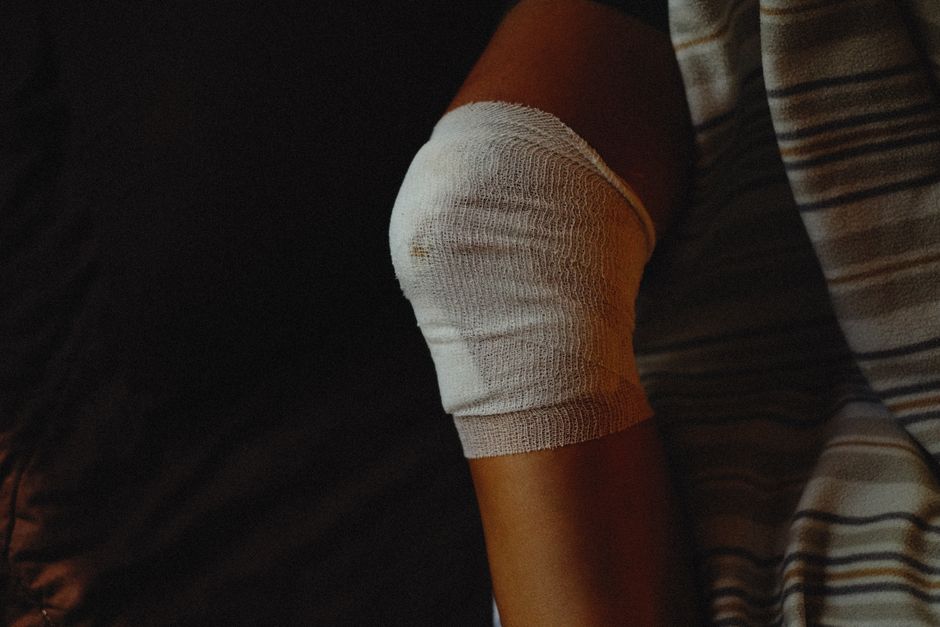
Wrapping your knee for patella support is about controlling how the kneecap tracks in its groove. A proper wrap applies gentle, targeted pressure to guide the patella without restricting your range of motion or cutting off circulation. The most reliable method uses a simple elastic bandage applied in a figure-eight pattern around the joint, which stabilizes the kneecap while allowing the knee to bend naturally. You need the right bandage, the right tension, and the right pattern—otherwise, you are just putting a bandage on without real support.
What Does Patella Support Actually Do?
The patella, or kneecap, sits in a groove at the end of your thigh bone. It moves up and down as you bend and straighten your leg. When that movement is smooth, you do not notice it. When it is not—due to muscle weakness, tightness, or injury—you feel pain, grinding, or instability.
A wrap provides external support that does two things. First, it adds mild compression, which improves proprioception—your brain’s awareness of where the joint is in space. Second, it applies directional pressure that can help guide the kneecap along its proper track. This is why a simple circular wrap is not enough. The wrap needs to cross over the kneecap in a way that supports its natural movement path, not just squeezes it.
How To Wrap A Knee For Patella Support Properly: Step By Step
Start with a 3-inch or 4-inch elastic bandage. Wider is better for the knee because it distributes pressure more evenly. You also need the bandage to be long enough—usually 72 to 108 inches—to complete the pattern comfortably.
Follow these steps in order:
- Sit with your knee bent at about a 30-degree angle. This slight bend keeps the patella seated in its groove while you wrap.
- Anchor the bandage just below the kneecap, wrapping twice around your leg. Keep it snug but not tight. You should be able to slide one finger underneath easily.
- Bring the bandage diagonally upward across the front of the knee, crossing over the center of the patella.
- Wrap once around your thigh, just above the kneecap.
- Bring the bandage diagonally back down across the front, crossing over the patella in the opposite direction. This creates an X shape over the kneecap.
- Wrap once around your leg below the knee again, then repeat the diagonal crosses two or three more times.
- Finish by wrapping horizontally around the middle of your knee, covering the X pattern, and secure the end with the clips or hook-and-loop fastener that came with the bandage.
The key is the X pattern. That crossing pressure over the patella is what provides the support. A plain spiral wrap does not do this—it only compresses, which helps with swelling but does little for patellar tracking.
How Tight Should The Wrap Be?
Tension is the most common mistake people make. Too tight and you restrict blood flow or push the patella deeper into the joint, which increases pain. Too loose and the wrap slides around, providing no meaningful support.
Use the finger test. After applying the wrap, try to slide one finger under the bandage at the back of your knee. If you cannot, it is too tight. The wrap should feel secure and present, but it should never cause tingling, numbness, or a change in skin color. Your toes should stay warm and pink.
If you feel throbbing under the wrap, remove it immediately and reapply with less tension. This is not a case where tighter is better. Compression that is too firm can compress the nerves and blood vessels behind the knee, which sits in a vulnerable spot called the popliteal fossa.





When Should You Not Wrap Your Knee?
Wrapping is not appropriate for every knee problem. If you have significant swelling, a locked knee that will not fully straighten, or pain that prevents you from putting weight on the leg, a wrap is not the answer. These signs point to structural damage—a torn ligament, a meniscus tear, or a fracture—that requires medical evaluation, not compression.
If your knee is hot to the touch, red, or visibly swollen beyond mild puffiness, see a clinician before wrapping. Wrapping over an acutely swollen joint can increase pressure inside the joint and worsen the problem. Ice, elevation, and rest are the appropriate first steps for acute injury, not compression bandages.
If you have peripheral artery disease, diabetes with neuropathy, or any condition that affects circulation in your legs, talk to your doctor before using compression wraps. Reduced blood flow combined with external compression can cause tissue damage that you might not feel due to nerve changes.
What Are The Alternatives To Wrapping?
Wrapping is a temporary, low-cost option, but it is not the only one. A patellar strap—a narrow band worn just below the kneecap—applies focused pressure to the patellar tendon. Some people find this more comfortable than a full wrap because it does not restrict the rest of the knee. Research on patellar straps is mixed, with some studies showing benefit for patellar tendinopathy while others show no clear advantage over placebo.
A neoprene knee sleeve provides warmth and compression across the whole joint. It does not provide directional support the way a figure-eight wrap does, but it can improve comfort during activity. For many people with mild patellar instability, the warmth and gentle compression are enough to reduce symptoms.
Kinesiology tape is another option. Applied in specific patterns, it can provide sensory feedback and light directional support. The evidence for kinesiology tape is limited and inconsistent. Some people report meaningful relief; others notice no difference. It is not a substitute for a structured wrap if you need real mechanical support.
The most effective long-term approach is not any wrap at all—it is strengthening the muscles that control the patella. The vastus medialis oblique, a teardrop-shaped muscle on the inner side of your thigh, is the primary stabilizer of the kneecap. Weakness here is a common cause of patellar tracking problems. A physical therapist can design a program that targets this muscle along with the glutes and core, which all contribute to knee alignment.
How Long Can You Wear A Knee Wrap?
A knee wrap is for activity, not for all-day wear. Use it during exercise, walking, or any activity that provokes symptoms. Remove it when you are resting or sleeping. Wearing a compression wrap continuously can cause skin irritation, reduce circulation, and lead to muscle weakening because the wrap does some of the work your muscles should be doing.
If you find you need the wrap for every single activity, that is a signal that the underlying problem is not being addressed. The wrap is managing symptoms, not fixing the cause. This is the point where you should seek professional evaluation rather than continuing to rely on the wrap.
There is no standard maximum wear time that applies to everyone. The general principle is simple: the less you need it, the better. Use it as a tool, not as a permanent solution.
Does Wrapping Prevent Knee Injuries?
No. A wrap does not prevent injuries. It can reduce symptoms during activity, and it may improve your confidence in the joint, but it does not strengthen the structures around the knee or change how the joint handles impact. No study has shown that knee wrapping reduces the rate of future knee injuries.
If you are wrapping to prevent injury during high-risk sports, understand that the wrap is doing very little mechanically. The forces involved in cutting, jumping, and landing are far greater than any elastic bandage can counteract. Injury prevention comes from strength, conditioning, and proper movement patterns—not from external support.
This is not to say wrapping is useless. It has a legitimate role in symptom management and can help you stay active while you address the underlying weakness. Just be clear about what it can and cannot do.
When To See A Professional
If your knee pain lasts more than two weeks despite rest and activity modification, see a healthcare provider. If the pain is sharp, causes the knee to give way, or is accompanied by swelling that appears within a few hours of injury, seek evaluation sooner.
Patellar pain that does not respond to simple measures—rest, ice, a wrap—warrants a proper diagnosis. The cause could be chondromalacia patellae, patellar tendinopathy, patellofemoral pain syndrome, or something else entirely. These conditions have different treatment approaches, and wrapping alone will not resolve any of them.
A physical therapist can assess your movement patterns, muscle strength, and joint alignment to identify why your patella is not tracking properly. This is the information you need to fix the problem, not just manage it.
Frequently Asked Questions
Can I sleep with a knee wrap on?
No. Remove the wrap before sleeping because prolonged compression can restrict circulation and irritate the skin. Use the wrap only during activity or periods of standing and walking.
What is the difference between a knee wrap and a knee brace?
A wrap is an elastic bandage that provides compression and light directional support. A brace has rigid or semi-rigid components, such as hinges or straps, that provide structural stability against side-to-side forces or severe instability.
How do I know if my knee wrap is too tight?
If you cannot slide one finger under the bandage, if your toes tingle or go numb, or if the skin below the wrap changes color, it is too tight. Remove it and reapply with less tension.
Can wrapping make patellar pain worse?
Yes, if the wrap is too tight or applies pressure directly over the patella, it can increase pain. The wrap should cross over the kneecap, not press deeply into it, and should never cause new pain or numbness.
