
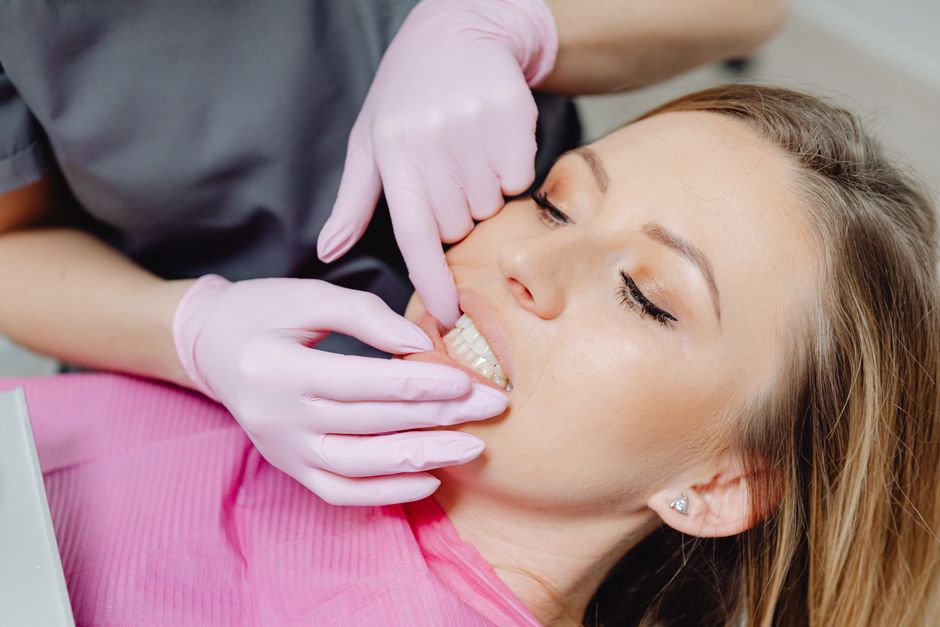
Professional teeth whitening at the dentist uses a high-concentration peroxide gel, often activated by light or heat, to break apart stain molecules inside the tooth. A typical in-office session takes about 60 to 90 minutes, and many people see a noticeable change in a single visit. Your dentist will check your teeth and gums first, protect your soft tissues, apply the gel, and may send you home with a custom tray for touch-ups.
How To Whiten Teeth At The Dentist What To Expect?
You will sit in a dental chair while the clinician isolates your gums and applies a professional-strength bleaching agent. The gel contains hydrogen peroxide or carbamide peroxide at concentrations far higher than anything sold over the counter.
Most visits follow a similar sequence:
- A shade check, so you and your dentist can compare before and after
- A cleaning, because plaque and surface stains block the gel from reaching the tooth
- A protective barrier on the gums, lips, and cheeks
- Application of the whitening gel to the front teeth
- One or more cycles, each lasting roughly 15 to 30 minutes
- A rinse and a final shade comparison
Light or heat may be used between cycles. The evidence that these devices add much beyond the gel itself is mixed. Some research suggests they speed up the reaction; other studies find the gel does most of the work. Either way, the peroxide is the active ingredient.
You can usually drive yourself home and return to normal activities the same day.
How Does Professional Whitening Actually Work?
Peroxide molecules are small enough to pass through the enamel and into the layer beneath it, called dentin. There they react with pigment compounds — long chains of molecules that reflect light in a way your eye reads as yellow or brown.
The reaction breaks those chains into smaller, less colored fragments. This is why whitening changes the color of the tooth itself rather than scrubbing something off the surface. It is a chemical change, not an abrasive one.
This distinction matters. Whitening and cleaning are different processes. A polish removes stains sitting on the outside of the enamel. Whitening reaches stains that have worked their way inside over years of coffee, tea, wine, or tobacco use.
It also explains why whitening does not work on every kind of discoloration. Stains from inside the tooth — from trauma, certain medications, or decay — respond differently or not at all. That is a structural limit, not a failure of the product.
Is In-Office Whitening Better Than Take-Home Kits?
In-office whitening produces the fastest change. A single session can shift several shades, which is why it is common before weddings, job interviews, or other events.
Take-home trays from your dentist use lower concentrations and typically take days to weeks to reach a similar result. Store-bought strips and gels are weaker still and often take longer.
The end result after a full course can be comparable across methods. The main differences are speed, cost, and how much control you have over the process.
| Method | Typical speed | Peroxide strength | Who applies it |
|---|---|---|---|
| In-office | One visit | High | Dentist or hygienist |
| Custom take-home trays | Days to weeks | Moderate | You, at home |
| Over-the-counter strips | Weeks | Low | You, at home |
Many dentists combine the two: an in-office session to jump-start the change, then trays at home to maintain it. That approach is common in practice, though head-to-head trials comparing every combination are limited.





Does Whitening Hurt, And How Long Does Sensitivity Last?
Tooth sensitivity is the most common side effect. It usually shows up during the session or within a day or two after, and typically fades on its own within a few days.
The mechanism is fairly well understood. Peroxide can temporarily reach the nerve-rich inner part of the tooth and irritate it. The effect is generally reversible as the tissue recovers.
Gum irritation is the other frequent complaint. It happens when the gel contacts soft tissue. A well-placed protective barrier greatly reduces this, which is one reason professional application exists.
Things that may help, based on general clinical practice:
- Avoid very hot or very cold drinks for a day or two
- Use a toothpaste for sensitive teeth in the days around treatment
- Skip whitening touch-ups until any sensitivity settles
- Tell your dentist if discomfort is significant or lasts more than a few days
If you have receding gums, worn enamel, or untreated cavities, whitening can be more uncomfortable. Your dentist should screen for these first. This is not a minor point — exposed dentin and open cavities let the gel reach areas it should not.
How Long Do Results Last?
Results commonly last from several months to about a year or two, depending on your habits. There is wide variation between people, so any single number is a rough guide rather than a promise.
The biggest factor is what you expose your teeth to. Coffee, tea, red wine, cola, and tobacco all re-stain teeth over time. So does anything acidic that softens enamel.
Touch-ups extend results. A single in-office session every year or two, or occasional use of custom trays, is a common maintenance pattern.
One thing worth knowing: whitening does not work on crowns, veneers, bonding, or fillings. Those materials do not respond to peroxide. If you have visible restorations on front teeth, your dentist may need to plan around them, because whitening your natural teeth can make an unmatched crown stand out more.
Who Should Not Get Their Teeth Whitened?
Whitening is not appropriate for everyone, and this is where a dental exam matters. Your dentist can identify situations where the treatment should be delayed or avoided.
Reasons to hold off or reconsider include:
- Untreated cavities or active gum disease
- Significant enamel wear or exposed roots
- Pregnancy or breastfeeding — no clinical guidelines currently establish safety for whitening during these periods, so most clinicians advise waiting
- Teeth discolored by trauma or certain medications, which often do not respond to peroxide
- Young children, whose teeth and gums are still developing
Age matters for a specific reason. The pulp inside a tooth is larger in children, and the evidence on whitening primary or young permanent teeth is limited. Most clinicians avoid it in young patients outside of specific dental supervision.
If you have sensitive teeth, existing restorations, or a history of gum recession, tell your dentist before the visit. It changes how the appointment is planned.
What Happens After Your Appointment?
Your dentist will likely give you aftercare instructions. The first 24 to 48 hours matter most, because teeth are more prone to picking up new stains right after whitening.
Common guidance includes avoiding dark-colored foods and drinks, skipping tobacco, and using a straw for anything that could stain. Some clinicians also suggest a desensitizing gel or toothpaste.
You may notice the shade continues to shift slightly in the day or two after treatment. This is normal. The final result is usually judged a few days later, not in the chair.
If you want to maintain results, the plan usually comes down to habits: limit staining drinks, keep up with cleanings, and use touch-up trays as your dentist advises. There is no way to whiten teeth permanently — the color will drift back over time, and that is expected.
Frequently Asked Questions
How long does a dentist teeth whitening appointment take?
Most in-office whitening sessions take about 60 to 90 minutes, including prep and gel cycles. Some appointments run longer if multiple cycles are used.
Is dentist teeth whitening painful?
It is usually not painful, but temporary tooth sensitivity is common and typically fades within a few days. Gum irritation can occur if the gel touches soft tissue, which the protective barrier is meant to prevent.
How many shades whiter can teeth get in one visit?
Many people see a noticeable change after a single session, though the exact number of shades varies widely between individuals. Your starting color, the cause of discoloration, and the gel strength all affect the result.
Can I whiten my teeth at the dentist if I have crowns or veneers?
Whitening does not change the color of crowns, veneers, bonding, or fillings. Your dentist can whiten your natural teeth and then discuss whether any restorations need to be replaced to match.
