
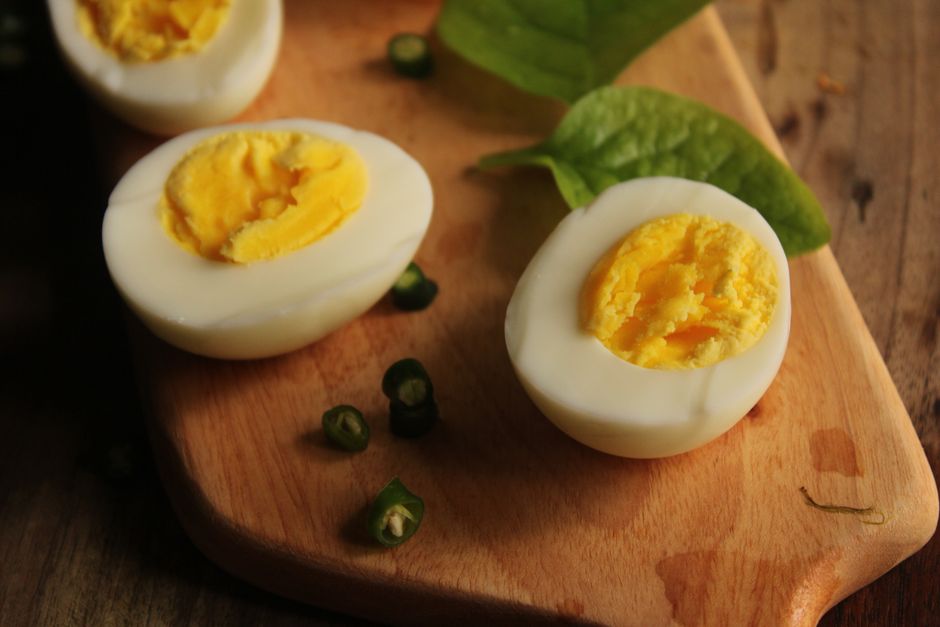
A hard-boiled egg needs about 9 to 12 minutes in gently boiling water, depending on the size of the egg and how firm you want the yolk. Small eggs can be done closer to 9 minutes, while large or extra-large eggs usually need 11 to 12 minutes for a fully set yolk. After boiling, cooling the egg quickly in ice water stops the cooking and makes peeling easier.
That basic range covers most kitchen situations. The details below explain why the timing shifts, what happens inside the egg at each stage, and how to avoid the two most common problems: rubbery whites and that gray-green ring around the yolk.
How Long To Boil Eggs Hard Boiled by Egg Size
Egg size is the single biggest factor most people overlook. A large egg and a small egg can differ by several minutes even in the same pot.
The times below assume the egg goes into water that is already boiling, which is the most predictable method.
- Small — about 9 minutes
- Medium — about 10 minutes
- Large — about 11 minutes
- Extra-large — about 12 minutes
These are general kitchen ranges, not clinical thresholds, and they shift with a few variables. A refrigerator-cold egg takes slightly longer than one that has sat at room temperature. Higher altitude lowers the boiling point of water, which means food cooks a bit slower and you may need to add time. Starting eggs in cold water and bringing them up to a boil adds another layer of guesswork, because the time to reach boiling varies with your stove and pot.
If you want one number to remember for a standard large egg, 11 minutes is a solid default. Adjust from there.
What Happens Inside the Egg as It Cooks
Egg white and egg yolk set at different temperatures, and that gap explains why timing matters so much.
Egg white proteins begin to thicken and set at a lower temperature, roughly around 140°F (60°C), and become fully firm a bit higher. Yolk proteins set at a higher temperature, closer to 158°F (70°C). This is why an egg can have a fully cooked white and a yolk that is still soft or runny. The yolk simply needs more heat to firm up.
When you boil an egg past the point where both are fully set, the proteins keep tightening. That is what turns a tender white into a rubbery one. The yolk also starts to dry out and crumble.
The gray-green ring some people see around the yolk is a separate reaction. It forms when sulfur from the white meets iron from the yolk and creates iron sulfide. This happens more at higher heat and longer cooking times. It is harmless and does not mean the egg has spoiled, but it does signal that the egg was cooked a little long. Cooking time and quick cooling are the main levers that control it.
Why the Ice Bath Matters
Pulling eggs out of boiling water and dropping them straight into ice water does two things at once.
First, it stops the cooking almost immediately. An egg left in hot water keeps cooking from residual heat even after you turn off the burner, so those extra minutes can push a good egg into rubbery territory. The cold water halts that.
Second, the quick temperature drop helps with peeling. As the egg cools, the white contracts slightly and pulls away from the inner membrane. That small gap makes the shell easier to remove.
Let the eggs sit in the ice bath for at least a few minutes, or until they are cool enough to handle. Some people leave them longer, which is fine.





Why Some Eggs Are So Hard to Peel
Peeling trouble is one of the most common complaints, and it is not really about your technique.
Fresh eggs are harder to peel than older ones. A very fresh egg has a lower pH in the white and the membrane clings tightly to the shell. As an egg ages, its pH rises and the membrane loosens, which makes peeling easier. Eggs that are about one to two weeks old tend to peel more cleanly than eggs laid that same week.
So if you are buying the freshest eggs you can find and they stick to the shell, that is the reason. It is not a flaw in your method. If peeling matters more than freshness for a particular recipe, letting eggs sit in the refrigerator for a week or two before boiling can help.
Other factors that can affect peeling include how quickly the egg is cooled and how the shell is cracked. Cracking the shell all over and starting to peel from the wider, rounded end, where the air pocket sits, often works better than starting at the pointed end.
Common Boiling Methods Compared
There is more than one way to get to a hard-boiled egg. The method changes the timing and the margin for error.
| Method | How it works | Timing note |
|---|---|---|
| Boiling water start | Lower eggs into already boiling water | Most predictable; use the size-based times above |
| Cold water start | Eggs and water heated together | Timing starts once water boils; less precise |
| Steaming | Eggs sit above boiling water in a steamer | Often faster; similar firmness range |
| Pressure cooking | High heat under pressure | Much shorter times; needs its own settings |
The boiling-water start is the easiest to control because your timer and the cooking both begin at the same moment. Cold-water starts are common but add a variable, since the time to reach a boil depends on your pot, burner, and how many eggs you are cooking.
How to Tell a Hard-Boiled Egg Is Done
Timing is the reliable way to know, but a few visual and physical cues help.
A properly hard-boiled egg feels firm when you tap it and does not wobble. When you cut it open, the white should be fully opaque and firm, and the yolk should be set all the way through without being dry or crumbly. A yolk that is still glossy or liquid in the center is not fully hard-boiled.
If you are unsure, the safest approach is to cook one egg as a test with your setup, note the time, and adjust. Stoves, pots, and starting temperatures vary enough that a single test egg often saves a lot of guesswork.
One caution worth stating plainly: if an egg has an unusual smell or a slimy or discolored appearance after peeling, do not eat it. Hard-boiled eggs should be refrigerated and are generally best used within about a week, which is standard food safety guidance for cooked eggs.
Frequently Asked Questions
How long do you boil eggs for hard boiled?
About 9 to 12 minutes in gently boiling water, depending on egg size and how firm you want the yolk. A large egg is usually ready around 11 minutes.
Is 10 minutes enough for a hard boiled egg?
Ten minutes is enough for a medium egg and often for a large one, though a large egg may need closer to 11 minutes for a fully set yolk. Egg size and starting temperature both affect the result.
Why do my hard boiled eggs have a green ring around the yolk?
The green-gray ring is iron sulfide, formed when sulfur from the white reacts with iron in the yolk during longer or hotter cooking. It is harmless, and shorter cooking plus a quick ice bath helps prevent it.
Should you put eggs in cold water or boiling water?
Starting eggs in already boiling water gives the most predictable timing because the cooking and your timer begin together. A cold-water start works too, but the time to reach a boil varies and makes the result less consistent.
