
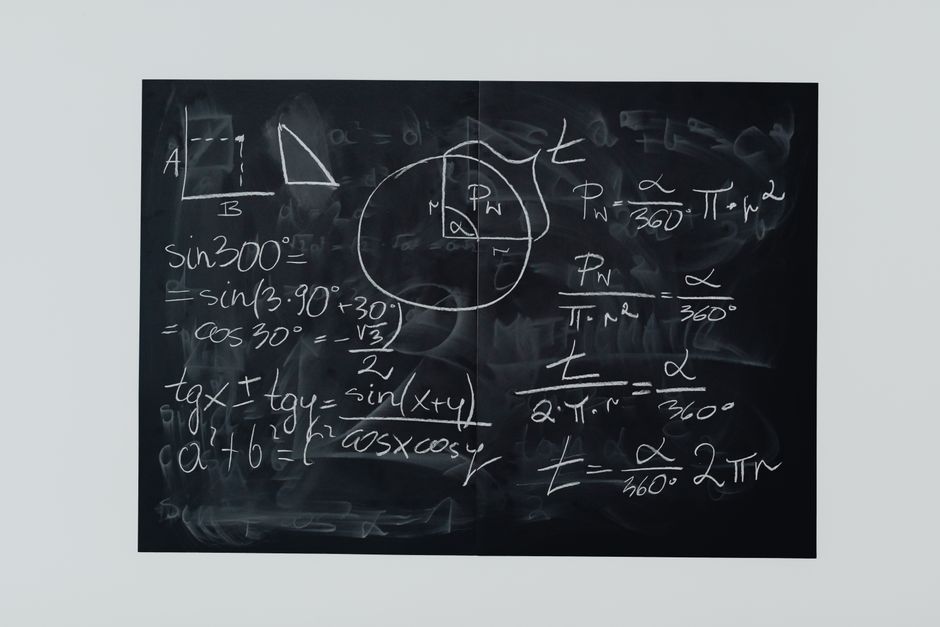
The Pythagorean theorem is one of the most useful tools in basic geometry. It applies only to right triangles — triangles with one 90-degree angle. If you know the lengths of any two sides of a right triangle, the theorem lets you find the third side with simple arithmetic. The formula is a² + b² = c², where c is the longest side, called the hypotenuse, and a and b are the two shorter sides that form the right angle. To find a missing side, you square the two known sides, add or subtract them, and then take the square root.
What Exactly Does the Pythagorean Theorem State?
The theorem describes a fixed relationship between the three sides of a right triangle. It states that the square of the hypotenuse equals the sum of the squares of the other two sides. This is not an approximation. It is a mathematical certainty for every right triangle, regardless of its size.
The hypotenuse is always the side opposite the 90-degree angle. It is also always the longest side. If you are looking at a triangle and are unsure which side is the hypotenuse, find the right angle. The side directly across from it is the hypotenuse.
This relationship has been known for thousands of years. It is named after the Greek mathematician Pythagoras, though evidence suggests the principle was understood even earlier in other cultures. Today it remains a foundational tool in construction, navigation, computer graphics, and countless other fields.
How To Use The Pythagorean Theorem To Find Missing Sides: Step by Step
The process depends on which side you are missing. There are two situations: finding the hypotenuse or finding one of the shorter legs.
Situation 1: Finding the hypotenuse. You know both legs, a and b. Add their squares and take the square root. The formula is c = √(a² + b²).
Example: A triangle has legs of 3 and 4. Square 3 to get 9. Square 4 to get 16. Add them to get 25. The square root of 25 is 5. The hypotenuse is 5.
Situation 2: Finding a missing leg. You know the hypotenuse and one leg. Subtract the square of the known leg from the square of the hypotenuse. Then take the square root. The formula is a = √(c² − b²).
Example: A triangle has a hypotenuse of 13 and one leg of 5. Square 13 to get 169. Square 5 to get 25. Subtract 25 from 169 to get 144. The square root of 144 is 12. The missing leg is 12.
In both cases the order of operations matters. Always square first, then add or subtract, then take the square root. Do not skip the squaring step or take the square root before you finish the addition or subtraction.
Common Mistakes and How to Avoid Them
One frequent error is using the wrong side as the hypotenuse. The hypotenuse must be the side opposite the right angle. If you accidentally plug a leg into the c position, your answer will be wrong.
Another common mistake is forgetting that c is always the largest number in the equation. If your calculated hypotenuse is shorter than one of the legs, something went wrong. Recheck your arithmetic.
Students also sometimes confuse when to add versus subtract. Here is the rule to remember: if you are finding the hypotenuse, you add. If you are finding a leg, you subtract. The hypotenuse is always the largest side, so its square must be the largest number in the equation.
Rounding errors are another issue. If your answer involves a decimal, keep enough digits during intermediate steps. Round only at the very end. Rounding too early can shift your final answer noticeably, especially in real-world applications like construction.





When Can You Use the Pythagorean Theorem?
The theorem only works for right triangles. If the triangle does not have a 90-degree angle, the formula does not apply. This is a hard limit. You cannot use a² + b² = c² on an equilateral triangle or a scalene triangle without a right angle.
However, many non-right triangles can be split into two right triangles by drawing an altitude — a line from one vertex perpendicular to the opposite side. Once split, you can apply the Pythagorean theorem to each right triangle separately. This technique is common in trigonometry and in calculating the height of a triangle.
The theorem also appears in coordinate geometry. The distance between two points on a graph is found using the same principle. The horizontal difference becomes one leg, the vertical difference becomes the other leg, and the straight-line distance is the hypotenuse.
In real life, the theorem helps carpenters check that corners are square. If a corner forms a right angle, the diagonal measurement will match the Pythagorean calculation. Builders use this method constantly. The classic 3-4-5 triangle is a quick field check: mark 3 feet along one wall, 4 feet along the other, and the diagonal should measure 5 feet.
What Is a Pythagorean Triple?
A Pythagorean triple is a set of three whole numbers that satisfy the theorem. The most famous is 3, 4, 5. Others include 5, 12, 13 and 8, 15, 17. These triples are useful because they give clean, whole-number answers without decimals.
Multiples of triples also work. If you multiply each number in a triple by the same factor, the result is still a valid right triangle. For example, 6, 8, 10 is double the 3-4-5 triple. The relationship holds because the equation scales evenly.
Recognizing triples can save time on tests and in practical work. If you see two sides that match part of a known triple, you can often identify the third side without doing any arithmetic. But this shortcut only works when the numbers are exact members of a triple. Otherwise, you must do the full calculation.
Worked Examples You Can Follow
Example 1: Finding the hypotenuse. A right triangle has legs of 6 and 8. Square 6 to get 36. Square 8 to get 64. Add to get 100. The square root of 100 is 10. The hypotenuse is 10.
Example 2: Finding a missing leg. A right triangle has a hypotenuse of 17 and one leg of 15. Square 17 to get 289. Square 15 to get 225. Subtract to get 64. The square root of 64 is 8. The missing leg is 8.
Example 3: Working with decimals. A right triangle has legs of 2.5 and 6. Square 2.5 to get 6.25. Square 6 to get 36. Add to get 42.25. The square root of 42.25 is 6.5. The hypotenuse is 6.5.
Try these on your own before checking the answers. The process is the same every time. Identify which side is missing, square the known sides, add or subtract, then take the square root.
Why the Theorem Works: A Brief Explanation
Understanding why the theorem is true helps you remember it and trust it. One of the clearest proofs involves drawing squares on each side of a right triangle. The area of the square built on the hypotenuse equals the combined area of the squares built on the two legs.
Imagine a right triangle with legs of 3 and 4. A square on the 3-side has an area of 9. A square on the 4-side has an area of 16. Together they cover 25 square units. The square on the hypotenuse of 5 has an area of 25. The areas match exactly.
This geometric proof has been known for centuries. It is one of the most elegant demonstrations in mathematics because it relies purely on area and visual reasoning. The algebra follows directly from this relationship between areas.
There are hundreds of different proofs of the Pythagorean theorem. Mathematicians have developed proofs using algebra, geometry, calculus, and even rearranged puzzles. The sheer number of independent proofs reinforces how fundamental this relationship is to the structure of space.
When the Theorem Does Not Apply
The theorem fails for non-right triangles. If you attempt to use it on an acute or obtuse triangle, your answer will not match the actual side length. This is not a limitation of the formula. It is simply a mismatch between the tool and the problem.
For non-right triangles, you need the law of cosines. That formula is c² = a² + b² − 2ab·cos(C), where C is the angle opposite side c. When angle C is 90 degrees, the cosine term becomes zero, and the law of cosines reduces exactly to the Pythagorean theorem. This is why the Pythagorean theorem is sometimes called a special case of the law of cosines.
Also, the theorem works only in flat, Euclidean space. On curved surfaces — like the surface of a sphere — the relationship changes. Navigation over long distances on Earth requires different formulas that account for curvature. For everyday geometry on flat surfaces, the Pythagorean theorem is exact.
One more limitation: the theorem gives you the length of a side, but not any information about the angles of the triangle. To find angles, you would need trigonometry — sine, cosine, and tangent functions. The theorem and trigonometry are closely related, but they answer different questions.
Practical Applications in Daily Life
Beyond the classroom, the theorem shows up in many practical settings. Carpenters and builders use it to ensure foundations are square. TV screen sizes are measured diagonally, which is a hypotenuse calculation. Ladder placement against a wall follows the same principle — the wall and ground form the legs, and the ladder is the hypotenuse.
In sports, the theorem helps calculate throwing distances or the shortest path across a field. In navigation, it converts latitude and longitude differences into straight-line distances. In computer graphics, it calculates distances between pixels and determines how objects scale on screen.
Even simple household tasks can use it. If you need to know whether a piece of furniture will fit through a doorway at an angle, the diagonal measurement of the furniture is a hypotenuse calculation. If the diagonal is smaller than the doorway opening, it will fit. This is the same math, applied to a real problem.
The theorem is also foundational in physics. It combines perpendicular forces or velocities into a single resultant vector. If you walk 3 miles east and 4 miles north, your straight-line distance from the start is 5 miles. The theorem gives you that answer instantly.
Frequently Asked Questions
How do I know which side is the hypotenuse?
The hypotenuse is always the side opposite the 90-degree right angle and is always the longest side of the triangle. If you identify the right angle first, the side directly across from it is the hypotenuse.
Do I add or subtract when using the Pythagorean theorem?
Add the squares of the two legs when finding the hypotenuse. Subtract the square of a known leg from the square of the hypotenuse when finding a missing leg.
Can I use the Pythagorean theorem on any triangle?
No, it only works on right triangles that have one 90-degree angle. For other triangles you need the law of cosines or must split the triangle into right triangles first.
What is the 3-4-5 rule in construction?
The 3-4-5 rule uses the Pythagorean theorem to check if a corner is square. Measure 3 units along one wall, 4 units along the other, and the diagonal between those points must be 5 units if the corner is a perfect right angle.
