
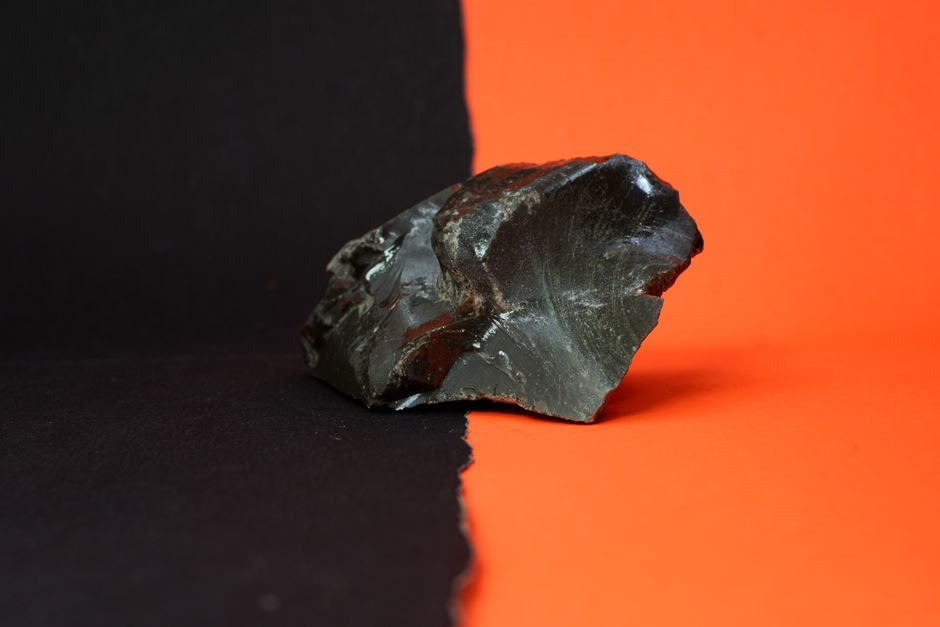
Black obsidian is a natural volcanic glass that forms when lava cools too quickly for crystals to grow. Real black obsidian has a distinctive glassy look, a conchoidal fracture pattern, and a hardness of about 5 to 5.5 on the Mohs scale. Fake black obsidian is usually made of dyed glass, resin, or slag, and it often fails simple tests involving light, temperature, and surface inspection.
What Does Real Black Obsidian Look Like?
Real black obsidian is not perfectly black in every light. Hold it up to a bright light source. A genuine piece will show a faint glow at the edges or thin spots. This glow is often dark brown, deep purple, or smoky gray. The color comes from tiny iron and magnesium impurities in the glass.
Completely opaque black with no light passing through at all is a warning sign. Most real obsidian allows some light through thin areas. Exceptionally thick pieces may block all light, but most jewelry and small specimens will show some translucency.
Look at the surface texture. Real obsidian feels smooth and glassy, like a wine bottle. It often has natural irregularities — small pits, tiny cracks, or wavy lines from the flow of molten lava. These imperfections are normal and actually support authenticity. A perfectly uniform surface with no flaws is more suspicious than one with minor blemishes.
How To Tell If Black Obsidian Is Real Or Fake Using The Light Test
The light test is the most reliable method available to consumers. Shine a bright flashlight directly through the stone. A real piece will transmit some light, appearing dark brown or deep amber at the edges. This is called translucency.
Fake obsidian made of dyed glass behaves differently. Darkly dyed glass often blocks all light completely. If the dye is lighter, the glass may glow green, blue, or unnatural colors. Real obsidian never glows green or blue. It only shows browns, grays, and smoky tones.
Some fakes are made of black resin or plastic. These materials block light entirely and feel warm to the touch. Real obsidian feels cool initially because it is a poor conductor of heat. Resin and plastic warm up quickly in your hand.
Testing Hardness And Surface With Simple Methods
Obsidian sits at about 5 to 5.5 on the Mohs hardness scale. This is harder than a copper penny but softer than a steel knife blade. A common test involves scratching the surface with a steel object. A steel knife will scratch real obsidian. It will also scratch most glass fakes, so this test alone is not conclusive.
A better surface test uses a sharp edge. Real obsidian fractures like glass, producing razor-thin edges. Look at any broken or chipped areas. Real obsidian shows a smooth, curved break pattern called conchoidal fracture. This looks like the inside of a seashell. Fake resin pieces break with dull, rough edges. Dyed glass breaks with a similar pattern to obsidian, making this test more useful for ruling out resin than glass.
Check for bubbles. Use a magnifying glass or a jeweler’s loupe. Real obsidian is volcanic glass and rarely contains air bubbles. Dyed glass and resin fakes frequently contain tiny spherical bubbles visible under magnification. The presence of multiple bubbles strongly suggests a fake.





Temperature And Weight Tests For Black Obsidian
Real obsidian feels cold when you first touch it. This is because glass conducts heat away from your skin quickly. Hold the stone in your palm for a few seconds. Real obsidian stays cool longer than resin or plastic. Resin warms to body temperature within seconds.
Weight is another clue. Real obsidian has a density of about 2.4 grams per cubic centimeter. It feels heavier than plastic or resin of the same size. It feels similar in weight to most glass. If a large piece feels suspiciously light, it is likely resin or hollow glass.
Tap the stone gently against your teeth or a hard surface. Real obsidian produces a sharp, glassy click. Resin produces a dull thud. This test is subjective, but experienced collectors find it useful.
Common Fake Materials Used For Black Obsidian
Dyed glass is the most common fake. Manufacturers melt glass and add black dye or metallic oxides. These pieces look convincing at first glance but fail the light test by blocking all light or showing unnatural colors.
Resin and plastic fakes are common in cheap jewelry. They are lightweight, warm to the touch, and often show mold lines from the manufacturing process. Look for seam lines or perfectly uniform shapes — real obsidian is natural and irregular.
Slag glass is a byproduct of metal smelting. It looks similar to obsidian but often has a more metallic sheen or unusual surface texture. Slag glass is technically real glass but not volcanic in origin. It is not obsidian.
Black onyx is sometimes mislabeled as black obsidian. Onyx is a type of chalcedony, a crystalline quartz. It is harder than obsidian and often has a waxy luster rather than a glassy one. Onyx is a real gemstone but is not obsidian.
Where To Buy Real Black Obsidian
Buying from reputable mineral dealers is the safest way to get genuine obsidian. Established sellers with physical storefronts or long-standing online reputations are less likely to sell fakes. Ask for the stone’s origin. Real obsidian comes from volcanic regions including the United States, Mexico, Iceland, Italy, and Japan.
Be cautious with extremely cheap listings. Real obsidian is not expensive — small tumbled stones often sell for a few dollars. But suspiciously low prices on large pieces usually indicate resin or glass. If a seller offers a fist-sized “obsidian” sphere for five dollars, it is almost certainly fake.
Read reviews and look for photos from multiple angles. Legitimate sellers show natural variations in color and surface. Sellers using the same stock photo repeatedly may be selling mass-produced fakes.
Frequently Asked Questions
Does real black obsidian let light through?
Yes, real black obsidian is translucent at thin edges and shows a brown or smoky glow under bright light. Completely opaque pieces are likely dyed glass or resin.
Is real black obsidian cold to the touch?
Yes, real obsidian feels cool initially because it conducts heat away from your skin. Resin and plastic fakes warm up quickly in your hand.
Can a scratch test confirm real obsidian?
A steel knife will scratch real obsidian, but it also scratches most glass fakes. The scratch test is useful for ruling out resin but cannot distinguish obsidian from dyed glass on its own.
Is black obsidian expensive?
No, real black obsidian is an affordable stone. Small tumbled pieces cost a few dollars, but extremely cheap large pieces are usually fake.
