
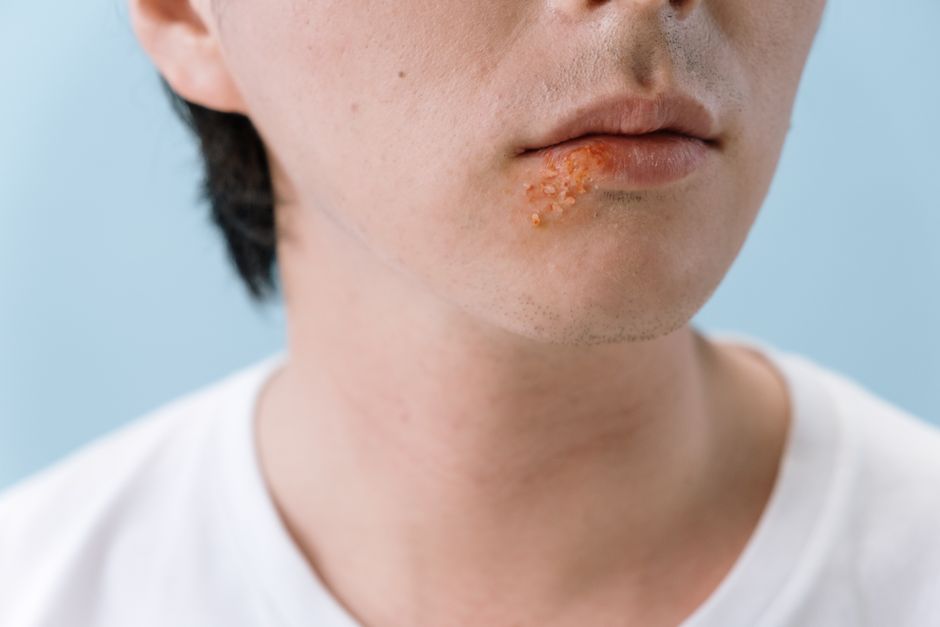
Orajel cold sore products are over-the-counter treatments applied directly to a cold sore to relieve pain and, in some formulations, help the sore heal. The active ingredients vary by product, so the first step in using any of them safely is reading the label to know exactly what you are putting on your skin. Used as directed, these products are generally well tolerated. Used incorrectly, some ingredients can irritate healthy skin or cause harm if swallowed.
What Ingredients Are in Orajel Cold Sore Products?
The name “Orajel” covers several different products, and they do not all contain the same medicine. Knowing which one you have matters, because the safety rules differ.
The most common Orajel cold sore product contains benzocaine, a local anesthetic. It numbs the area to ease pain. It does not kill the virus or shorten the cold sore. Some Orajel cold sore products also contain allantoin, a skin protectant, and camphor, which produces a cooling sensation.
Other products in the cold sore category use docosanol, an antiviral that works differently. Docosanol is not a benzocaine product. If you are looking specifically for an antiviral, check the drug facts panel rather than assuming the brand name tells you.
This distinction matters. Benzocaine relieves symptoms. Docosanol is intended to shorten healing time when started early. They are not interchangeable, and the label directions for each are different.
How Do You Apply a Cold Sore Product Correctly?
Apply it only to the cold sore itself, not to the surrounding skin. This is the single most important application rule.
Wash your hands with soap and water before and after applying. Use a clean cotton swab or a clean finger rather than a shared applicator. If you use your finger, wash it again immediately afterward. Cold sores are caused by herpes simplex virus type 1, and the fluid inside the blister is contagious. Touching the sore and then touching your eyes, nose, or genitals can spread the virus to those areas.
Follow the frequency stated on the label. Do not apply more often than directed, and do not apply a thicker layer hoping for faster results. More product does not mean more relief. It increases the chance of irritation and, with benzocaine, increases the amount absorbed into the body.
Do not apply the product inside your mouth, on your gums, or on your tongue unless the label specifically says it is made for that use. Do not use it in your eyes or near your eyes. Benzocaine products are for external use on the lip and around the mouth only.
What Are the Real Risks of Benzocaine Products?
Benzocaine carries a rare but serious risk that most people have never heard of. The FDA has warned that benzocaine products can cause a condition called methemoglobinemia, in which the blood carries less oxygen than it should.
This reaction is uncommon, but it has occurred after using benzocaine sprays and gels, including in people who had used the products before without problems. Symptoms include pale, gray, or blue-tinged skin, lips, or nail beds, shortness of breath, confusion, headache, rapid heart rate, and dizziness. If any of these appear, stop using the product and get emergency medical help.
Children under 2 years old should not be given benzocaine products at all. The FDA advises against it because of the methemoglobinemia risk in this age group. For young children and infants, cold sores should be evaluated by a clinician rather than treated with an over-the-counter numbing gel.
Do not use benzocaine products on large areas of skin, on broken skin beyond the cold sore, or for longer than the label allows. Do not use more than one benzocaine product at the same time.





Can You Use Orajel Cold Sore Products With Other Medications?
For most people using a benzocaine gel on a small cold sore, interactions with other medicines are not a major concern. The amount absorbed through intact lip skin is small.
There are situations that deserve more caution. If you are already using another product that contains benzocaine, such as a throat spray or a teething gel, you could be adding to your total exposure. If you use a medication that affects oxygen delivery in the blood, or you have a condition such as anemia, heart disease, or lung disease, talk to a pharmacist or clinician before using benzocaine.
If you are taking prescription antiviral medication for cold sores, an over-the-counter numbing gel does not replace it. The two do different things. Ask your prescriber whether adding a topical product is appropriate.
Pregnant or breastfeeding readers should check with a clinician before using any cold sore product. No clinical guidelines currently establish a clearly defined safe dosing approach for benzocaine use during pregnancy or breastfeeding, so this is a conversation to have with a professional rather than a decision to make from a label alone.
When Should You See a Doctor Instead of Self-Treating?
Most cold sores heal on their own within one to two weeks without any treatment. A product may ease discomfort, but it will not change the underlying course of the infection.
See a clinician if any of the following apply:
- The cold sore is near or in your eye, or you have eye pain, redness, or blurred vision
- You have a weakened immune system from illness, medication, or treatment
- The sore is unusually large, spreading, or not improving after about two weeks
- You have frequent outbreaks
- You have a fever or feel generally unwell along with the sore
- The sore appears in a young child or infant
- You have eczema, and the cold sore is spreading into areas of eczema
Prescription antiviral medications, taken by mouth, can shorten outbreaks and reduce how often they happen. That is a conversation for a clinician, not something an over-the-counter gel can do.
What Does the Evidence Actually Show About These Products?
Benzocaine numbs skin. That effect is well established and is the reason it is included in these products. What it does not do is treat the virus.
Docosanol has been studied for cold sore treatment, and some trials suggest it may shorten healing time when started at the first sign of a cold sore. The evidence is not uniform across all studies, and the benefit, where it appears, is modest. Starting it after the blister has fully formed is unlikely to help much.
No over-the-counter cold sore product cures herpes simplex virus or removes it from your body. The virus stays in nerve cells and can reactivate. Products manage symptoms and, in some cases, may slightly speed healing. They do not eliminate the infection.
This is where marketing language and clinical reality separate. A product described as “treating” a cold sore is usually managing the symptom, not the virus. That is not a flaw in the product. It is simply what the product does.
How Can You Reduce the Chance of Spreading a Cold Sore?
Cold sores are contagious from the moment you feel the tingling until the sore has completely crusted over and healed. The virus spreads through direct contact with the sore or its fluid.
Keep your hands away from the sore. Do not pick at it or squeeze it. Do not share lip balm, utensils, cups, towels, or razors while the sore is active. Do not kiss anyone, especially infants and people with weakened immune systems, until it has fully healed. Wash your hands often, particularly after applying any product.
Replace your lip balm or lipstick if you used it during the outbreak. The virus can survive on these items long enough to reinfect you or someone else.
Triggers for outbreaks vary between people. Common ones include sun exposure, stress, fatigue, illness, and hormonal changes. If you notice a pattern, sun protection on the lips may help reduce sun-triggered outbreaks. This is a reasonable step, though individual results vary.
Frequently Asked Questions
Can I use Orajel cold sore gel on my gums or inside my mouth?
No, unless the specific product label states it is made for inside the mouth. Benzocaine gels for cold sores are intended for external use on the lips and around the mouth only.
How often can I apply a benzocaine cold sore product?
Follow the frequency printed on the product label, and do not apply it more often than directed. Applying more frequently or in thicker layers does not speed healing and raises the risk of irritation or absorption-related side effects.
Is it safe to use Orajel cold sore products during pregnancy?
No clinical guidelines currently establish a defined safe dosing approach for benzocaine use during pregnancy or breastfeeding. Check with a clinician before using one.
Does Orajel cold sore cream cure the virus?
No over-the-counter cold sore product cures or removes herpes simplex virus from the body. These products relieve pain and, in some cases, may modestly speed healing, but the virus remains in nerve cells and can reactivate.
