
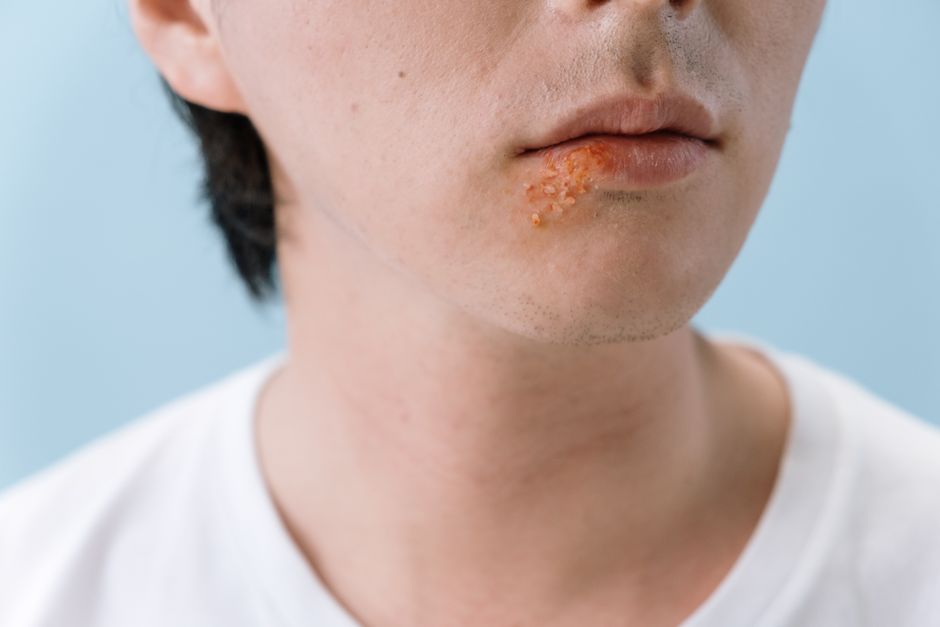
A cold sore on your lip is caused by the herpes simplex virus type 1 (HSV-1). Once you are infected, the virus stays in your body for life, hiding in nerve cells near your face. It can reactivate and travel back to your lip, causing a new blister to form.
What Causes A Cold Sore On Your Lip?
The short answer is the herpes simplex virus. Most cold sores come from HSV-1, which is different from HSV-2, the type usually linked to genital herpes. You likely picked up the virus as a child through casual contact like kissing a relative or sharing a cup.
Once the virus enters your body, it moves to a cluster of nerves near your ear called the trigeminal ganglion. There it stays inactive. For most people, this causes no problems at all. For others, the virus wakes up periodically and causes a cold sore.
When the virus reactivates, it travels down the nerve fibers to the skin of your lip. There it reproduces, killing skin cells and creating the familiar blister. This process takes about 48 hours from the first tingle to the visible sore.
Why Does The Virus Reactivate?
The virus does not reactivate randomly. It responds to stress on your body. The most common triggers are well documented by research.
- Illness and fever — a cold, flu, or any infection that raises your temperature
- Sun exposure — ultraviolet light on the lips is a strong trigger
- Stress — both emotional and physical stress weaken immune control
- Hormonal changes — menstruation is a common trigger in women
- Fatigue — lack of sleep lowers your immune response
- Lip trauma — dental work, cuts, or chapped lips
Your immune system normally keeps the virus in check. When something suppresses that immune control, even briefly, the virus takes the opportunity to replicate. This is why cold sores often appear when you are already feeling run down.
What Does A Cold Sore Look Like And How Long Does It Last?
A cold sore follows a predictable pattern. It starts with a tingling, burning, or itching sensation on your lip. Within a day or two, small fluid-filled blisters form. These blisters may merge into one larger sore.
After a few days, the blisters burst and weep clear fluid. This is the most contagious stage. A crust then forms over the sore. The crust cracks and may bleed, which can be painful. Eventually the crust falls off, and the skin heals.
The entire process takes about 7 to 10 days from first symptom to complete healing. The first outbreak you ever have is often the worst and may last up to two weeks. Recurrent outbreaks are usually milder and shorter.





Are Cold Sores Contagious?
Yes, cold sores are highly contagious. The virus spreads through direct contact with the blister fluid or saliva. You can pass it to someone else by kissing, sharing utensils, sharing lip balm, or touching your sore and then touching someone else.
You are most contagious when the blisters are visible and weeping. However, the virus can shed in saliva even when you have no visible sore. This is called asymptomatic shedding. It means you can potentially pass the virus to others without knowing it.
Once the sore is fully crusted over and healing, the risk of transmission drops significantly but does not completely disappear until the skin is fully healed.
How Is A Cold Sore Treated?
Antiviral medications can shorten the duration of a cold sore. These work best when started at the very first sign of a tingle, before the blister appears. They do not cure the virus or prevent future outbreaks, but they reduce the severity and length of the current one.
Common antiviral drugs include acyclovir, valacyclovir, and famciclovir. These are available as prescription pills or topical creams. Some topical antiviral creams are available over the counter. Prescription oral antivirals are generally more effective than topical creams.
For people with frequent outbreaks, doctors sometimes prescribe daily antiviral medication to suppress the virus. This is called suppressive therapy. It can significantly reduce the number of outbreaks and the amount of viral shedding.
Over-the-counter creams containing docosanol can also help. These work by preventing the virus from entering healthy cells. They are less potent than prescription antivirals but can shorten healing time by about half a day to a day when used early.
Home remedies like ice packs, aloe vera, or tea tree oil are popular but have limited evidence. Ice can numb the area and reduce swelling. There is no strong clinical evidence that herbal remedies shorten outbreak duration. If you use them, do not let them replace proven antiviral treatment.
Can You Prevent Cold Sores?
You cannot eliminate the virus from your body. Once you have HSV-1, you have it for life. But you can reduce how often outbreaks happen.
Identify your personal triggers. If sun exposure causes your outbreaks, use lip balm with SPF daily. If stress is your trigger, focus on sleep and stress management. If illness triggers outbreaks, be extra careful about lip protection when you are sick.
If you get more than six outbreaks per year, talk to your doctor about suppressive antiviral therapy. Taking a daily antiviral pill can cut outbreak frequency dramatically. Many people on suppressive therapy go months or years without a single cold sore.
When Should You See A Doctor?
Most cold sores resolve on their own and do not require medical attention. However, some situations warrant a doctor visit.
- The sore does not heal within two weeks
- You have frequent outbreaks that disrupt your life
- The sore spreads to your eyes or other parts of your face
- You have a weakened immune system from medication or illness
- The pain is severe or the area becomes infected with bacteria
Cold sores on the eye are especially dangerous. The virus can infect the cornea and cause scarring that threatens vision. If you feel a sore forming near your eye, seek medical care immediately.
Common Myths About Cold Sores
There is a lot of misinformation about cold sores. One common myth is that cold sores are caused by poor hygiene. They are not. The virus is extremely common and easily transmitted. Getting a cold sore does not mean you are unclean.
Another myth is that only certain people get cold sores. In reality, most adults worldwide carry HSV-1. Many simply never have visible outbreaks. You cannot assume someone without cold sores is uninfected.
Some people believe cold sores are the same as canker sores. They are not. Canker sores are shallow ulcers inside the mouth, on the cheeks or gums. They are not caused by a virus and are not contagious. Cold sores appear on the lips or around the mouth and are caused by HSV-1.
There is also a myth that herpes medication cures the infection. It does not. Antiviral drugs suppress the virus but never eliminate it from your body. The virus remains dormant in your nerve cells for life.
Frequently Asked Questions
Can stress alone cause a cold sore?
Stress alone does not cause the initial infection, but it is a well-documented trigger for reactivating the virus in people who already carry it. Managing stress can reduce outbreak frequency.
Are cold sores a sign of a weakened immune system?
Occasional cold sores are normal and do not indicate a serious immune problem. Frequent, severe, or prolonged outbreaks can sometimes signal an underlying immune issue and are worth discussing with a doctor.
Can you get a cold sore from sharing a towel?
The virus does not survive long on dry surfaces, so towel transmission is unlikely but not impossible if the towel is damp and used immediately after someone with an active sore. Direct skin contact and shared lip products are far more common transmission routes.
Will a cold sore leave a permanent scar?
Most cold sores heal without leaving a permanent scar. Scarring is more likely if you pick at the scab, if the sore becomes infected with bacteria, or if you have darker skin that is prone to post-inflammatory hyperpigmentation.
