
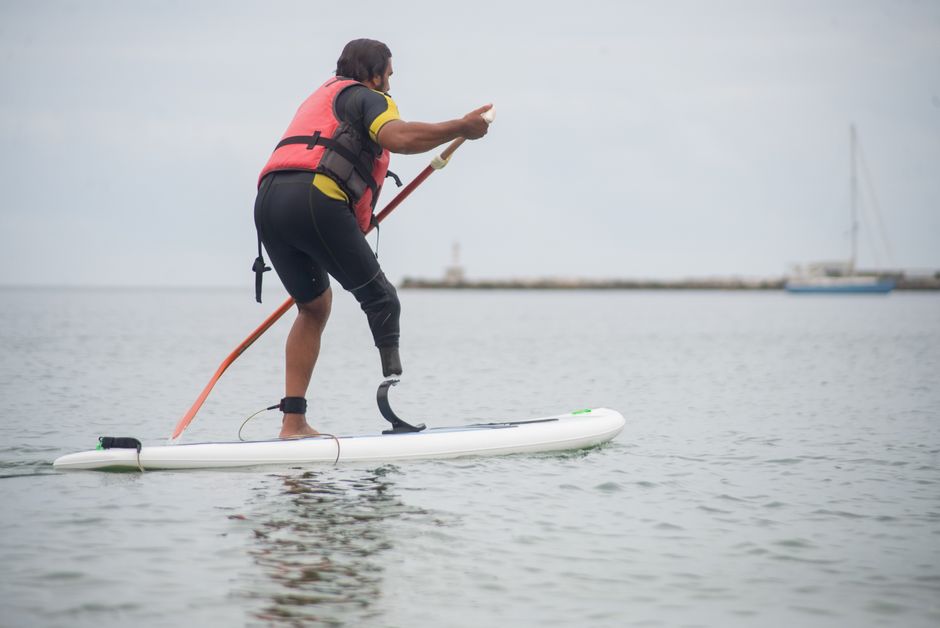
Paddle boarding looks harder than it is. You stand on a large, stable board, hold a long paddle, and move across calm water at your own pace. Most beginners can stand up and paddle forward within their first session on flat water, though staying on your knees for the first few minutes is a smart way to get your balance before you rise.
Learning to use a paddle board comes down to a few basics: get on the board from shallow water, keep your feet centered, bend your knees, and look at the horizon instead of your feet. The rest is practice. This guide covers what you need to know to start safely and avoid the mistakes that make beginners fall in.
What Equipment Do You Need to Start Paddle Boarding?
You need four things: a board, a paddle, a leash, and a personal flotation device. Everything else is optional.
The two main board types are inflatable and hard (solid). Inflatables are the more common choice for beginners. They pack down, travel easily, and are generally more forgiving to fall onto. When inflated to the manufacturer’s recommended pressure, a quality inflatable feels firm and stable. Hard boards glide a little faster and track straighter, but they cost more and need a roof rack or truck bed to move.
Board size matters more than brand for a beginner. Wider and thicker boards are more stable. A board in the range of roughly 10 to 11 feet long and about 32 inches wide is a common starting point for average-sized adults, but the right size depends on your weight and height. Board manufacturers publish weight capacity for each model, and staying within that range matters. A board that is overloaded sits low in the water and becomes unstable.
The paddle should be about 8 to 10 inches taller than you when you stand it upright on the ground. Many paddles adjust, so you can fine-tune the length once you are on the water.
A leash connects your ankle to the board. On flat water, use a straight or coiled leash. On moving water like a river, a quick-release leash is the safer choice because a standard leash can snag on debris. A properly fitted life jacket (the US Coast Guard calls these personal flotation devices, or PFDs) is essential. In many locations it is legally required. Even where it is not, wear one.
How Do You Get On and Balance on a Paddle Board?
Start in shallow, calm water. Carry the board into water about knee-deep, then place it parallel to the shore with the fin pointing out toward deeper water.
Get on in this order:
- Hold the board steady with one hand on each side.
- Place one knee in the center of the board, just behind the carry handle.
- Bring your other knee up so you are kneeling on all fours.
- Sit back on your heels and find your balance before moving.
The carry handle sits at the balance point of the board. Keeping your weight near it is the single most useful positioning rule. If you drift too far toward the nose or tail, the board tips.
When you are ready to stand, place the paddle across the board in front of you and grip it with both hands. Push up from a kneeling position one foot at a time, keeping your feet about hip-width apart and parallel. Do not stand with your feet in a line like a surfer — that is for waves, not flat water. Keep your knees slightly bent. Locked knees make you stiff and easier to tip.
Look at the horizon, not your feet or the water directly in front of you. Your balance system relies heavily on your eyes. Looking down makes almost everyone wobble. This is one of those small adjustments that changes everything.
If you feel unsteady, drop back to your knees. There is no penalty for kneeling. Many experienced paddlers kneel in wind or chop.
How Do You Hold the Paddle and Paddle Forward?
Hold the paddle with one hand on the top handle (the T-grip) and the other hand lower on the shaft. The lower hand should be roughly halfway down the shaft. If you are paddling on your right side, your right hand is low and your left hand is on top.
Reach forward and place the blade fully in the water near the nose of the board. Pull the blade back toward your feet. Do not pull with your arm alone. The power comes from your torso — you rotate your hips and shoulders into the stroke, similar to how you would row. Arm-only paddling tires you out fast and is a common beginner mistake.
Take several strokes on one side, then switch. To switch, slide your top hand down and your bottom hand up the shaft, or simply move the paddle to the other side and reverse your grip. Most beginners switch every 4 to 6 strokes.
To steer, paddle in a sweeping arc away from the board instead of straight back. To turn quickly, take a wide backward sweep on one side. To slow down or stop, drag the blade in the water beside you or step back slightly and press the paddle down behind you.
Keep your strokes long and smooth. Short, choppy strokes waste energy and move you less.




Where Should Beginners Paddle?
Choose flat, calm water with little boat traffic. Lakes, protected bays, and calm inlets are good starting points. Avoid rivers with current, ocean surf, and areas with strong wind until you have more experience.
Wind is the factor beginners underestimate most. Paddling into a headwind is far harder than paddling on a still day, and offshore wind can push you away from shore faster than you can paddle back. Check the wind forecast before you go, and paddle into the wind on your way out so it helps you home.
Stay close to shore on your first few outings. Pick a launch point with easy access and no obstacles. Avoid crowded swimming areas.
Water temperature matters as much as air temperature. Cold water can cause a gasp reflex and rapid loss of muscle control if you fall in unexpectedly. If the water is cold, dress for the water, not the air — a wetsuit or drysuit is appropriate. This applies even on a warm, sunny day.
What Are the Most Common Beginner Mistakes?
Most beginner problems come from a short list of habits.
- Looking down. This is the top cause of wobbling. Keep your eyes on the horizon.
- Standing too far forward or back. Stay centered over the carry handle.
- Paddling with arms only. Use your torso to power the stroke.
- Going out in wind or chop too soon. Flat water first, always.
- Skipping the leash or life jacket. Both are basic safety equipment, not optional add-ons.
One more: many beginners grip the paddle too tightly and hold their breath while concentrating. Relax your grip and breathe normally. Tension makes balance harder, not easier.
Is Paddle Boarding Safe for Beginners?
Paddle boarding is generally a low-injury activity when done on calm water with proper equipment, but it is not risk-free. Drowning is the most serious risk, and it is strongly associated with not wearing a life jacket. Wear one every time.
Falls are common and usually harmless on flat water. The bigger dangers are environmental: cold water, fast currents, offshore wind, and boat traffic. Learning to fall safely helps — fall away from the board and try to land flat rather than diving. Avoid falling onto the fin.
People with certain health conditions, recent injuries, or balance disorders should talk to a doctor before starting. Paddle boarding requires shoulder, core, and leg strength, and it involves the risk of falling into water. If you are unsure whether it is appropriate for you, that is a question for a clinician, not a general guide.
Take a lesson if you can. Many outfitters offer beginner classes, and a single session with an instructor can shorten the learning curve considerably and teach you local water safety.
Frequently Asked Questions
How long does it take to learn paddle boarding?
Most people can stand and paddle forward on calm water within their first session, often in under an hour. Comfort and confidence build over several outings, especially in wind or chop.
Can you paddle board if you can’t swim?
You should be a confident swimmer before paddle boarding, because falling in is a normal part of the activity. A life jacket helps but does not replace swimming ability.
Do you stand or sit on a paddle board?
You can do both. Beginners often start kneeling or sitting for stability, then stand once they feel balanced. There is no rule that you must stand.
What should I wear paddle boarding?
Wear quick-drying clothing and dress for the water temperature, not the air temperature. Add a wetsuit or drysuit in cold water and always wear a properly fitted life jacket.
