
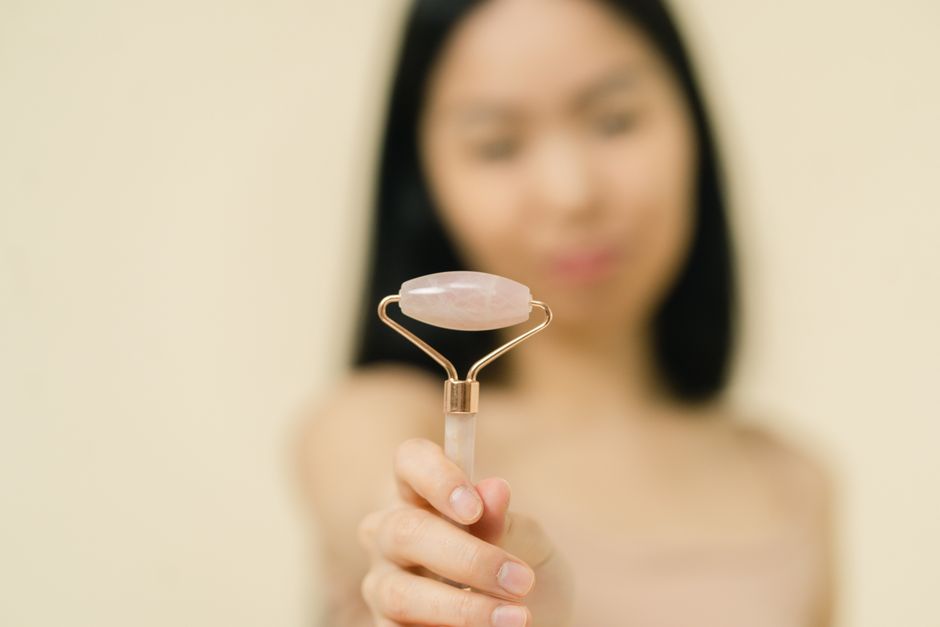
You use a jade roller by rolling a chilled stone tool across clean, moisturized skin in upward and outward strokes, starting at the center of your face and working toward your hairline. Gua sha works differently: you hold a flat stone at a low angle and glide it along the contours of your face with light pressure, following the same outward direction. Both tools are used on clean skin with some kind of slip — a facial oil, serum, or moisturizer — and both take about three to five minutes per session. That is the short answer. The rest of this article explains how to do each one, why the technique matters, and what these tools can and cannot do for your skin.
What Do Jade Rollers and Gua Sha Tools Actually Do?
They massage your face. That is the honest description.
The visible effects come from two things: the physical movement of tissue and the cold temperature of the stone. Massage increases local blood flow to the skin, which can make your face look temporarily brighter and slightly less puffy. Cold constricts blood vessels near the surface, which can reduce the look of swelling for a short time. These effects are real but short-lived — usually minutes to a few hours, not days.
What these tools do not do is change your skin’s structure. They do not dissolve fat, build collagen, or permanently lift sagging tissue. Any claim that a stone can reshape your jawline or erase wrinkles is not supported by clinical evidence. The skin’s deeper layers — where collagen and elastin live — sit well below what a rolling stone can reach.
There is one exception worth knowing about. Gua sha as a technique has been studied in a broader context for musculoskeletal pain, not facial cosmetic use. That research involves different tools, different pressure, and different body areas. It does not transfer directly to rolling a stone across your cheeks.
How To Use A Jade Roller And Gua Sha On Your Face Step by Step
Order matters. Do the roller first, then gua sha, then finish with your usual skincare.
Start with clean skin. Wash your face and pat it dry. Apply a facial oil, serum, or moisturizer — something with enough slip that the stone glides instead of dragging. Dry skin plus a stone equals friction, and friction is how you irritate your face.
Chill the tools if you want the de-puffing effect. A few minutes in the refrigerator is enough. Do not freeze them. Frozen stone on skin can cause discomfort and, in rare cases, cold injury.
Roll in one direction. Begin at the center of your face — beside your nose or at your chin — and roll outward and upward toward your ears and hairline. Use light pressure. The goal is a gentle sweep, not a deep press. Repeat each stroke a few times, then move to the next area.
Work in zones. A simple order that covers the whole face:
- Jaw and chin, rolling toward the ears
- Cheeks, rolling from the nose outward
- Under the eyes, rolling from the inner corner outward — very light pressure here
- Forehead, rolling from the center up toward the hairline
- Neck, rolling downward toward the collarbone
Then switch to gua sha. Hold the flat edge of the stone at a low angle — close to parallel with your skin, not perpendicular. Glide along the same paths you just rolled, using slightly more pressure than the roller but still gentle. Three to five strokes per area is typical.
Finish with your normal routine. Wipe off excess oil if you need to, then apply moisturizer or sunscreen as usual.
Does the Direction You Roll Actually Matter?
Not the way most people think.
The popular claim is that rolling upward and outward “drains lymph” and that rolling downward pushes fluid the wrong way. The lymphatic system does drain toward the neck and collarbone, and gentle massage can support that movement. But the idea that a specific stroke direction on your face produces a measurable, lasting change in lymph drainage is not well established. The evidence for facial massage affecting lymph flow is thin.
What upward and outward strokes do accomplish is consistency. You cover the whole face evenly. You avoid tugging skin downward, which is gentler on the tissue. And you avoid the one direction that genuinely causes problems: dragging hard in any direction.
So follow the upward-and-outward pattern because it is gentle and organized, not because the alternative is harmful. The pressure you use matters far more than the compass direction.





Which Tool Should You Use — Roller, Gua Sha, or Both?
They are not interchangeable, but they overlap more than the marketing suggests.
A roller is easier to use and harder to get wrong. The handle gives you control, and the rolling motion is self-limiting — you cannot press very hard without it feeling obvious. It is a reasonable starting point if you have never used facial tools before.
Gua sha gives you more control over pressure and angle, which means more room to do it well and more room to do it badly. The flat edge can cover broader areas of the face in fewer strokes. It also requires more attention to technique.
Using both is fine. There is no clinical reason to believe the combination produces better results than either one alone. If you only want to buy one, pick whichever you will actually use consistently — because the temporary effects fade within hours, and the only way to see them regularly is to do it regularly.
What Are the Risks and Who Should Skip These Tools?
For most people with healthy skin, gentle use is low risk. The problems come from pressure, frequency, and skin conditions.
Active acne, cysts, or open sores. Rolling or scraping over inflamed skin can spread bacteria and worsen irritation. Wait until the area has healed.
Rosacea or very reactive skin. Facial massage and cold can trigger flushing in some people. If your skin flushes easily, test a small area first.
Eczema, psoriasis, or dermatitis. Broken or inflamed skin barriers do not respond well to friction. Skip these tools during a flare.
Recent cosmetic procedures. After fillers, Botox, chemical peels, or laser treatments, the skin and underlying tissue need time to settle. Ask your provider when it is safe to resume facial massage. There is no single standard timeline that applies to everyone.
Blood thinners or easy bruising. Gua sha in particular can cause bruising if you press too hard. Keep pressure very light, or skip it.
Any mole or spot that has changed. Do not massage over it. See a dermatologist.
One more practical point: clean your tools. Stone is porous, and oil, skin cells, and bacteria collect on the surface. Wash with mild soap and warm water after each use, and dry them fully.
What Results Can You Realistically Expect?
Expect a temporary effect, not a transformation.
Right after a session, your face may look slightly less puffy and a bit more even in tone. That is the blood flow and the cold at work. It typically fades within a few hours. If you use these tools most days, you may notice the effect lasts a little longer or shows up more reliably — but this is about consistency of a temporary effect, not cumulative skin change.
What you should not expect: smaller pores, fewer wrinkles, a sharper jawline, or fat loss. No clinical evidence supports those outcomes from facial rolling or gua sha.
If puffiness is a persistent problem rather than an occasional morning thing, that is worth a doctor’s attention. Facial swelling can have medical causes, including thyroid, kidney, and allergic conditions. A stone tool will not address those.
Frequently Asked Questions
How often should I use a jade roller and gua sha?
Most people use them once daily, often in the morning when puffiness is most noticeable. There is no established clinical guideline on frequency, so use them as often as your skin tolerates comfortably.
Should I use a jade roller on dry skin?
No. Always apply a facial oil, serum, or moisturizer first so the stone glides without dragging. Rolling on dry skin creates friction that can irritate your face.
Can gua sha actually slim your face or jawline?
No. Gua sha can reduce the look of temporary puffiness, which may make your face appear slightly less swollen for a few hours. It does not reduce fat or change bone structure.
Do I need to chill a jade roller before using it?
Chilling is optional but can enhance the temporary de-puffing effect. A few minutes in the refrigerator is enough — do not freeze it, since frozen stone on skin can cause discomfort.
