
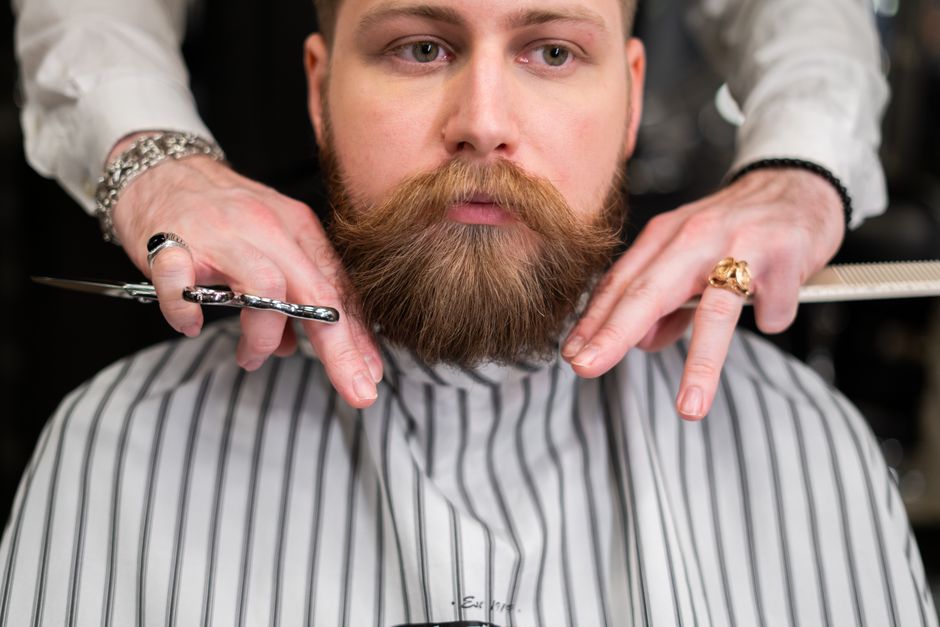
Trimming your own hair at home comes down to four things: cutting less than you think you should, working with your hair’s natural growth pattern, using the right tool for each section, and checking your work with a second mirror. Most men can maintain a short haircut at home with clippers and a few basic techniques. The learning curve is real — your first attempt will not match a barber’s work — but the skills improve quickly with practice.
What You Need Before You Start Cutting
Good results start with preparation, not technique. Gather everything before you make the first cut so you are not stopping halfway through with hair on the floor.
- Clippers with adjustable guard attachments (sizes 1–8 cover most short styles)
- Hair scissors — sharp, dedicated to hair only
- Comb with fine and wide teeth
- Spray bottle filled with water
- Hand mirror plus access to a wall mirror
- Cape or old towel to protect your clothes and catch clippings
- Good lighting — overhead plus a lamp you can angle toward your head
Wet hair appears longer than it is. If you cut wet, you may remove more than intended once it dries and springs back. For clipper work, dry hair gives you a more accurate picture of the final length. For scissor work on longer sections, slightly damp hair is easier to control.
How Do You Set Up for Your First Self Haircut?
Set up in a bathroom or garage where you can stand in front of a large mirror with a hand mirror behind you. This two-mirror setup is how you see the back of your head. Without it, you are cutting blind.
Part your hair the way you normally wear it. Look at your current shape and decide what you are actually trying to achieve — a clean-up of the same style, or a shorter length overall. Be specific. “Shorten the sides, leave the top alone” is a plan. “Make it shorter” is not.
Start with the longest guard you think you need. You can always go shorter. You cannot put hair back. This is the single most important rule in self-cutting.
How To Trim Your Own Hair For Guys: Step by Step
Work in this order: sides and back first, then the top, then blending, then detail work. This sequence lets you see the overall shape develop before you commit to anything on the more visible top section.
Step 1: Cut the sides and back with clippers
Attach your starting guard. For a typical short taper, that might be a size 3 or 4 on the sides. Move the clippers upward from the bottom of your neck and sides, against the direction of hair growth. Use slow, overlapping strokes. Overlap each pass by about half the width of the clipper blade so you do not leave strips of uncut hair.
For the back, use your free hand to feel the shape as you go. Your fingers can detect uneven patches that your eyes miss through the mirror.
Step 2: Create the fade or blend
A fade is a gradual transition from short at the bottom to longer at the top. To create it, switch to progressively shorter guards as you move down the sides and back. Change guards in small increments — one size at a time — and blend each zone into the one above it.
Blending is the hardest part to learn. Move the clippers in a rocking motion at the transition line, flicking outward as you reach the boundary between two lengths. This softens the line so there is no visible step. Expect your first few attempts to show some hard lines. That improves with repetition.
Step 3: Trim the top with scissors
Comb a section of hair up between your index and middle fingers. Hold the hair between your fingers and cut above them. Your fingers act as a guide that keeps the length consistent. Work in small sections, moving across the top of your head.
Cut less than you think you need on the first pass. Comb the section back down, check the length, and decide whether to take more. For a basic trim, removing a small amount at a time gives you control.
If you want texture or a more natural finish on top, cut into the ends with the tips of your scissors rather than straight across. This avoids a blunt, helmet-like edge.
Step 4: Check for missed spots
Put down the clippers and look at your whole head from multiple angles. Use the hand mirror to check the back. Run your fingers over your scalp to feel for patches you missed. Look at the hairline around your ears and neck — these areas often need attention.
Check in natural light if possible. Bathroom lighting can hide uneven areas that show up clearly in daylight.
Step 5: Clean up the edges
Use the clippers without a guard, or with a very short guard, to clean the neckline and around the ears. For the neckline, a common approach is to create a gentle curve rather than a straight line — a straight line across the back of the neck can look harsh and grows out awkwardly.
Some men use a razor for the cleanest neckline. If you do, shave with the grain to reduce irritation, and apply a small amount of shaving cream or gel first.





What Mistakes Do Most Beginners Make?
The most common mistake is cutting too much too fast. Hair grows roughly half an inch per month on average, so a cut that removes too much takes weeks to correct. Patience is not optional here.
Other frequent problems:
- Cutting wet hair with clippers — wet hair clumps and can clog guards, leading to uneven cutting
- Skipping the guard change — using the same length everywhere produces a flat, unshaped result
- Not overlapping clipper passes — leaves visible lines and strips
- Ignoring the back of the head — the hardest area to see and the most likely to be uneven
- Cutting against the natural growth pattern — can cause the hair to stick up or lie flat in unwanted ways
Hair growth patterns vary. Some men have cowlicks or whorls that make certain sections grow in unexpected directions. Working with these patterns rather than against them produces a cleaner result. If you have a strong cowlick, cut that section slightly longer and blend it into the surrounding hair.
When Should You Stop and See a Barber?
Self-cutting works well for maintenance between professional cuts. It is less reliable for major style changes, complex fades, or significant length removal. If you want to go from long hair to a completely different short style, a barber is the better starting point.
If you have a special event coming up, do not experiment with a new technique the day before. Give yourself at least a week to fix any mistakes. And if you are genuinely unhappy with the result, a barber can often correct an uneven self-cut without having to shave everything off.
There is no clinical risk in cutting your own hair, but there is a practical one: clipper blades can pull or nick skin if they are dull or if you press too hard. Keep blades clean and oiled, and let the clippers do the work rather than pushing them into your scalp.
Frequently Asked Questions
Can you cut your own hair with just clippers?
Yes, for short styles and maintenance cuts, clippers alone can produce a clean result. Scissors are needed if you want to trim longer sections on top or add texture.
Should you cut your hair wet or dry?
Dry hair gives a more accurate final length with clippers because wet hair appears longer than it is. Slightly damp hair is easier to manage with scissors on longer sections.
How do you fade your own hair at home?
Start with a longer guard at the top of the fade zone and switch to shorter guards as you move down, blending each section into the one above with a rocking motion. It takes practice to get smooth transitions.
How often should you trim your hair?
For short cuts, every two to four weeks maintains the shape. Hair grows roughly half an inch per month on average, so timing depends on how quickly your hair grows and how short you keep it.
