
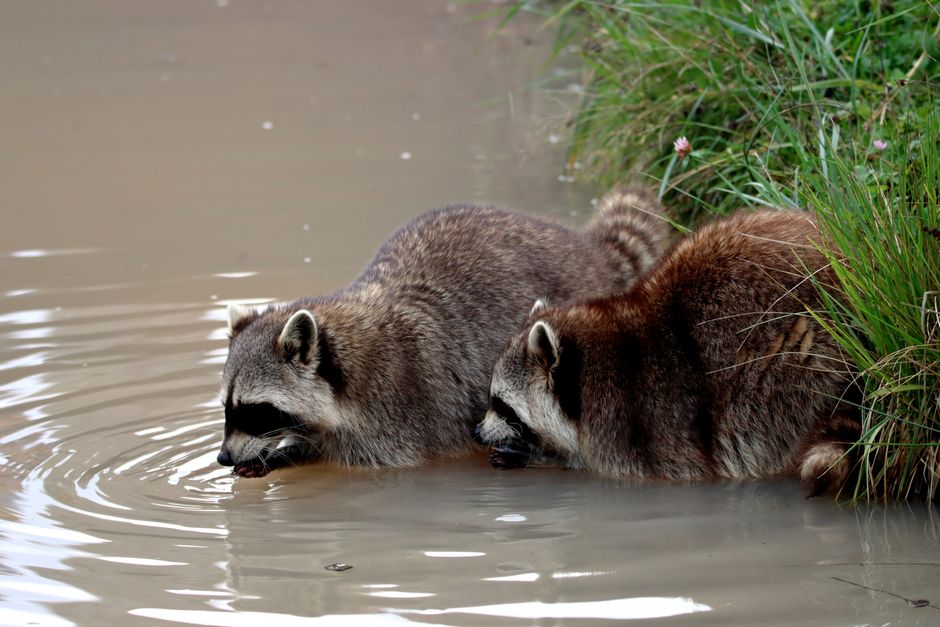
To tell if a raccoon is a boy or girl, look at the distance between the anus and the urinary opening. In males, the gap is about an inch or more, and the testicles may be visible below the penis. In females, the anus and urinary opening are very close together, almost touching, with a visible vaginal opening just below the anus. This method works best on adult raccoons or older juveniles.
What is the main physical difference between male and female raccoons?
The most reliable way to tell a male raccoon from a female is the distance between the anus and the genital opening. In males, this distance is noticeably larger because the penis is located farther from the anus. In females, the anus and the urogenital opening are very close together — often less than half an inch apart.
If you see a small bump or bulge under the tail that is separate from the anus, that is the penis of a male. Females have a single opening (the urogenital opening) directly below the anus, with no gap in between.
Can you tell by the presence of testicles?
Yes, but only during certain times of year. Male raccoons have testicles that descend into the scrotum outside the body cavity. During the breeding season, which runs from January through March in most of North America, the testicles are clearly visible as two almond-shaped lumps below the penis.
Outside of breeding season, the testicles may retract closer to the body and become harder to see. In juvenile males, the testicles are small and may not be noticeable at all until they reach about 5–6 months of age.
How to tell a baby raccoon’s sex
Sexing a baby raccoon (a kit) requires careful examination. The same rule applies — check the distance between the anus and the genital opening — but the differences are much smaller. Use good lighting and a calm, gentle approach. If the animal is very young (under a few weeks), the difference may be subtle, and professional experience often helps.
A safe guide: if you see two distinct openings clearly separated, it is likely a male. If the openings are flush together or nearly touching, it is likely a female. Never squeeze or force the animal. If you are unsure, leave it to a wildlife rehabilitator.





Are there any size or color differences between males and females?
In adult raccoons, males are generally larger and heavier than females. A typical adult male weighs 15–25 pounds, while females usually weigh 10–20 pounds. Males also tend to have broader heads and thicker necks. However, size varies by region, diet, and age, so it is not a reliable way to determine sex on its own.
Coat color and mask patterns are the same in both sexes. You cannot tell a raccoon’s sex by its fur, mask, or tail rings. These traits vary individually, not by sex.
How to tell a raccoon’s sex from a distance or in a photo
From a distance, the most reliable clue is the size difference, but it is not accurate. A large raccoon is likely a male, but a female can also be large. There is no visual indicator on the face or body shape that consistently distinguishes sex without examining the underside.
In a clear photo taken from underneath (such as from a wildlife camera), you can often see the gap between openings. In a side view, a male’s scrotum may be visible as a bulge between the legs during breeding season. Otherwise, sex determination from photos is difficult without a clear ventral view.
Why does it matter to know a raccoon’s sex?
For wildlife rehabilitators, knowing the sex helps in caring for orphaned or injured raccoons. It can also matter for tracking populations, managing nuisance animals, or studying behavior. During spring, a female raccoon may have a litter of kits nearby, so trapping or removing a female could orphan young. Understanding sex can inform humane wildlife management.
For homeowners, telling a male from a female raccoon does not change how you handle nuisance issues. Both sexes can cause damage and carry diseases like rabies or roundworm. Always keep a safe distance and contact wildlife professionals for removal.
Common mistakes when trying to sex a raccoon
A frequent mistake is confusing the anus with the genital opening, especially in females where they are very close. Another common error is assuming a large raccoon is automatically male. Females can be large, especially in northern regions where body size increases with latitude.
People also sometimes mistake the scent glands near the anus for testicles. Raccoons have anal glands that can produce small bumps on either side of the anus. These are present in both sexes, so they should not be used to determine sex.
Is there a behavioral difference?
Behavior is not a reliable way to tell male from female raccoons, especially from a distance. Males tend to be more solitary except during breeding season, and females are more likely to be seen with young. However, both sexes can exhibit aggression when cornered, and both are active at night. Unless you see a female nursing or carrying kits, behavior alone will not give you a confident answer.
Frequently Asked Questions
How can you tell if a raccoon is male or female from a picture?
Look for a clear underside view — a visible gap between anus and genital opening indicates a male, while a close-together pair indicates a female.
Do male raccoons have visible testicles all year?
No. The testicles are most visible during the breeding season (January–March) and may retract or become hard to see during the rest of the year.
Can you tell the sex of a baby raccoon by its face?
No. Facial features, mask, and fur are the same in both sexes. You must examine the underside to determine sex in young raccoons.
Why is it important to know if a raccoon is a boy or girl?
It matters mainly for wildlife rehabilitation and population management — for example, to avoid separating a female from her young during nuisance removal.
