
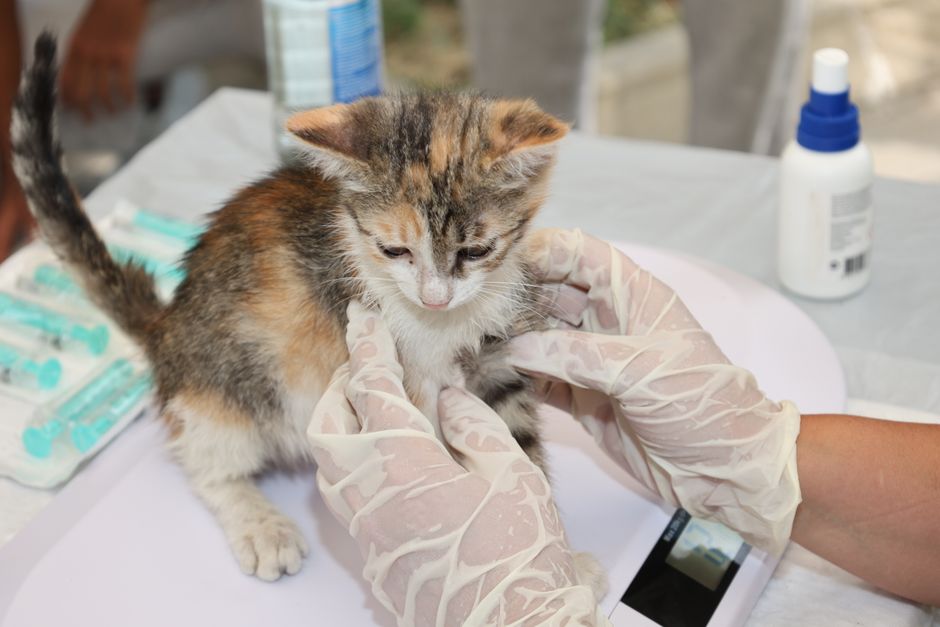
Ear mites are one of the most common reasons a kitten scratches at its ears, and the signs are usually visible once you know what to look for. The classic picture is intense scratching, head shaking, and a dark, crumbly discharge in the ear canal that looks a lot like coffee grounds. If you see that combination in a young cat, ear mites should be near the top of your list — but they are not the only cause, and confirming the diagnosis usually takes a veterinarian.
What Are Ear Mites and Why Do Kittens Get Them So Often?
Ear mites are tiny parasites that live on the surface of the ear canal, feeding on skin debris and earwax. The species that most commonly affects cats is Otodectes cynotis. It is not a worm or an insect you can easily see — an adult mite is roughly the size of a pinpoint, and it is usually pale and moving when viewed under magnification.
Kittens get them so often for a simple reason: mites are contagious between animals, and young cats are frequently exposed. A kitten born to a mother with mites, or housed with other infected cats in a shelter or multi-cat home, can pick them up quickly. The mites do not jump or fly. They spread through close physical contact, and they can survive for a short time away from a host in a warm environment.
One detail worth knowing: ear mites are not limited to the ear canal. They can sometimes be found on the skin around the ears, neck, and tail base, which is part of why an infestation can cause itching beyond the ears themselves.
How To Tell If A Kitten Has Ear Mites — The Main Signs
The most recognizable sign is a dark, dry, crumbly debris inside the ear canal that resembles coffee grounds. This is a mix of earwax, skin cells, blood from tiny scratches, and the mites themselves. It tends to collect in the vertical part of the ear canal, the part you can see when you gently fold the ear back.
Alongside the discharge, watch for these behaviors:
- Frequent scratching at one or both ears, sometimes hard enough to break the skin
- Head shaking or tilting
- Rubbing the ears against furniture or the floor
- Redness or swelling in the ear flap and canal
- Hair loss or scabs around the ears, neck, or base of the tail
- A faint odor from the ear in some cases
The scratching is not random. Mites irritate the ear canal lining, and the resulting inflammation is what drives the intense itch. A kitten with a heavy infestation can scratch almost constantly, and the self-trauma can lead to open sores or a buildup of fluid in the ear flap, a condition called an aural hematoma.
Some kittens show very few signs at first. A mild infestation can smolder quietly, which is one reason mites spread so easily in group settings before anyone notices.
How Can You Check a Kitten’s Ears at Home?
You can look, but you cannot reliably diagnose ear mites at home by eye alone. Here is a reasonable way to check without causing harm.
Work in good light, ideally with a second person gently holding the kitten. Fold the ear flap back and look into the canal. Note the color and texture of anything inside. Coffee-ground debris is suspicious. So is redness, swelling, or a lot of dark wax.
Do not push cotton swabs deep into the canal. You can injure the eardrum or pack debris further in. If you want to sample the surface debris, a soft cotton ball at the opening of the canal is safer than a swab.
You may have heard that you can see mites as tiny white specks that move. In practice, this is unreliable. The mites are very small, and what looks like movement could be a trick of the light. A veterinarian confirms the diagnosis by taking a sample of the debris and examining it under a microscope, where the mites or their eggs are visible.
There is also a home test some people try, involving a cotton ball and a dark surface. It is not a dependable method. If you suspect mites, the microscope exam at a clinic is the step that actually settles the question.





What Else Looks Like Ear Mites in a Kitten?
Several other conditions produce scratching and ear debris, and telling them apart matters because the treatments differ.
Bacterial or yeast infections are common in kittens and can cause discharge, odor, and itching. A yeast infection often produces a darker, sometimes greasy discharge, while bacterial infections can be pus-like. Neither responds to mite treatment.
Allergies, including food and environmental allergies, can make a kitten scratch at its ears and head. The ears may look relatively clean compared to a mite infestation.
Foreign material, such as a grass awn or a piece of debris lodged in the canal, can cause sudden intense scratching, usually in one ear.
Ear polyps or other growths are less common in kittens but can cause head shaking and discharge.
Because these conditions overlap so much in appearance, a visual inspection alone is not enough. A veterinarian can look at the debris under a microscope and, if needed, run additional tests. This is the honest position: you can strongly suspect ear mites at home, but you cannot confirm them without that exam.
What Does Ear Mite Treatment Involve?
Treatment is prescription-based in most cases, and it is not the same as treating a bacterial or yeast infection. Several medications are effective against ear mites, and the choice depends on the kitten’s age, weight, and overall health.
Some treatments are applied directly into the ear canal. Others are given as a spot-on product on the skin or as an injection. Your veterinarian will select based on what is appropriate for a young cat, because not every product is safe for kittens. This is a genuine safety point: some over-the-counter ear products are not labeled for use in kittens, and using the wrong one can cause harm.
Treatment usually needs to cover the full life cycle of the mite, which is why a single application is often not enough. Your veterinarian will give you a schedule. Follow it even if the kitten seems better before the course is finished.
If other pets live in the home, they often need treatment too, even if they show no signs. Mites move between animals, and an untreated pet can reinfect the kitten. Your veterinarian can advise on this.
Cleaning the ears gently before applying medication is often part of the routine. Your veterinarian can show you how to do this safely. Do not use harsh cleaners or home remedies like hydrogen peroxide or oil-based mixtures unless a veterinarian specifically recommends them — some can irritate the canal or mask the problem.
Can Ear Mites Cause Long-Term Problems?
In most cases, uncomplicated ear mite infestations respond well to treatment, and the kitten recovers without lasting damage. The main risks come from delay or from the scratching itself.
Heavy scratching can break the skin and lead to secondary bacterial infections. It can also cause an aural hematoma, a pocket of blood between the ear cartilage and skin that often needs to be drained by a veterinarian. In severe or long-standing cases, chronic inflammation can affect the ear canal, and in rare situations the eardrum or middle ear can be involved.
Kittens with a heavy mite load may also be more prone to other health issues simply because their immune systems are still developing and their overall condition may be poor. That is another reason prompt treatment matters.
The evidence on long-term outcomes is generally reassuring for straightforward cases. The uncertainty lies mainly in how much damage occurs before treatment starts, which varies from kitten to kitten.
How Can You Reduce the Risk of Ear Mites?
Because mites spread through contact, prevention is mostly about managing exposure. If you are bringing a new kitten into a home with other cats, a veterinary check before introduction is a sensible step. Shelters and breeders vary in how thoroughly they screen for mites, so a fresh exam is reasonable even if the kitten looks clean.
Keep bedding and shared spaces clean. Mites do not survive long off a host, but reducing close contact with unknown animals lowers the odds. If one pet in the home is diagnosed, treat all of them as your veterinarian advises.
There is no vaccine for ear mites, and no product guarantees a kitten will never get them. The realistic goal is early detection and prompt treatment when they do appear.
Frequently Asked Questions
What do ear mites look like in a kitten’s ear?
They usually appear as dark, crumbly debris that looks like coffee grounds inside the ear canal. The mites themselves are tiny and hard to see without magnification, so the debris is the more reliable clue.
Can I treat my kitten’s ear mites at home?
Most effective ear mite medications are prescription products, and some over-the-counter options are not safe for kittens. A veterinarian should confirm the diagnosis and choose a treatment appropriate for your kitten’s age and weight.
Are ear mites contagious to other pets or to people?
Ear mites spread easily between cats and can also affect dogs, so other pets in the home often need treatment. Human infestation is rare and not considered a typical concern.
How long does it take for a kitten’s ear mites to clear up?
Improvement is often seen within days of starting treatment, but the full course must be completed because the medication needs to cover the mite life cycle. Your veterinarian will set the exact schedule.
