
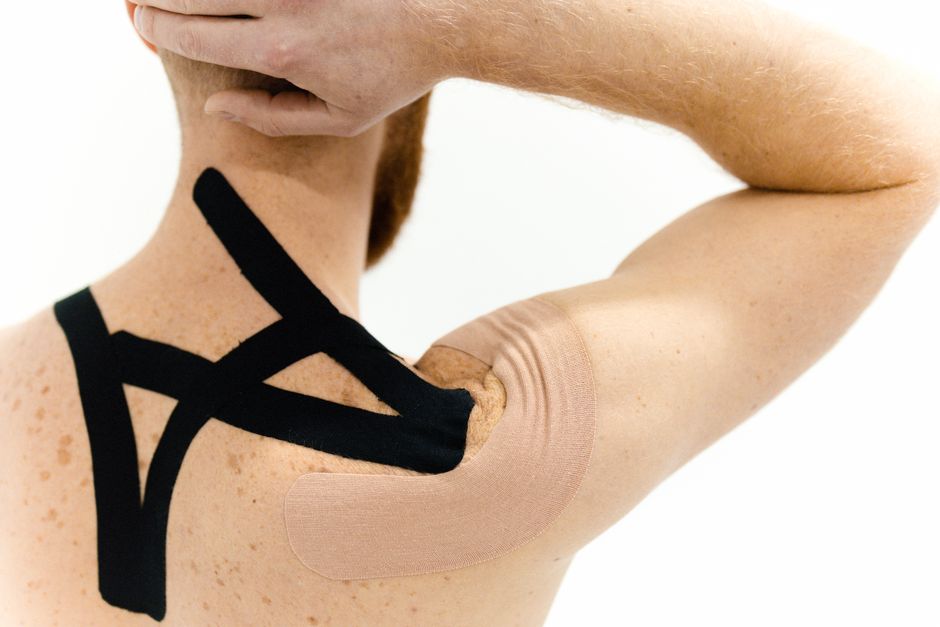
You can tape your own shoulder at home with kinesiology tape or rigid athletic tape, but the method depends on what you are trying to support. Kinesiology tape stretches with your skin and is used for muscle and joint discomfort. Rigid tape holds a joint in a fixed position and is harder to apply correctly without help. For most shoulder pain, kinesiology tape is the more realistic choice for self-application.
Taping does not fix the underlying cause of shoulder pain. It can reduce strain on specific tissues and improve how movement feels. If you have sharp pain, weakness, numbness, or a recent injury, taping is not a substitute for a medical evaluation.
What Does Shoulder Taping Actually Do?
Kinesiology tape is an elastic cotton strip with an acrylic adhesive. It stretches in one direction, and that stretch is the whole point. When applied over a muscle or joint, it can change how the tissue beneath it loads and moves.
The proposed mechanisms are partly mechanical and partly sensory. The tape lifts the skin slightly, which may reduce pressure on nerve endings underneath. It also stimulates skin receptors, which can change how the brain interprets pain signals from the shoulder. Some clinicians describe this as altering proprioception — your sense of where your joint is in space.
What the evidence shows is more modest than marketing suggests. Some studies indicate kinesiology tape can reduce pain scores in the short term for certain shoulder conditions, but results vary and the effect is generally small. A review of shoulder taping research found that benefits were inconsistent across studies and often not better than placebo tape. That does not mean it does nothing. It means the effect is real for some people and unmeasurable for others.
Rigid tape works differently. It is non-elastic and used to limit joint movement, often after dislocation or in cases of instability. Applying rigid tape to your own shoulder is difficult because you need to hold the joint in a specific position while anchoring the tape. Doing it wrong can restrict movement in ways that cause new problems.
How Do You Apply Kinesiology Tape To Your Shoulder By Yourself?
Self-application works best for the front of the shoulder, the top of the shoulder, and the upper arm. The back of the shoulder is hard to reach and hard to see. For those areas, you may need a mirror or a second person.
Here is the general process for a common application over the front and top of the shoulder:
- Clean and dry the skin. No lotion, oil, or sunscreen. Hair should be trimmed, not shaved, in the area you plan to tape.
- Measure the tape before cutting. For a shoulder strip, cut a piece long enough to run from the upper chest, over the front of the shoulder, and toward the back of the upper arm. Round the corners of the tape to reduce peeling.
- Position your arm where you want it during wear. If you want more range of motion, place your arm in a relaxed, slightly raised position. If you want more support, keep the arm closer to your side. The position of your arm when you apply the tape determines how much stretch it will have when you move.
- Peel a few inches of backing and anchor the tape at one end without stretching that anchor. Press it down firmly.
- Apply the rest of the tape with light stretch — roughly 10 to 25 percent — along the muscle you are targeting. Do not stretch the last few inches either. Those anchors hold the tape in place.
- Rub the tape firmly for 10 to 15 seconds. Friction and heat activate the adhesive.
You can also apply a simple strip over the top of the shoulder, from front to back, to support the deltoid and upper trapezius. This is easier to reach and easier to see in a mirror.
Kinesiology tape typically stays on for three to five days. It can get wet in the shower. Pat it dry rather than rubbing it. If it starts to peel at the edges, trim the loose part rather than pulling it off and reapplying.
Which Type Of Tape Should You Use?
Kinesiology tape and rigid athletic tape are not interchangeable. They do different things and suit different situations.
| Feature | Kinesiology Tape | Rigid Athletic Tape |
|---|---|---|
| Stretch | Elastic, stretches along the length | Non-elastic or minimally elastic |
| Main purpose | Support movement, reduce discomfort, sensory feedback | Limit joint movement, provide mechanical stability |
| Self-application difficulty | Moderate — front and top of shoulder are reachable | High — hard to apply correct tension alone |
| Wear time | Typically 3–5 days | Usually removed after activity or within a day |
| Best for | General shoulder discomfort, overuse, mild strain | Acute injury support under clinical guidance |
Some people use both. A rigid tape may be applied first for stability, with kinesiology tape over it for comfort. That approach is usually done by a clinician, not at home.





What Shoulder Problems Can Taping Help With?
Taping is most commonly used for rotator cuff discomfort, shoulder impingement symptoms, and general overuse pain. It is also sometimes used during rehabilitation after injury to support gradual return to activity.
The evidence is strongest for short-term pain reduction during movement. Studies on kinesiology tape for shoulder pain often measure pain during specific tasks, like reaching overhead or lifting. Some people report less pain during those movements while wearing tape. Whether that translates into faster recovery or better long-term outcomes is not well established.
For rotator cuff tendinopathy, taping is sometimes used alongside exercise therapy. The exercise is doing the real work of strengthening the tendon. The tape may make movement feel better so you can do the exercises. It is not replacing them.
For frozen shoulder, taping has limited evidence. The condition involves progressive stiffening of the joint capsule, and tape cannot change that process. Some clinicians use it for comfort, but it is not a primary treatment.
For shoulder instability or dislocation, do not rely on self-applied tape. Those situations need proper assessment and often structured bracing or rehabilitation.
When Should You Not Tape Your Shoulder?
Do not tape over broken skin, rashes, moles, or areas of active infection. Do not tape if you have a known allergy to acrylic adhesives. If you have sensitive skin, test a small piece on your forearm for 24 hours before applying it to your shoulder.
Remove the tape if you notice increasing redness, itching, blistering, or swelling. These can signal a reaction to the adhesive. Some people develop contact dermatitis after repeated use.
Do not use tape to push through pain that is getting worse. If your shoulder pain is severe, waking you at night, or accompanied by weakness or numbness in the arm or hand, see a healthcare provider. Taping is not appropriate for possible fractures, dislocations, or nerve injuries.
People with certain medical conditions — including circulation problems, active cancer in the area, or a history of blood clots — should check with a clinician before using compression or taping techniques.
How Long Should You Keep Taping?
Taping is generally used as a short-term tool, not a permanent solution. Most clinicians suggest using it for days to a few weeks while you work on the underlying issue, whether that is rest, activity modification, or strengthening exercises.
If taping helps, that is useful information. It suggests that external support changes your symptoms. But if you need tape every day for months to function, that is a sign the underlying problem is not resolving and needs proper evaluation.
Some people find that alternating taping days with no-tape days helps them gauge whether they are improving. If pain stays the same or gets worse when the tape is off, the tape is masking a problem rather than helping solve it.
Frequently Asked Questions
Can you tape your shoulder by yourself?
Yes, for the front and top of the shoulder using kinesiology tape. The back of the shoulder is difficult to reach and usually requires help or a mirror.
How long do you leave kinesiology tape on your shoulder?
Kinesiology tape is typically worn for three to five days. Remove it sooner if you notice skin irritation, peeling, or increased pain.
Does shoulder taping actually help pain?
Some studies suggest kinesiology tape can reduce short-term pain during movement, but results vary and the effect is often small. It is best used alongside other treatment, not instead of it.
What tape is best for shoulder pain?
Kinesiology tape is the most practical option for self-application. Rigid athletic tape provides more stability but is hard to apply correctly without help.
