
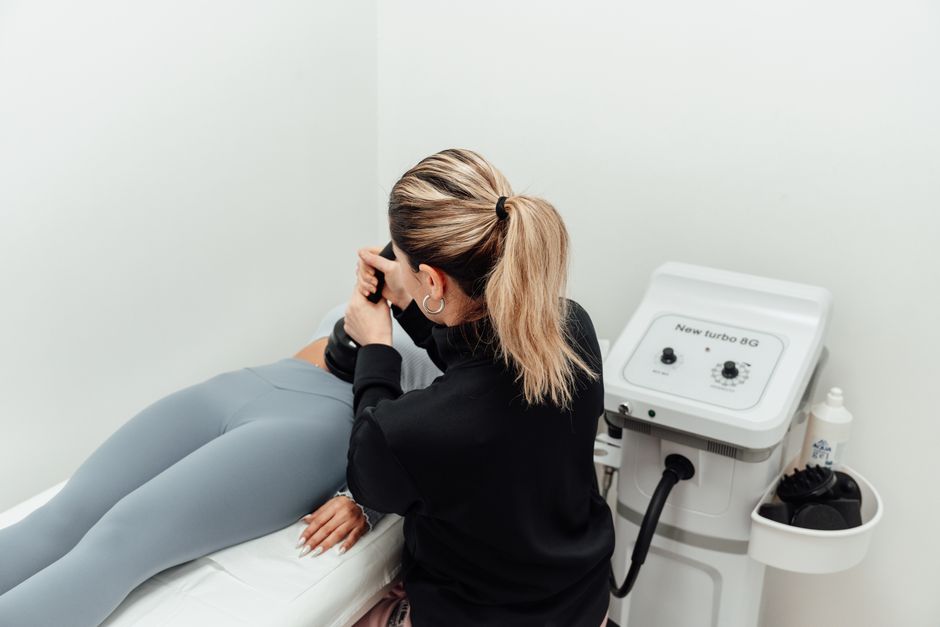
You use a percussion massage device like a Theragun on your back by applying the padded head to the muscles beside your spine — never directly on the spine or bony areas — moving slowly, and keeping the pressure at a level that feels like a firm massage rather than pain. Sessions of about two minutes per area are typical. The device is a massage tool, not a treatment for the cause of back pain, so it works best as one part of a broader plan that includes movement and, when needed, care from a clinician.
If you are reaching for a Theragun because your back aches, that is a reasonable place to start. What matters is knowing what these devices can and cannot do, and how to use one without making things worse.
What Does A Percussion Massage Device Actually Do?
A percussion massager delivers rapid, repeated pulses into muscle tissue. Depending on the device, that is roughly 1,700 to 2,900 pulses per minute, and the head moves in and out a short distance rather than vibrating in place.
The idea behind it is mechanical, not chemical. The tapping action may temporarily reduce muscle tension and change how the tissue feels. Some research suggests percussion therapy can briefly improve range of motion and reduce perceived soreness after exercise. The word to hold onto is briefly. These effects are short-lived and do not correct structural problems in the spine.
There is a limit to what we know here. Many studies on percussion devices are small, and several are funded by manufacturers. That does not make the findings false, but it means claims should be read with care. No large, independent trial has shown that a Theragun treats a herniated disc, spinal stenosis, or arthritis of the spine.
What the evidence does support is a modest, temporary easing of muscle-related discomfort. That is a real benefit for many people. It is just a smaller benefit than the marketing sometimes implies.
Where On Your Back Should You Use It?
You use it on the muscle, not on the bone. The spine is a column of bone with nerves running through and around it. Percussion directly over the spine or the bony knobs you can feel along the center of your back is not appropriate.
Target the large muscle groups that run alongside the spine. These are the erector spinae, the long muscles that help you stand and bend. They sit to the left and right of the bony ridge in the middle of your back. Working these muscles is where a percussion device makes the most sense.
Also reasonable to target:
- The upper back and shoulder blade area, where muscle tension often collects
- The muscles along the lower back, on either side of the spine
- The area between the shoulder blades, avoiding the spine itself
Areas to avoid entirely:
- The spine and the bony points along it
- The neck, where nerves and blood vessels sit close to the surface
- Any area that is bruised, swollen, or recently injured
- Over the kidneys, which sit in the lower back, if you have any kidney condition
If pressing on a spot sends pain shooting down your leg, stop. That pattern can point to nerve involvement, and a massage device is not the tool for it.
How To Use A Theragun On Your Back For Pain Relief
Start with the lowest speed and the softest attachment. Most devices come with several heads. A round, dampened head is a sensible starting point for the back, since it spreads the force over a wider area.
Here is a simple sequence:
- Set the device to its lowest speed setting
- Place the head against the muscle beside your spine, not on it
- Let the device do the work — do not press hard into the tissue
- Move slowly, about an inch per second, over the area
- Spend roughly two minutes on each muscle group
- Breathe normally and keep your back relaxed
Pressure matters more than speed. The device should feel like a strong but comfortable massage. If you find yourself tensing up or holding your breath, ease off. Pain is a signal to stop, not to push through.
Reaching your own back can be awkward. Many people cannot comfortably hold a device on their mid or upper back without help. Using a wall or a chair to brace the device, or having someone else apply it, can make the process easier and safer.
If you have a back condition, a recent injury, or you are not sure whether percussion is appropriate for you, ask a clinician or physical therapist first. This is not a case where you should guess.





How Often Should You Use It?
There is no official guideline that sets a frequency for percussion massage on the back. That is an honest limitation. Clinical guidelines exist for exercise, physical therapy, and medication for back pain. They do not exist for how often to run a massage gun.
What is generally described in product instructions and clinical practice is short sessions — often a couple of minutes per area — once or twice a day when you are sore. More is not better. Overworking an area can leave it tender.
Watch for signs you are overdoing it:
- Increased soreness that lasts more than a day
- Bruising or skin irritation
- Numbness or tingling that was not there before
If any of these appear, stop and let the area rest. If symptoms persist, see a clinician.
When A Theragun Is Not The Right Answer
Back pain has many causes, and a massage device addresses only muscle-related discomfort. Some situations call for medical care instead.
Seek care promptly if you have:
- Pain that follows a fall or injury
- Weakness, numbness, or loss of control in your legs
- Loss of bladder or bowel control
- Fever along with back pain
- Unexplained weight loss with new back pain
- Pain that is worse at night or does not ease with rest
Those signs can point to conditions that need evaluation, not massage. Loss of bladder or bowel control with back pain, in particular, is a reason to seek emergency care.
It is also worth being clear about what a percussion device is not. It is not a substitute for strength training, stretching, or the movement your back needs to stay healthy. It is not a treatment for disc problems, arthritis, or nerve compression. And it does not replace care from a doctor or physical therapist when pain is persistent or getting worse.
Does It Work Better Than Other Approaches?
We do not have strong evidence that percussion massage outperforms other methods for back pain. The research comparing it head-to-head against stretching, exercise, or hands-on massage is limited.
What we do know is that staying active, building strength, and addressing the underlying cause of back pain have the strongest support. Massage of any kind, including percussion, tends to sit in a supporting role. It can help you feel better in the moment and make it easier to move.
That is a fair way to think about a Theragun. Not a cure. Not a replacement. A tool that may take the edge off muscle tension so you can do the things that actually help your back over time.
Frequently Asked Questions
Can you use a Theragun directly on your spine?
No. Percussion directly on the spine or the bony points along it is not appropriate because nerves run through and around that area. Work the muscles beside the spine instead.
How long should you use a Theragun on your back?
About two minutes per muscle group is typical, and once or twice a day when sore is common practice. There is no official guideline setting a frequency, so keep sessions short and stop if an area becomes tender.
Is a Theragun good for lower back pain?
It may briefly ease muscle tension in the lower back, but no strong evidence shows it treats the underlying cause of most lower back pain. If pain shoots down your leg or comes with weakness or numbness, see a clinician instead.
Who should not use a percussion massager on their back?
People with a recent back injury, a known spinal condition, or nerve symptoms should check with a clinician before using one. Anyone with unexplained back pain, fever, or loss of bladder or bowel control should seek medical care rather than self-treat.
