
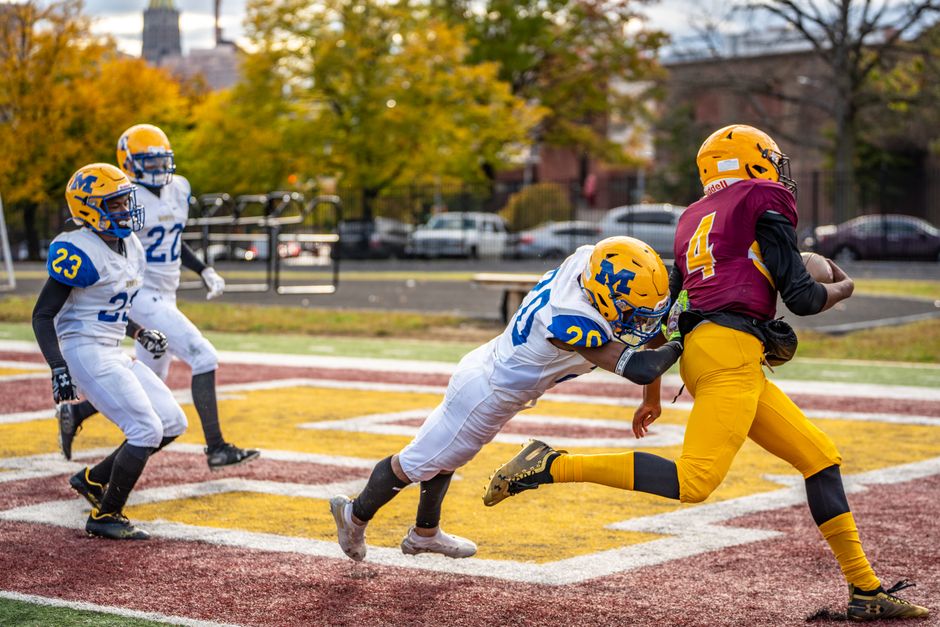
To tackle in American football, you must strike the opponent with your shoulder — never the head or facemask — while keeping your head up and out of the way, wrapping both arms around the opponent’s body, driving your hips and legs through the contact, and finishing the play to the ground. The single most important element is keeping the head up and to the side. A head-down tackle is the leading cause of catastrophic neck and spine injuries in the sport, and it is also illegal at every level of organized football.
Everything else — the stance, the angle, the footwork, the wrap — exists to make that head position possible at full speed. This guide breaks down the technique the way it is taught by qualified coaches, explains the physiology behind why it works, and covers the safety rules that govern it.
What Is the Correct Body Position for a Football Tackle?
The correct tackling posture starts before contact. A defender who arrives upright and square will lose the leverage battle against almost any ball carrier. The body must be low, angled, and loaded.
The core mechanics:
- Feet: Shoulder-width or slightly wider, knees bent, weight on the balls of the feet. Never flat-footed.
- Hips: Lower than the ball carrier’s hips. This is the leverage point. Low man wins the collision.
- Back: Flat and angled forward, roughly 45 degrees. Not vertical, not bent at the waist.
- Head: Up, eyes on the target, and positioned to the side of the opponent’s body — not in front of it.
- Arms: Bent at the elbows, ready to wrap. Not extended straight out.
The tackler’s chest and shoulder lead the way. The head follows the shoulder, not the other way around. Coaches call this “shoulder-first, head-out.”
Why this matters physiologically: the cervical spine is designed to absorb force along its natural curve. When the head is up, the neck’s lordotic curve distributes impact. When the head is down, the spine straightens into a column, and axial loading can compress or fracture vertebrae. This is the mechanism behind most catastrophic cervical spine injuries in football, and it is why head-down contact has been banned across the sport.
How Do You Actually Execute a Tackle Step by Step?
Execution breaks into four phases. Each one sets up the next.
1. Approach and Breakdown
The defender closes the distance under control. The “breakdown” is a short, choppy shuffle — feet moving fast, hips low, body under control. Rushing in at full sprint with no breakdown is how missed tackles and penalties happen. The goal is to arrive at the ball carrier on balance, not flying past.
2. Contact and Strike
The shoulder strikes the opponent’s midsection or thigh area — the “strike zone” between the chest and the knees. The head is up and to one side. The arms drive through the opponent’s body, not around the outside.
3. Wrap and Squeeze
Both arms wrap around the opponent and lock. This is the difference between a tackle and a collision. A shoulder charge without a wrap is a missed tackle waiting to happen, and at higher levels it can draw a penalty. The hands grab cloth, and the arms squeeze tight.
4. Drive and Finish
The legs keep churning. The hips drive forward and upward through the opponent. The defender finishes the play by taking the ball carrier to the ground, then gets up and separates.
One non-obvious point: the power in a tackle comes from the legs and hips, not the arms. The arms secure the opponent. The legs deliver the force. A defender who tries to arm-tackle a bigger ball carrier will lose that battle almost every time.
Why Is Keeping the Head Up So Important?
Head-up tackling is not a style preference. It is a safety requirement rooted in how the spine fails under load.
When a player lowers the head at the moment of contact, the cervical spine straightens. Force applied along that straight column travels directly into the vertebrae and spinal cord rather than being distributed. This mechanism can produce fractures, dislocations, and in the worst cases, spinal cord injury. The risk rises sharply when the head-down contact happens at speed and against a resisting opponent.
Because of this, spearing — using the top of the helmet as the primary contact point — has been illegal in American football for decades. The rules exist for a reason that predates modern rule enforcement: the injury mechanism is well documented and consistent.
Keeping the head up also has a performance benefit. A defender with eyes up can see the ball carrier’s hips, which telegraph direction. A head-down defender is effectively blind at the moment of contact, which is exactly when a ball carrier makes a cut.





What Are the Most Common Tackling Mistakes?
Most missed tackles and most dangerous tackles share a short list of errors.
- Head down at contact. The most dangerous and the most common at the youth level. It must be corrected immediately.
- Arriving too high. Standing upright into contact gives up leverage and invites a stiff-arm or a broken tackle.
- Not wrapping up. A shoulder bump is not a tackle. Without the wrap, the ball carrier keeps running.
- Stopping the feet. A defender who stops moving at contact loses the drive phase and gets dragged.
- Diving instead of breaking down. Launching at a ball carrier’s feet from distance is a low-percentage play and a poor angle.
- Leading with the facemask. This is illegal and dangerous. The facemask is not a contact surface.
Coaches drill these errors out through repetition at controlled speed before ever moving to full contact. That progression matters — technique learned at walking pace holds up better at game speed than technique learned only in live hitting.
How Do You Practice Tackling Safely?
Safe tackling practice follows a progression from no contact to full contact, and it is governed by rules at every level of the sport.
The general progression used by qualified coaches:
- Form and stance work with no opponent, focusing on posture and footwork.
- Fit and freeze — a defender fits into a stationary or slow-moving partner and holds the position.
- Thud — contact is made but the play is not taken to the ground.
- Live tackling — full speed, full finish, in controlled conditions.
USA Football, the sport’s national governing body for youth and amateur development, has published tackling guidelines that emphasize head-up, shoulder-first contact and limit the amount of full-contact practice time. Many state high school athletic associations and the NCAA have adopted similar limits on full-contact drills, largely in response to research linking repeated head impacts to long-term neurological risk.
The evidence on reducing injury through technique training is encouraging but not unlimited. Some studies indicate that teaching proper tackling form reduces certain injuries, particularly to the head and neck. The evidence is strongest for reducing head-down contact, which is a directly measurable behavior. Whether technique training meaningfully reduces overall injury rates across a whole season is less firmly established.
Does Tackling Technique Differ by Position or Level?
The fundamentals are the same everywhere, but the application changes with the situation.
Open-field tackling requires more breakdown and patience. The defender is often alone against a ball carrier in space, and the angle matters more than the force.
Goal-line and short-yardage tackling is a leverage and mass contest. Defenders stay low and drive.
Special teams tackling happens at the highest closing speeds in the game, which makes head position and body control even more critical. Kickoff and punt coverage produce some of the most violent collisions in football.
At the youth level, the priority is form over force. At the college and professional level, players are bigger, faster, and stronger, but the technique does not change — the margin for error shrinks. A head-down tackle that might cause a stinger at the youth level can cause a catastrophic injury at higher speeds.
What Rules Govern Tackling in American Football?
Several rules exist specifically to protect players during tackles. These are enforced at the high school, college, and professional levels, though the exact wording and penalties vary.
- Spearing: Using the crown of the helmet to contact an opponent is illegal.
- Targeting: Contact to the head or neck area of a defenseless player is illegal and can result in ejection.
- Facemask and horse-collar tackles: Grabbing the facemask or pulling a player down from behind by the collar is illegal.
- Helmet-to-helmet contact: Prohibited when it involves the crown of the helmet or contact to a defenseless player’s head.
These rules are not just about penalties. They are designed around the same injury mechanisms that make head-up, shoulder-first tackling the correct technique. The rulebook and the coaching manual point in the same direction.
Frequently Asked Questions
What is the most important part of tackling technique?
Keeping the head up and out of the contact is the most important element, because head-down contact is the primary cause of catastrophic neck and spine injuries. Everything else — the low hips, the wrap, the drive — supports that head position.
Is it illegal to tackle with your head down?
Yes, using the crown of the helmet to contact an opponent, known as spearing, is illegal at the high school, college, and professional levels. It also carries serious injury risk regardless of the penalty.
How do you tackle a bigger player?
Get your hips lower than the ball carrier’s hips and drive through the strike zone between the chest and knees. Leverage and leg drive matter more than size in a tackle.
Do you have to wrap your arms to make a legal tackle?
In most rulesets, a tackle requires contact that brings the ball carrier to the ground, and a shoulder charge without a wrap is generally not considered a proper tackle. Wrapping also dramatically improves the chances of actually stopping the runner.
