
The iliotibial band, or IT band for short, is that thick piece of tissue running down the outside of your thigh from your hip to your knee. When it gets tight, it can cause a sharp pain on the outer knee, especially for runners and cyclists. Many people reach for a foam roller, but you do not need one to get relief. You can effectively stretch your IT band using your own body weight, a towel, or even just a wall. The key is knowing which movements actually target the band and which ones are a waste of time.
What Is the IT Band and Why Does It Get Tight?
The IT band is not a muscle. This is a common misunderstanding. It is a thick band of fascia — a connective tissue — that runs down the outside of your leg. It connects your glute and hip muscles to your shin bone. Because it is not a muscle, it does not actually stretch like one. When people say their IT band feels tight, what they are usually feeling is tension from the muscles attached to it, especially the gluteus maximus and the tensor fasciae latae (TFL) at the front of your hip.
Research shows that true IT band tightness is often a result of weakness or overuse in the surrounding muscles. When your glutes are weak, your TFL takes over too much work. That extra load pulls on the IT band and creates that familiar tight feeling. The pain at the knee is usually from friction, not the band itself being short. Understanding this changes how you should approach stretching it.
How To Stretch Your IT Band Without a Foam Roller: The Standing Cross Stretch
This is the most straightforward way to stretch your IT band without any equipment. Stand up straight. Cross your left leg behind your right leg. Keep both feet flat on the ground. Lean your upper body to the left, reaching your left arm overhead and curving to the right. You should feel a stretch along the outside of your left hip and thigh.
Hold this position for 20 to 30 seconds. Do not bounce. Repeat on the other side. Many people make the mistake of leaning too far forward or backward. Keep your torso in a straight line as you lean sideways. This stretch directly targets the TFL muscle and the upper portion of the IT band. The American Council on Exercise includes this movement in their standard flexibility recommendations for lateral hip tightness.
Does the Seated Butterfly Stretch Actually Help the IT Band?
No, it does not. The seated butterfly stretch targets your inner thighs and groin. It has zero effect on the IT band. This is one of the most common mistakes people make when searching for IT band relief. They find a list of “hip stretches” and assume all of them apply. The IT band is on the outside of your leg. A stretch that opens the inside of your leg cannot reach it.
If you see a stretch that focuses on the inner thigh, skip it. Focus only on stretches that move your leg across your body or that involve a sideways lean. The IT band responds best to adduction — moving your leg toward the midline of your body — and to lateral flexion of the torso. Anything else is just wasting your stretching time.





How To Use a Towel or Strap for a Deeper IT Band Stretch
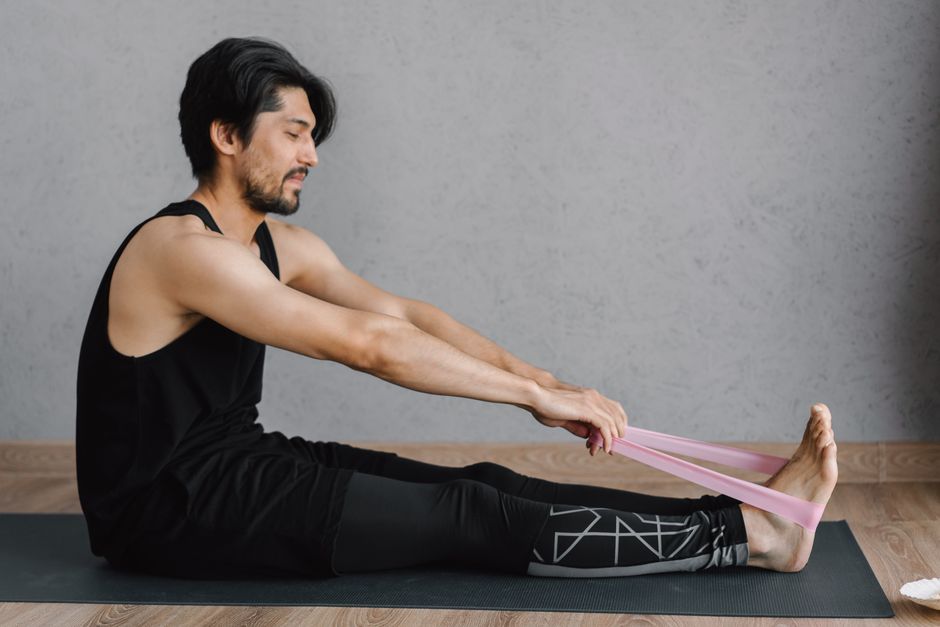
If you want a deeper stretch than the standing version, you can use a towel, a belt, or any strap you have at home. Lie on your back on a comfortable surface. Loop the towel around the bottom of your left foot. Keep your left leg straight. Use the towel to pull your left leg across your body toward your right side. You do not need to lift the leg high. Just bring it across the midline until you feel a stretch on the outside of your left hip and thigh.
Hold for 20 to 30 seconds. Keep your hips flat on the ground. If your hips lift off the floor, you are pulling too far. This stretch is more controlled than the standing version and allows you to adjust the intensity precisely. A study published in the Journal of Athletic Training found that passive stretching with a strap was just as effective as foam rolling for reducing IT band tension in the short term. The key difference is that the strap stretch requires no equipment beyond what you already have at home.
What Does Research Say About Stretching the IT Band?
The evidence on IT band stretching is more complicated than most articles suggest. A 2019 review in the International Journal of Sports Physical Therapy found that stretching alone has limited long-term effects on IT band syndrome. The band itself is very strong and does not lengthen much under tension. What stretching does do is reduce the tension in the muscles attached to it, especially the TFL and gluteus medius.
Some studies suggest that strengthening the glutes and hips is more effective than stretching for treating IT band pain. A 2020 study in Orthopaedic Journal of Sports Medicine found that runners who did hip strengthening exercises for six weeks had significantly less IT band pain than those who only stretched. The researchers noted that stretching provides short-term relief, but strengthening provides lasting change.
This does not mean stretching is useless. It means you should not rely on it alone. If you are stretching your IT band but still have pain, the missing piece is likely strength work. Clamshells, side-lying leg raises, and hip thrusts target the gluteus medius and maximus. When those muscles are strong, they take pressure off the IT band. Think of stretching as the temporary fix and strengthening as the permanent solution.
Stretching vs. Foam Rolling for the IT Band: What the Evidence Shows
| Method | What It Does | Evidence Level |
|---|---|---|
| Standing cross stretch | Targets TFL and upper IT band | Moderate — short-term tension relief |
| Towel/strap stretch | Passive adduction of the leg | Moderate — similar to foam rolling per Journal of Athletic Training |
| Foam rolling | Applies pressure to the band and surrounding muscles | Moderate — reduces perceived tightness temporarily |
| Hip strengthening | Reduces load on IT band by strengthening glutes | Strong — best long-term outcome per multiple studies |
Foam rolling is popular because it feels good. But research shows that it does not actually change the length of the IT band. A 2018 study in the Journal of Strength and Conditioning Research found that foam rolling increased range of motion for only about 10 minutes. The same effect can be achieved with a standing stretch or a strap stretch. If you do not have a foam roller, you are not missing out on anything essential.
Common Mistakes When Stretching the IT Band Without a Foam Roller
- Holding the stretch for too long. The IT band and its attached muscles respond best to holds of 20 to 30 seconds. Holding for 60 seconds or more does not provide extra benefit and can sometimes irritate the hip joint.
- Stretching a cold band. Always do a few minutes of light activity first — walking, marching in place, or leg swings. Stretching a cold IT band is less effective and increases the risk of pulling a muscle.
- Only stretching one side. Even if you only feel pain on one side, stretch both sides equally. Muscle imbalances between your left and right leg can cause compensation patterns that keep the pain coming back.
- Ignoring the glutes. If your glutes are weak, no amount of IT band stretching will fix the problem. Add glute strengthening to your routine at least twice a week.
- Stretching through sharp pain. A gentle stretch should feel like a tug, not a stab. Sharp pain on the outside of your knee during a stretch may indicate IT band syndrome or bursitis. Stop and see a physical therapist if the pain is consistent.
How Often Should You Stretch Your IT Band Without a Foam Roller?
Stretching once a day is enough for most people. If you are in the middle of a flare-up of IT band pain, you can stretch twice a day — once in the morning and once before bed. Do not stretch immediately before running unless you have warmed up for at least five minutes first. Stretching a cold IT band right before exercise can actually increase your risk of irritation.
Consistency matters more than intensity. A gentle stretch done every day is better than an aggressive stretch done once a week. If you miss a day, do not try to make up for it by stretching longer the next day. Just get back to your normal routine. The IT band adapts slowly, and patience is part of the process.
When Stretching Is Not Enough
If you have been stretching your IT band consistently for two to three weeks and still have pain, it is time to look at other factors. Check your running or walking form. Do you cross your feet in front of your body when you walk? Do you run on a slanted road surface? Do you sit for long hours with your legs crossed? All of these can put extra tension on the IT band.
A physical therapist can assess your gait and identify muscle weaknesses you cannot feel on your own. Some people need orthotics for flat feet, which changes how the leg aligns and reduces IT band strain. Others need to change their exercise routine to include more cross-training. Swimming and cycling with proper bike fit are easier on the IT band than running on hard pavement.
As of 2026, there is no clinical evidence that any single stretch or device can cure IT band syndrome permanently. The condition usually resolves when you address the underlying causes — weak glutes, poor movement patterns, or overtraining. Stretching is one tool in the toolbox. It is a good tool, but it is not the only one.
Frequently Asked Questions
Can you stretch your IT band without a foam roller?
Yes. The standing cross stretch and the towel stretch are both effective without any equipment.
How long should you hold an IT band stretch?
Hold each stretch for 20 to 30 seconds. Longer holds do not provide extra benefit.
Does walking help loosen the IT band?
Walking can help warm up the muscles around the IT band but does not directly stretch it.
What makes IT band pain worse?
Running on slanted surfaces, weak glutes, and sitting with legs crossed can all increase IT band tension.
