
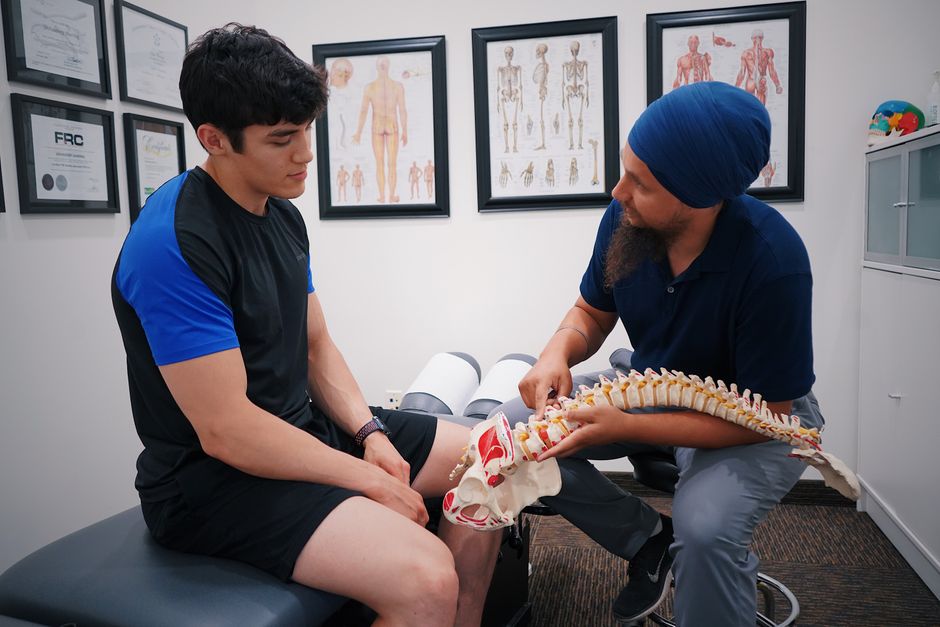
The muscles that run along your spine, the spinal erectors, are the workhorses of your back. They keep you upright, help you lift, and protect your spine from injury. Strengthening them is not about looks; it is about function and long-term back health. The most effective way to build these muscles is with a mix of exercises that involve both bending forward and resisting that bend, using a form that prioritizes a neutral spine.
What Are the Spinal Erectors and Why Do They Matter?
The erector spinae is a group of three muscles that run vertically on each side of your spine, from your pelvis and lower ribs up to your neck and skull. Their main job is to extend your spine, meaning they pull you from a bent-forward position back to upright. They also help you control the speed of bending forward and maintain your posture when you stand or sit for long periods.
Weak spinal erectors are a common factor in lower back pain. When these muscles cannot handle the demands you place on them, other structures, like ligaments and spinal discs, take on extra stress. Strengthening them builds a foundation of support that makes everyday movements like lifting groceries, playing with kids, or working in the garden safer and easier.
These muscles respond well to both static holds and dynamic movement. You need to train them through their full range of motion, but you also need to teach them to brace and protect the spine under load.
How To Strengthen Spinal Erectors Exercises Form: The Core Principles
Before you pick up a weight, you need to understand the concept of a neutral spine. This is the natural S-curve of your back, with a slight inward curve in your lower back and a slight outward curve in your upper back. Maintaining this position during exercise is the single most important element of safe and effective erector training.
When you round your back under load, you put excessive pressure on the front of your spinal discs. When you over-arch it, you jam the small joints in the back of your spine. A neutral spine distributes force evenly through the vertebrae and discs, which is exactly what you want.
Breathing is also part of the form. You should brace your core as if you are about to be punched in the stomach. This creates intra-abdominal pressure that stabilizes your entire torso and helps your erectors work more efficiently. Do not hold your breath for the entire set; exhale on the hard part of the movement.
Foundational Exercises: The Back Extension
The back extension, performed on a Roman chair or hyperextension bench, is one of the most direct ways to target your spinal erectors. The movement involves bending forward at the hips and then using your lower back muscles to return to a straight line with your body.
Set the pad of the bench so that your hip bones are at the top edge. Cross your arms over your chest or hold a light weight plate. Start with your body in a straight line from head to heels. Slowly hinge forward at the hips, keeping your back flat, until your torso is roughly parallel to the floor. Do not round your spine at the bottom.
Pause briefly, then use your glutes and spinal erectors to pull your torso back up to the starting position. The movement should come from your hips, not from your lower back. Avoid going past a straight line at the top, as hyperextending your spine can cause unnecessary compression.
If you cannot perform a full rep with good form, reduce the range of motion instead of using momentum. Quality beats quantity here. You should feel this working in your lower back and glutes, not in your hamstrings.





Deadlifts: The King of Spinal Erector Training
Deadlifts are a compound movement that heavily recruits the spinal erectors, but they do so isometrically. This means the erectors work to keep your spine in a fixed, neutral position while your hips and legs do the moving. This is a critical distinction because it trains the muscles to resist unwanted movement, which is exactly what they do in real life.
When you deadlift, you start with the bar on the floor. Hinge at your hips and bend your knees until your shins touch the bar. Grip the bar with your hands just outside your legs. Flatten your back and brace your core. Push the floor away with your legs, and as the bar passes your knees, drive your hips forward to stand up tall.
The most common form error in deadlifting is rounding the lower back. If you cannot keep your spine neutral at the start position, the weight is too heavy or your hamstrings are too tight. Lower the weight and work on your hip hinge mechanics first. A rounded back turns a safe exercise into a high-risk one for disc injury.
Start with a light weight and focus on the setup. The deadlift is not a race to see how much you can lift; it is a skill that takes time to develop. Once your form is consistent, you can gradually add weight over weeks and months.
Good Mornings: A More Advanced Option
Good mornings are a barbell exercise that places the bar on your upper back, similar to a back squat position. From there, you hinge forward at the hips while keeping your spine completely neutral, then return to standing. This movement directly overloads the spinal erectors through a lengthened position.
This exercise requires excellent hip mobility and core strength. It is not for beginners. If your lower back rounds at any point during the movement, the load is too heavy. Start with just the empty barbell and practice the hip hinge pattern until it feels smooth and controlled.
Keep your knees slightly bent throughout. Push your hips backward as if you are trying to close a drawer with your glutes. Your torso should lower until it is nearly parallel to the floor, but only go as far as you can maintain a flat back. Squeeze your glutes to return to the starting position.
Because this exercise places the load directly on your spine, it demands respect. Progress slowly and film yourself from the side to check your form. A rounded back here is a recipe for injury, not a badge of honor.
Bodyweight Alternatives: Bird Dogs and Planks
Not everyone has access to a gym or wants to lift heavy weights. Bodyweight exercises can still effectively strengthen your spinal erectors, though they will not build the same level of raw strength as loaded movements. They are excellent for beginners, rehabilitation, and as a warm-up.
The bird dog is a simple but effective exercise. Start on your hands and knees with your spine neutral. Extend your right arm forward and your left leg backward simultaneously, keeping your hips square to the floor. Pause for a second, then return to the start and switch sides. The key is to move slowly and avoid letting your lower back sag or arch.
Front planks also engage the erectors, but they work them isometrically to prevent your hips from dropping. The erectors contract to keep your body in a straight line. Hold a plank with your forearms on the floor and your body rigid. Start with 20-second holds and build up gradually as your strength improves.
These exercises are not as intense as deadlifts, but they teach your body to brace and stabilize. They are a safe starting point for anyone with a history of back pain, provided the movement is pain-free.
Common Form Mistakes and How to Fix Them
One of the most frequent mistakes is using momentum to swing through the movement. Whether you are doing back extensions or deadlifts, swinging your torso up uses your hip flexors and momentum instead of your erectors. Slow down the tempo and control the descent. A three-second lowering phase will eliminate most swinging.
Another common error is looking up at the ceiling during the exercise. This over-extends your neck and can cause your upper back to round as a compensation. Keep your gaze at the floor about a meter in front of you. This helps keep your entire spine in a neutral line.
Lifting too heavy, too soon is the root cause of most form breakdowns. Your ego is not part of the exercise. If you cannot maintain a neutral spine for all repetitions, the weight is too heavy. Reduce the load and build up gradually. Patience is the most underrated tool in strength training.
Finally, neglecting your glutes and hamstrings will limit your progress. The spinal erectors work together with your posterior chain. If your glutes are weak, your lower back will overwork and fatigue quickly. Include exercises like hip thrusts, glute bridges, and Romanian deadlifts in your routine to build a balanced posterior chain.
How Often Should You Train Your Spinal Erectors?
Like any muscle group, the spinal erectors need time to recover after training. They are involved in almost every movement you do during the day, so they are already getting some stimulation. Dedicated strengthening sessions should happen two to three times per week with at least one rest day in between.
If you are doing heavy deadlifts, once per week may be sufficient. If you are doing bodyweight exercises like bird dogs and planks, you can do them more frequently. Listen to your body. Soreness is normal, but sharp pain is a sign that something is wrong.
Consistency matters more than intensity. Doing a few sets of back extensions twice a week for six months will produce better results than a brutal workout once a month. Your spinal erectors respond to progressive overload, which means you need to gradually increase the difficulty over time, whether that is more weight, more reps, or a longer hold.
Frequently Asked Questions
What is the best exercise for spinal erectors?
The back extension on a Roman chair is the most direct isolation exercise for the spinal erectors. Deadlifts are the best compound movement because they train the erectors to stabilize your spine under heavy load.
How long does it take to strengthen lower back muscles?
Most people notice improved strength and endurance within six to eight weeks of consistent training. Significant structural changes in muscle size typically take three to four months of progressive overload.
Can I train my spinal erectors every day?
Daily training is not recommended because the muscles need recovery time to grow stronger. Two to three focused sessions per week is sufficient for most people, with at least one rest day between sessions.
Are back extensions safe for people with back pain?
Back extensions can be safe for mild back pain, but you should consult a healthcare professional first. The movement should be pain-free throughout the full range of motion, and you should start with bodyweight only.
