
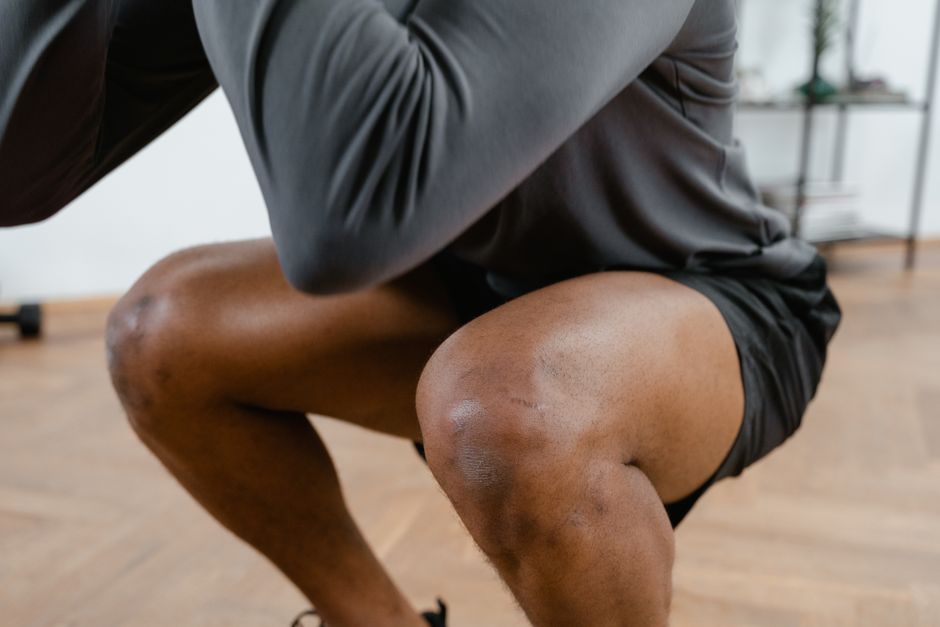
Squatting with knee pain usually means your form is off, not that squats are bad for you. The fix is straightforward: adjust your stance width, control your descent, and keep your weight on your midfoot. When done correctly, squats actually strengthen the muscles that protect your knees.
What Causes Knee Pain When Squatting?
Knee pain during squats is rarely a knee problem. Most of the time, it comes from how your hips and ankles move — or don’t move. When your hips are tight or your ankles lack mobility, your knees take the extra load.
Research published in the Journal of Orthopaedic & Sports Physical Therapy found that people with limited hip mobility had significantly more knee valgus — that inward collapse of the knee — during squats. That collapse puts stress on the medial collateral ligament and the patellofemoral joint.
Another common cause is shifting your weight too far forward onto your toes. This increases shear force behind the kneecap. The patella is designed to glide smoothly in its groove. When you lean forward, that groove changes angle, and the kneecap gets pinched.
Weak glutes also play a role. Your gluteus medius stabilizes your hip during the squat. When it’s weak, your thigh rotates inward, and your knee follows. The squat itself isn’t the problem. The problem is that your body is compensating for something else.
How To Squat Without Knee Pain Fix Your Form
Fix your stance first. Stand with your feet slightly wider than shoulder-width apart. Point your toes out at about 30 degrees. This position allows your hips to open up and your femurs to track properly in the hip socket.
Now focus on your descent. Push your hips back like you’re sitting into a chair that’s slightly behind you. Keep your chest up and your weight on your midfoot — not your toes and not your heels. Imagine screwing your feet into the floor by rotating them outward without actually moving them. This activates your external rotators and keeps your knees stable.
Control the lowering phase. A study in Sports Biomechanics found that faster descent speeds increased patellofemoral joint stress by up to 30 percent. Take two to three seconds to lower yourself. Pause briefly at the bottom. Then drive up through your whole foot.
Depth matters. You do not need to squat below parallel to get results. Squat to the depth where your form stays solid. For most people with knee pain, that is just above parallel — where your thighs are roughly parallel to the floor but not below it. Going deeper without the mobility to support it just loads the knee.
| Form Element | Common Mistake | Correct Technique |
|---|---|---|
| Stance | Feet too narrow | Wider than shoulder-width |
| Weight distribution | On toes | Midfoot |
| Knee tracking | Knees cave inward | Knees track over second toe |
| Descent speed | Dropping fast | 2–3 second controlled lowering |
| Depth | Going too low | Stop at parallel or above |
What Does Research Say About Squat Depth and Knee Safety?
There is a persistent myth that deep squats destroy your knees. The evidence does not support that. A 2013 review in the British Journal of Sports Medicine looked at multiple studies and found no link between deep squats and knee injury in healthy people with proper form.
But there is a catch. The same review noted that people with existing patellofemoral pain — pain behind or around the kneecap — did worse with deep squats. If you already have knee pain, going to full depth is not the right move. You need to build strength and control first at a shallower depth.
Research from the American Council on Exercise showed that partial squats — stopping at 90 degrees — produced similar quadriceps activation to deep squats. You are not losing much muscle activation by limiting your depth. You are gaining joint safety.
The American College of Sports Medicine states that proper squat technique is safe for most adults. They emphasize that form, not depth, is the primary factor in knee safety.



What Are the Most Common Form Mistakes People Make?
The most common mistake is letting your knees travel too far forward over your toes. Some forward movement is normal and necessary. But when your knees shoot past your toes early in the descent, the load shifts to your patellar tendon. A study in Clinical Biomechanics found that this increased patellofemoral contact pressure by 35 percent.
The second mistake is the knee cave. This happens when your adductors — inner thigh muscles — overpower your glutes. Your knees collapse inward, and the joint twists under load. Fix this by consciously pushing your knees out toward your pinky toes during the squat. If you cannot do this, lower the weight or switch to bodyweight squats until your glutes catch up.
The third mistake is rounding your lower back. This is called butt wink. When your pelvis tucks under at the bottom of the squat, your lumbar spine flexes, and that changes the angle at your hips and knees. The fix is simple: do not squat deeper than you can while keeping your lower back neutral. If your butt winks at parallel, stop at half depth.
Some people also squat with their heels lifting off the ground. This is an ankle mobility issue. If your heels come up, your weight shifts forward, and your knees take the hit. Place a small weight plate under your heels to give your ankles more room, or work on ankle dorsiflexion stretches separately.
What Exercises Help Fix Squat Form and Reduce Knee Pain?
Before you squat again, strengthen the muscles that stabilize your knees. Three exercises have strong evidence behind them.
- Glute bridges. Lie on your back with knees bent and feet flat. Drive your hips up. Squeeze your glutes at the top. This wakes up your glutes, which are often asleep from sitting all day. Do three sets of 12 to 15 reps.
- Clamshells. Lie on your side with knees bent at 45 degrees. Keep your feet together and lift your top knee without moving your pelvis. This targets the gluteus medius, the muscle that prevents knee collapse. Do three sets of 12 to 15 reps per side.
- Step-ups. Stand in front of a sturdy box or step that is knee height. Step up with one foot and drive through your heel to stand on top. Step down slowly. This builds single-leg strength and teaches your knee to track properly under load. Do three sets of 8 to 10 reps per leg.
Then work on ankle mobility. Stand facing a wall with your toes a few inches from it. Keep your heel on the ground and drive your knee toward the wall. You should feel a stretch in your lower calf. Hold for 30 seconds per side. Do this before every squat session.
Some people report relief from using knee sleeves during squats. The evidence on sleeves is mixed. A 2020 study in The Journal of Strength and Conditioning Research found that knee sleeves increased proprioception — your awareness of where your knee is in space — but did not reduce joint stress. They may help you feel more stable, but they do not fix form issues.
When Should You See a Professional for Knee Pain?
If you have corrected your form and the pain persists after four to six weeks of consistent practice, it is time to see someone. A physical therapist can assess your movement patterns and identify the exact limitation — whether it is hip mobility, ankle range, or a muscle imbalance.
The CDC reports that about 25 percent of adults experience chronic knee pain. Not all of it is from squatting. Some people have underlying conditions like patellofemoral pain syndrome, IT band syndrome, or early osteoarthritis. These are not contraindications to squatting, but they require a modified approach.
If you feel sharp pain, catching, or locking in the knee during a squat, stop immediately. That is not a form issue. That is a sign of something structural, like a meniscus tear or loose body in the joint. See an orthopedic specialist.
Dull, achy pain around the kneecap that goes away when you stop squatting is more likely patellofemoral pain. This responds well to the form corrections and exercises listed above. But if it does not improve, a physical therapist can guide you through a graded exposure program that gradually increases your squat depth and load.
Frequently Asked Questions
Can squatting with knee pain make it worse?
Yes, squatting with poor form while in pain can increase joint stress and worsen underlying issues. Fix your form first or stop and see a professional.
Should I use knee wraps when squatting?
Knee wraps can provide stability but they do not correct form problems. Use them only if a professional recommends them for your specific condition.
How long does it take to fix squat form?
Most people see improvement in two to four weeks with consistent practice of the corrections and strengthening exercises. Full adaptation can take six to eight weeks.
Is it safe to squat every day?
Squatting every day is safe for most people if you use proper form and light weight. For strength gains, two to three sessions per week is more effective.
