
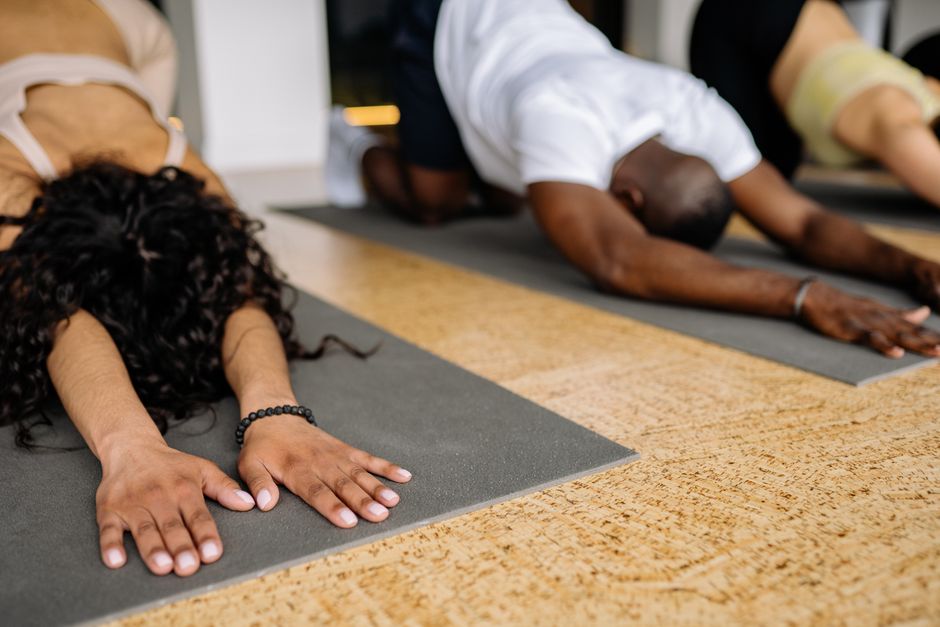
Sitting on the floor with lower back pain comes down to one principle: keep your pelvis in a position where your spine can hold its natural curves. Most people with lower back pain can sit on the floor comfortably if they raise their hips above their knees, avoid rounding the lower back, and change position every 20 to 30 minutes. The floor itself is not the problem. How you arrange your body on it usually is.
Why Does Sitting On The Floor Hurt Your Lower Back?
When you sit on a flat floor with your legs straight out, your pelvis rolls backward. This flattens or reverses the natural inward curve of your lower back, a curve called lumbar lordosis. The discs and the small joints of the spine end up loaded in a position they were not built to tolerate for long.
That said, the position alone does not explain everything. Research on sitting and back pain has found that no single posture reliably predicts pain across all people. What shows up more consistently is time. Staying in any one position, even a good one, for too long tends to bring on discomfort.
There is a second factor that gets less attention than it deserves. Your hip joints have a limited range of motion. If your hips cannot rotate or flex far enough to let your pelvis stay upright while seated on the floor, your lower back has to make up the difference. That is why two people can sit in what looks like the same position and only one of them hurts.
How To Sit On The Floor With Lower Back Pain Without Making It Worse
Raise your hips. This is the single most useful change you can make. When your hips sit higher than your knees, your pelvis can tilt forward and your lower back keeps its natural curve.
A firm cushion, a folded blanket, a yoga block, or a low stool all work. The height you need varies with your body. A common starting point is enough lift that your knees rest at or slightly below the level of your hips. Some people need more, some less.
Once your hips are raised, check three things:
- Your sitting bones should feel like they are bearing your weight evenly, not rolling you backward.
- Your lower back should have a slight inward curve, not a flat or rounded one.
- Your ribs should sit roughly over your pelvis rather than sinking behind them.
If your lower back still rounds even with a cushion, the limit is probably in your hips, not your cushion. In that case, sitting on a chair is not a failure. It is a reasonable accommodation.
Which Floor Sitting Positions Are Easier On The Lower Back?
Cross-legged sitting on a cushion is usually the most forgiving option. It widens the base of support and takes some demand off the hips. Many people find it lets them keep an upright pelvis with less effort.
Kneeling with your shins on the floor and your hips over your heels, sometimes called a hero or Japanese sitting position, keeps the spine tall. The catch is that it asks a lot of the knees and ankles. If those joints complain, this position is not a good trade.
Sitting with both legs straight out in front is the hardest position for most people with lower back pain. It rolls the pelvis back and flattens the lumbar curve. If you use this position, a cushion under the hips helps, and so does a small roll under the knees.
Sitting on one hip with the legs off to one side, sometimes called mermaid sitting, can work for short periods. It loads the spine unevenly, so it is better as a position you pass through than one you hold.





How Long Should You Sit On The Floor?
Change position every 20 to 30 minutes. This matters more than which position you choose. Tissue loading builds up over time, and shifting before discomfort sets in tends to work better than waiting until you already hurt.
Standing up and walking for a minute or two counts as a change. So does switching from cross-legged to kneeling, or moving to a chair and back.
There is no universal time limit that applies to everyone with lower back pain. Tolerance varies widely with hip mobility, disc health, and how long the pain has been present. Use your own symptoms as the guide. If pain climbs during floor sitting and settles after you get up, that is useful information about your current limit, not a sign you are doing something wrong.
What If Sitting On The Floor Still Hurts?
Stop and use a chair. Sitting on the floor is not a requirement for back health, and there is no evidence that floor sitting is better for your spine than sitting on a well-designed chair. Many people with lower back pain do better in a chair with feet flat and hips at or slightly above knee level.
If pain consistently appears with floor sitting and fades when you stop, the position is likely the trigger. That is worth respecting rather than pushing through.
Persistent lower back pain that does not improve, or that comes with leg weakness, numbness in the groin or saddle area, or changes in bladder or bowel control, needs medical evaluation promptly. Those symptoms are not something to manage with a cushion.
Does Sitting On The Floor Have Any Benefits?
Some research has looked at whether people who routinely sit on the floor have better hip mobility or fewer falls as they age. The findings are interesting but not strong enough to support floor sitting as a treatment for lower back pain. The evidence here is limited.
What is clearer is that varied movement across the day matters more than any single posture. If floor sitting is comfortable for you and you enjoy it, there is no reason to avoid it. If it hurts, there is no benefit worth chasing.
One clarification worth making: the idea that humans are “designed” to sit on the floor and that chairs are the cause of back pain is a claim that outruns the evidence. Back pain has many contributors, and chair use is not established as a primary cause.
Can You Build Tolerance For Floor Sitting Over Time?
Some people do gradually tolerate floor sitting better, usually because hip mobility improves rather than because the spine adapts. Hip mobility work and regular movement tend to help more than simply enduring longer sessions.
Progress is not guaranteed. If your hip structure limits how far your pelvis can tilt, no amount of practice will change that. Working with a physical therapist can help sort out whether your limit is mobility, strength, or something else.
What does not help is pushing through pain to build toughness. Pain during floor sitting is a signal about load and position, not a test of willpower.
Frequently Asked Questions
How do I sit on the floor with lower back pain?
Raise your hips above your knees using a firm cushion, folded blanket, or low stool, and keep a slight inward curve in your lower back. Change position every 20 to 30 minutes.
Is sitting on the floor bad for lower back pain?
Not by itself. The problem is usually a rounded pelvis and long periods without moving, both of which are manageable with a cushion and regular position changes.
What is the best floor sitting position for lower back pain?
Cross-legged sitting on a cushion is usually the most comfortable option because it widens your base of support. Kneeling can also work if your knees and ankles tolerate it.
Should I sit on the floor if it hurts my lower back?
No. If pain consistently appears with floor sitting and eases when you stop, use a chair instead. Floor sitting is not required for back health.
