
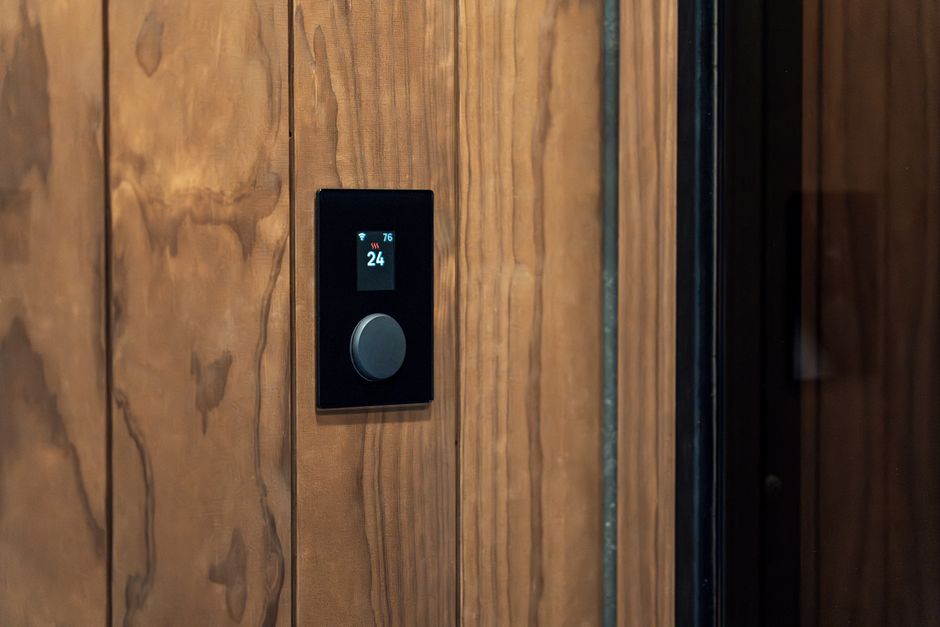
Setting a split air conditioner thermostat is not complicated, but the number you choose matters less than what the unit is actually doing with it. A split AC cools by moving heat from inside your home to the outside, and the thermostat tells the compressor when to run and when to stop. The temperature you set on the remote is a target, not a guarantee, and the mode you select changes how the system reaches that target.
Most people set the thermostat somewhere between 72°F and 78°F in cooling mode, and that range reflects how the equipment is designed to work. The unit will run until the room sensor reads your set point, then cycle off. Understanding that cycle — and the difference between temperature and mode — explains almost every question people have about these systems.
What Does the Thermostat on a Split AC Actually Control?
The number on your remote is a set point. It tells the indoor unit’s control board the temperature at which the compressor should stop cooling.
When you lower the set point, the compressor runs longer. When you raise it, the compressor runs less. That is the entire mechanism. The unit does not blow colder air because you set 65°F instead of 75°F — it simply runs for a longer stretch before shutting off.
This is the part most people get wrong. A split AC produces air at roughly the same temperature from the vent regardless of the set point, typically somewhere in the 50s to low 60s Fahrenheit depending on the model and conditions. The set point determines how long that air keeps blowing, not how cold it gets.
That distinction matters for two reasons. First, it means setting an extremely low temperature will not cool the room faster. Second, it means the compressor will run continuously, which uses more electricity and puts more wear on the system.
How To Set Thermostat In Split Ac Modes Temps
Mode and temperature work together, and the right combination depends on what you want the system to do.
Cool mode is the standard setting for hot weather. The compressor runs, the indoor fan blows air across the evaporator coil, and the room cools to your set point. This is the mode where temperature selection is most straightforward.
Dry mode removes moisture from the air. The compressor runs at a reduced rate and the fan moves more slowly, so the coil stays cold enough to condense water but the room does not cool as aggressively. In humid climates, dry mode can make a room feel more comfortable at a higher set point than cool mode would. Temperature settings in dry mode still exist, but the unit’s behavior is driven more by humidity removal than by hitting an exact number.
Fan mode does not cool at all. The compressor stays off and only the indoor fan runs. The thermostat setting has no effect on room temperature in this mode — it simply circulates existing air.
Auto mode lets the unit switch between cooling and heating (on systems with a heat pump) based on the room temperature relative to your set point. Some people find auto mode inefficient because the unit may switch modes more often than necessary.
For most cooling needs, cool mode with a set point between 72°F and 78°F is the practical answer. The U.S. Department of Energy recommends 78°F when you are home and higher when you are away, though comfort varies by person, humidity, and how the space is used.
What Temperature Should You Actually Set?
There is no single correct number. Comfort depends on humidity, air movement, clothing, activity level, and individual physiology.
What the evidence does support is that a higher set point uses less energy. The Department of Energy notes that you can save energy by setting your thermostat higher when you are away and adjusting it when you return. For every degree you raise the set point, the compressor runs less. The relationship is roughly linear within normal operating ranges.
Some practical reference points:
- 78°F is the Department of Energy’s recommended summer set point for occupied homes.
- 72°F to 76°F is a common comfort range for many people in dry climates.
- In humid conditions, a higher set point with dry mode or a dehumidifier running can feel as comfortable as a lower set point in cool mode.
- Below about 70°F, many people find the air uncomfortably cold and energy use rises sharply.
A ceiling fan or portable fan lets you raise the set point by a few degrees while maintaining the same perceived comfort. Moving air helps your skin release heat more effectively, which is a well-established principle of human thermoregulation.





Does Setting a Lower Temperature Cool the Room Faster?
No. This is one of the most persistent myths about air conditioning.
A split AC cools at a fixed rate determined by its capacity, the outdoor temperature, and the condition of the system. Setting 65°F does not make the compressor work harder or the air colder. It just makes the unit run longer before it stops.
The room will reach 75°F in the same amount of time whether you set 75°F or 65°F. The difference is that with a 65°F set point, the unit keeps running past 75°F and continues toward a target it may never reach on a hot day. That means wasted electricity and unnecessary compressor wear.
If you want faster cooling, the effective steps are different: close blinds to reduce solar heat gain, make sure doors and windows are shut, clean or replace the air filter, and confirm the outdoor unit has clear airflow around it. These affect how quickly the system can move heat out of the room.
How Do Humidity and Mode Affect Your Setting?
Humidity changes how a given temperature feels, and it also changes how the AC performs.
A split AC removes moisture as a byproduct of cooling. When humid air passes over the cold evaporator coil, water condenses and drains away. This is why an air conditioner makes a room feel drier as well as cooler.
In very humid conditions, the system spends more of its capacity on moisture removal and less on dropping the temperature. That is why a room can feel sticky even when the thermostat reads 74°F. Dry mode addresses this directly by prioritizing moisture removal over rapid cooling.
Some clinicians and building scientists note that indoor relative humidity between roughly 30% and 50% is generally considered comfortable and discourages mold and dust mite growth. A split AC in cool mode will often bring humidity into that range as it runs. If humidity stays high, the unit may be oversized, undersized, or low on refrigerant — all conditions that warrant a technician’s assessment.
What About Sleep Mode and Timers?
Sleep mode gradually raises the set point over several hours, usually by a few degrees. The idea is that your body temperature naturally drops during sleep, so a slightly warmer room stays comfortable while using less energy.
Timers let you program the unit to turn on or off at specific times. A common approach is to set the AC to start cooling 30 minutes before you arrive home and to raise the set point or turn off the unit when you leave.
These features do not change the fundamental relationship between set point and energy use. They simply let you vary the set point automatically based on your schedule.
Common Mistakes People Make With Split AC Thermostats
Setting the thermostat very low to cool a room faster is the most common error. It does not work and it wastes energy.
Leaving the unit in fan mode and expecting cooling is another. Fan mode moves air but does not remove heat. The room will not get cooler.
Ignoring the filter is a third. A clogged filter restricts airflow, which reduces the system’s ability to move heat and can cause the evaporator coil to freeze. A frozen coil stops cooling entirely until it thaws. Checking and cleaning the filter every few weeks during heavy use is a simple habit that keeps the system working as designed.
Setting the thermostat below the unit’s practical range is a fourth. Most residential split systems are designed to cool to a certain point relative to outdoor temperature. On a 100°F day, a set point of 68°F may be unreachable, and the compressor will run continuously without ever satisfying the thermostat.
Frequently Asked Questions
What temperature should I set my split AC to?
The U.S. Department of Energy recommends 78°F when you are home in summer. Many people find 72°F to 76°F comfortable, and the right number depends on humidity, air movement, and personal preference.
Does setting my AC lower make it cool faster?
No. A split AC cools at a fixed rate regardless of the set point. Setting a lower temperature only makes the compressor run longer, not cool the room any faster.
What does dry mode do on a split AC?
Dry mode removes moisture from the air by running the compressor at a reduced rate and slowing the indoor fan. It prioritizes dehumidification over rapid cooling and can make a room feel more comfortable in humid conditions.
Why does my split AC not reach the set temperature?
The unit may be undersized for the space, low on refrigerant, or struggling with a clogged filter or blocked outdoor unit. Extreme outdoor heat can also make certain set points unreachable.
