
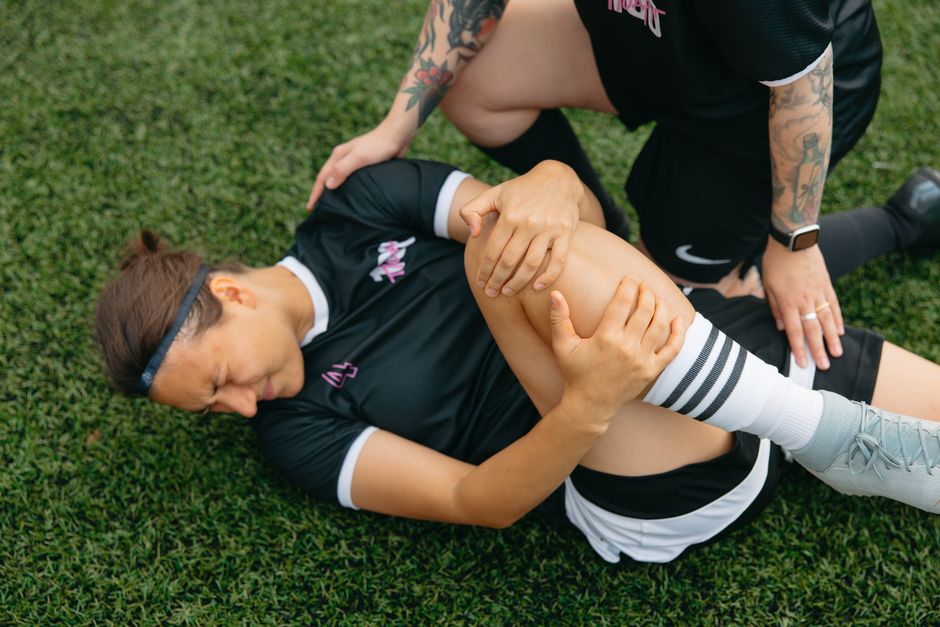
Running downhill feels like the reward at the end of a hard climb, but for many runners, that reward comes with a sharp price: knee pain. The impact of descending is significantly higher than running on flat ground, and your body has to work differently to control that force. You can run downhill comfortably by adjusting your form, strengthening your legs, and building up your tolerance gradually. The goal is not to avoid downhill running, but to teach your body how to absorb the shock safely.
Why Does Downhill Running Hurt Your Knees?
When you run on flat ground, your muscles absorb most of the impact. When you run downhill, gravity adds extra force to every step. Your quadriceps have to work in an eccentric contraction, meaning they lengthen while under tension. This is the same motion as slowly lowering a heavy weight. It creates microscopic damage in the muscle fibers, which leads to soreness and places more direct stress on the patellar tendon and the cartilage behind your kneecap.
The problem is often technique. Many runners lean back and slam their heels into the ground to brake. This locks the knee joint and forces the bones and cartilage to absorb the impact instead of the muscles. Over time, this repetitive pounding can irritate the joint and cause inflammation.
Some research suggests that downhill running increases the risk of patellofemoral pain syndrome, commonly known as runner’s knee. This condition involves pain around or behind the kneecap. It is one of the most common running injuries, and downhill sections frequently trigger the symptoms.
How To Run Downhill Without Hurting Your Knees
The first step is to change your mental approach. Do not fight the hill. Let gravity help you move forward, but control your speed with your stride, not by braking hard.
Keep your body upright or with a slight forward lean from the ankles. A common mistake is leaning backward, which shifts your center of mass behind your feet. This forces you to reach out with your heel to stop yourself, which is the fastest way to strain your knees.
Shorten your stride. Take quick, light steps rather than long reaching strides. Your feet should land underneath your center of mass, not far out in front of you. This keeps your knees bent and allows your quadriceps to act as shock absorbers.
Land on your midfoot rather than your heel. Heel striking on a downhill slope sends a jolt straight up through the knee. A midfoot strike keeps the ankle and knee flexed, which distributes the load across the muscles more effectively.
Relax your upper body. Tension in your shoulders and arms travels down to your legs. Keep your arms loose and slightly bent. Use them for balance, but do not let them flail.
Look ahead, not down at your feet. Your body follows your eyes. Looking down changes your head position and throws off your alignment. Scan the trail or road about 10 to 20 feet ahead so you can react to changes in terrain.
Strengthening Exercises To Protect Your Knees
Form alone is not always enough. Your muscles need to be strong enough to handle the eccentric load of descending. Weak quadriceps are a primary risk factor for downhill knee pain.
Focus on exercises that strengthen the entire leg chain, including the glutes, hamstrings, and calves. Strong glutes, in particular, help control hip movement and prevent the knee from collapsing inward.
- Step-downs: Stand on a step or box. Slowly lower one foot to the ground, keeping your knee aligned over your toes. Control the descent for a count of three. This mimics the downhill running motion directly.
- Wall sits: Slide your back down a wall until your thighs are parallel to the ground. Hold this position. It builds isometric strength in the quadriceps.
- Romanian deadlifts: This exercise strengthens the hamstrings and glutes. Strong hamstrings balance the work done by the quadriceps and stabilize the knee joint.
- Single-leg squats: These improve balance and strengthen the glutes and quadriceps on each leg independently. Start with a shallow range of motion and deepen it as you get stronger.
- Calf raises: The calves help absorb impact. Weak calves force the knee to take on more of the load.
Perform these exercises two to three times per week. Consistency matters more than intensity. Start with bodyweight and add resistance gradually.




How To Build Downhill Tolerance Safely
Your muscles and joints need time to adapt to the unique stress of downhill running. Jumping into a steep descent after months of flat running is a recipe for injury.
Start with gentle slopes. A 2% to 4% grade is enough to challenge your body without overwhelming it. Run downhill for short intervals, then walk back up. Repeat this for 10 to 15 minutes total.
Increase your downhill distance by no more than 10% per week. This applies to the total volume of descending, not just total mileage. If you run a route with a long downhill section, count that distance separately.
Consider adding downhill running to your routine no more than once per week at first. As your strength and tolerance improve, you can add a second session.
Pay attention to soreness. Some muscle soreness is normal, especially in the quadriceps. Sharp pain in the knee joint is not normal. If you feel a stabbing or catching sensation, stop and evaluate.
What To Do If Your Knees Already Hurt
If you are already experiencing knee pain, do not push through it. Continuing to run on an injured knee can turn a minor irritation into a chronic problem.
Reduce your mileage and avoid downhill sections entirely for one to two weeks. This gives the irritated tissues time to settle down. Apply ice to the knee for 15 minutes after activity if there is swelling.
Over-the-counter anti-inflammatory medications, such as ibuprofen, can help with short-term pain. Use them as directed on the label. They do not fix the underlying issue, but they can make it easier to move and stretch.
If the pain persists for more than two weeks despite rest, or if the knee swells significantly, locks, or gives way, see a healthcare provider. A physical therapist can assess your gait and identify specific weaknesses contributing to your pain.
No clinical evidence currently confirms that any single supplement prevents downhill knee pain. Some runners take glucosamine or omega-3 fatty acids for joint health, but results from studies are mixed. Do not rely on supplements to protect your knees.
Choosing The Right Footwear For Downhill Running
Your shoes play a role, but they are not a cure-all. A shoe with too much cushioning can reduce your feel for the ground and encourage poor form. A shoe with too little cushioning may not provide enough protection for high-impact descents.
Look for a shoe with a secure fit and a moderate heel-to-toe drop. A drop of 4 to 8 millimeters is a reasonable middle ground for most runners. This allows for a natural foot strike while still providing some support.
Replace your shoes when the midsole foam compresses. Most running shoes last between 300 and 500 miles, depending on your weight and running surface. Worn-out shoes lose their shock absorption and transfer more force to your knees.
For trail running, consider shoes with more aggressive tread. This helps with grip on loose surfaces and reduces the chance of slipping, which can cause sudden twisting forces on the knee.
Common Mistakes That Worsen Knee Pain
Several habits undermine your efforts to protect your knees. Addressing these is just as important as improving your form.
One common mistake is running downhill too fast. Speed amplifies the impact forces. Even with perfect form, running at a sprint down a steep hill is risky. Slow down and focus on control.
Another mistake is neglecting strength training. Running itself does not build enough strength to protect your knees from downhill stress. You need dedicated strength work to build the muscles that stabilize the joint.
Ignoring pain is perhaps the most damaging mistake. Mild discomfort that fades during the run is one thing. Pain that worsens as you run, or pain that lingers after you finish, is a warning sign. Heed it.
Frequently Asked Questions
Is it better to run downhill on toes or heels?
Land on your midfoot, not your heel or toes. A midfoot strike keeps your knee bent and allows your leg muscles to absorb the impact effectively.
Why do my knees hurt after running downhill?
This is usually caused by excessive impact on the kneecap and patellar tendon. Weak quadriceps and a heel-striking gait are the most common contributing factors.
How long does downhill running soreness last?
Muscle soreness typically peaks 24 to 48 hours after the run and fades within three to five days. Sharp joint pain that persists beyond this is not normal and should be evaluated.
Can I run downhill every day?
Daily downhill running does not give your muscles and joints enough time to recover. Limit downhill sessions to two or three times per week, especially when you are building tolerance.
