
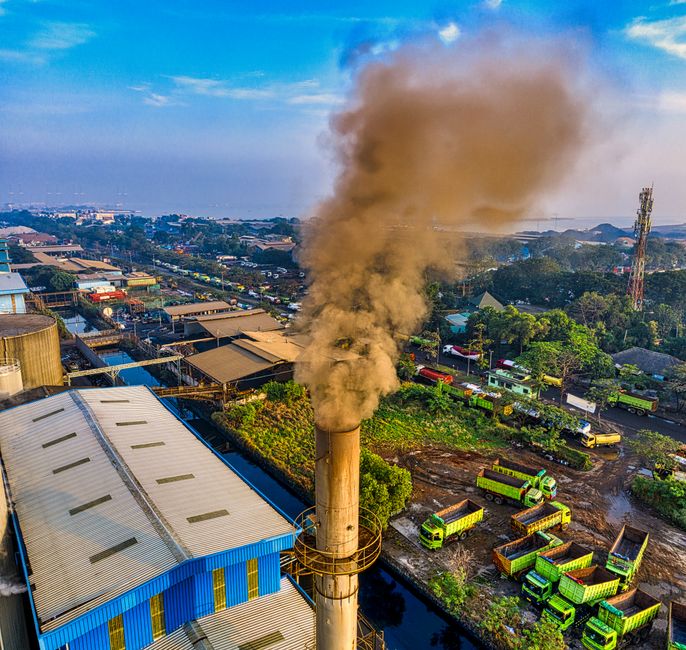
Cement is the most widely used building material on Earth, and its production is a major source of carbon dioxide. The industry is responsible for roughly 8% of global CO2 emissions. Reducing these emissions involves a combination of improving energy efficiency, switching to alternative fuels, changing the chemical recipe of cement, and capturing the CO2 before it reaches the atmosphere. The most significant challenge is that about half of the emissions come from the chemical process itself, not just from burning fuel, which means efficiency alone cannot solve the problem.
Why Is Cement Production So Hard To Decarbonize?
The core issue is the chemistry of making clinker, the key ingredient in Portland cement. To make clinker, limestone is heated to extreme temperatures in a kiln. This process, called calcination, releases CO2 directly from the limestone. This is not a side effect of burning fuel; it is a fundamental part of the chemical reaction. Even if a cement plant ran entirely on solar power, it would still produce massive amounts of CO2 from this step alone.
The second source of emissions is the thermal energy required to heat the kiln to around 1450°C. Traditionally, this heat comes from burning fossil fuels like coal and petcoke. The combination of process emissions and fuel combustion makes cement one of the most difficult industrial sectors to clean up. It is not a problem of simple inefficiency; it is a problem of fundamental process redesign.
How Can Alternative Fuels Reduce Emissions?
Substituting fossil fuels with waste-derived or biomass fuels is one of the most immediate ways to lower the carbon footprint of a cement plant. Materials like treated municipal solid waste, used tires, sewage sludge, and agricultural residues can replace a significant portion of the coal and coke used in the kiln. The high temperatures and long residence times in a cement kiln make it an effective environment for combusting these materials completely.
The emissions benefit depends on the fuel source. Biomass is considered carbon-neutral because the CO2 released during combustion was recently absorbed from the atmosphere by the plants. Waste-derived fuels are more complex; they often contain a mix of biogenic and fossil carbon. Using these fuels reduces reliance on virgin fossil resources, but it does not eliminate emissions. Many plants now achieve a thermal substitution rate of 50% or higher, but the real ceiling for this strategy is limited by fuel availability and the need to maintain product quality.
What Is The Role Of Clinker Substitution?
Clinker is the energy-intensive and emission-intensive part of cement. The simplest way to reduce emissions is to use less of it. This is done by blending clinker with supplementary cementitious materials (SCMs) like fly ash from coal power plants, granulated blast furnace slag from steel production, or natural pozzolans like volcanic ash. The resulting blended cement has a lower clinker factor and therefore a lower carbon footprint.
The practical limit here is twofold. First, the supply of traditional SCMs is shrinking as the steel and coal industries themselves decarbonize. Second, there are standards and performance requirements that limit how much clinker can be replaced in certain applications. While blended cements are standard practice, the industry cannot simply reduce the clinker factor to zero. The availability of quality SCMs is a growing constraint that requires new sources of materials to be developed.





How To Reduce Co2 Emissions In The Cement Industry With New Binders?
Beyond tweaking Portland cement, researchers are developing entirely new types of cement with lower inherent emissions. These include alkali-activated materials, which use industrial wastes activated by alkaline solutions, and calcium sulfoaluminate (CSA) cements, which require less limestone and lower kiln temperatures. These alternatives can potentially reduce CO2 emissions by 30% to 50% compared to traditional Portland cement.
However, these materials face significant hurdles. They often require different raw materials, different manufacturing processes, and different handling procedures on construction sites. Building codes and standards are written around Portland cement performance, making it difficult for new materials to gain approval. Scaling from laboratory success to mass production is a slow process. These novel cements are promising, but they are not yet ready to replace Portland cement on a global scale.
Can Carbon Capture Actually Work In Cement Plants?
Carbon capture, utilization, and storage (CCUS) is widely considered the most critical technology for deep decarbonization of the cement industry. Because so many emissions come from the chemical process itself, capture is the only way to deal with them directly. The technology involves separating CO2 from the flue gas and either storing it underground or using it as a raw material for other products.
There are several capture technologies being tested at commercial scale. Oxy-fuel combustion burns the fuel in pure oxygen, producing a concentrated stream of CO2 that is easier to capture. Amine-based post-combustion capture scrubs CO2 from the exhaust gases after combustion. Calcium looping uses a calcium-based sorbent to capture CO2 in a cyclical process. These methods are technically feasible, but they require large amounts of additional energy and significant capital investment.
The main barrier is cost and infrastructure. Capturing CO2 requires substantial energy, which reduces the plant’s overall efficiency. Transporting and storing the captured CO2 requires pipelines and geological storage sites that do not exist everywhere. While several demonstration projects are underway, CCUS remains expensive and is not yet deployed at the scale needed to make a meaningful dent in global emissions.
What Is The Impact Of Energy Efficiency Improvements?
Improving the energy efficiency of cement plants is a necessary but insufficient step. Modern dry-process kilns with preheater and precalciner towers are significantly more efficient than older wet-process kilns. Retrofitting older plants with these technologies can reduce fuel consumption and associated emissions by a substantial margin. Waste heat recovery systems can also capture excess heat to generate electricity for the plant.
These measures are considered low-hanging fruit. They save money and reduce emissions at the same time. However, the law of diminishing returns applies. The most efficient plants in the world are already approaching the thermodynamic limits of the current process. Efficiency gains can only address the fuel-related emissions, which are roughly half of the total. They cannot address the process emissions from limestone calcination, which will always occur as long as Portland cement is made this way.
Frequently Asked Questions
What is the single most effective way to reduce cement emissions?
Carbon capture and storage is the only technology that can address the process emissions from limestone calcination, which account for about half of the total. Efficiency improvements and fuel switching are helpful but cannot eliminate these inherent chemical emissions.
Can we make cement without using limestone?
Yes, alternative cements like alkali-activated materials and calcium sulfoaluminate cement use less or no limestone. These are not yet widely adopted because of performance standards, raw material availability, and the need for large-scale production infrastructure.
Is green concrete the same as low-carbon cement?
No, green concrete often refers to the use of recycled aggregates or other mix designs that reduce the total cement content. Low-carbon cement specifically refers to reducing the emissions from the cement or clinker production process itself.
Are carbon emissions from cement the same as those from burning fuel?
No, roughly half of cement emissions come from the chemical reaction of heating limestone, not from burning fuel. This is why simply switching to renewable energy at a cement plant cannot make the process carbon-neutral.
