
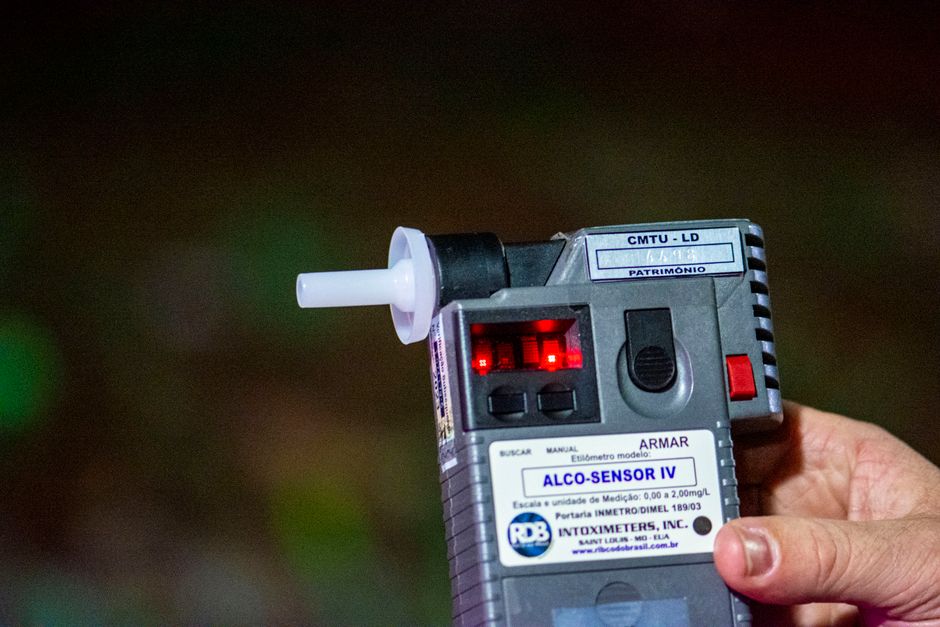
A breathalyzer measures the amount of alcohol in your breath and converts it to an estimate of your Blood Alcohol Concentration (BAC). The number displayed is a percentage, such as 0.08, which means 0.08 grams of alcohol per 100 milliliters of blood. For most drivers in the United States, a BAC of 0.08% or higher is legally too impaired to drive. For commercial drivers, the legal limit is 0.04%, and for drivers under 21, most states enforce a zero-tolerance limit of 0.02% or lower.
What Exactly Does the Number on a Breathalyzer Mean?
The number on a breathalyzer screen is your estimated Blood Alcohol Concentration. It is not a direct measurement of the alcohol in your blood. Instead, the device measures the alcohol vapor in your deep lung air and uses a standard ratio to estimate blood alcohol.
The science works because alcohol is volatile. When you drink, alcohol moves from your stomach and intestines into your bloodstream. As blood passes through your lungs, some of that alcohol evaporates into the air sacs. The amount of alcohol in your breath is directly related to the amount in your blood. The typical ratio used is 2100 to 1, meaning 2100 milliliters of breath contains the same alcohol as 1 milliliter of blood. This ratio is the basis for the estimate, but it varies slightly between individuals.
This is why the device is legally called an “evidential breath tester” in many jurisdictions. It provides an estimate that courts accept as evidence, but it is still an estimate based on a physiological average, not a direct blood test.
What Is a Legal BAC Limit?
In all 50 states, the legal limit for a non-commercial driver aged 21 and over is 0.08%. This is a federal standard that states adopted to receive federal highway funding. It applies to standard passenger vehicles.
Different limits apply to specific groups:
- Commercial drivers: 0.04% is the federal limit for operating a commercial vehicle.
- Drivers under 21: Most states enforce a zero-tolerance policy. Any measurable alcohol, typically 0.02% or higher, can result in a license suspension.
- Boating: Many states apply the same 0.08% limit to boat operators.
Being below the legal limit does not mean you are safe to drive. Impairment begins well before 0.08%. Research consistently shows that driving skills, reaction time, and judgment start to decline at BAC levels around 0.02% to 0.03%. The legal limit is a threshold for prosecution, not a threshold for safety.
How Accurate Are Breathalyzer Readings?
Professional-grade breathalyzers used by law enforcement are generally accurate when properly calibrated and used correctly. These devices are approved by the National Highway Traffic Safety Administration and must pass strict testing standards. However, they are not infallible.
Several factors can affect the accuracy of a breathalyzer reading:
- Calibration: Devices must be calibrated regularly. A device that is out of calibration can read higher or lower than the true value.
- Mouth alcohol: If you have recently consumed alcohol, vomited, or used mouthwash, residual alcohol in your mouth can cause a falsely high reading. Officers are trained to observe you for 15 to 20 minutes before testing to allow mouth alcohol to dissipate.
- Temperature: Body temperature affects the alcohol-to-breath ratio. A slightly elevated body temperature can increase the reading.
- Hematocrit: The ratio of red blood cells to plasma affects the blood-to-breath partition. People with low hematocrit can have readings that differ from their actual blood alcohol.
- Interfering substances: Some compounds in the environment or on your breath can be detected as alcohol. Modern fuel-cell sensors are more specific than older technology, but they are not perfect.
Consumer breathalyzers sold for personal use are less accurate than law enforcement devices. They use the same sensor technology but often have fewer quality controls. Some studies suggest that inexpensive consumer devices can vary significantly from actual blood alcohol levels. If you use one, treat the reading as a rough estimate, not a precise measurement.




What Do Different BAC Numbers Mean for Your Body?
As BAC rises, the effects on your body and brain become more pronounced. These effects are well documented in clinical research and are consistent across most people, though tolerance can mask some symptoms.
- 0.02%: Slight mood elevation, relaxation, and a mild loss of judgment. Some people experience a slight decline in visual function.
- 0.05%: Noticeable relaxation, reduced coordination, and slower reaction times. Judgment is impaired. This level is below the legal limit but is associated with measurable driving impairment.
- 0.08%: Legal limit for driving. Muscle coordination is reduced, balance is affected, and reaction time is significantly slower. Speech may be slightly slurred.
- 0.10%: Clear loss of coordination, slowed thinking, and difficulty with fine motor skills. Reaction time is markedly delayed.
- 0.15%: Major impairment in balance, coordination, and motor control. Vomiting may occur. This level represents a severe intoxication state.
- 0.30% and above: Stupor, loss of consciousness, and risk of alcohol poisoning. This is a medical emergency.
Tolerance changes how you feel at these levels, but it does not change how your body is actually impaired. A person who drinks daily may feel fine at 0.08%, but their reaction time and judgment are still measurably worse than when sober.
How Long Does Alcohol Stay in Your System?
Your liver processes alcohol at a fairly constant rate. On average, the liver metabolizes about one standard drink per hour. A standard drink is defined as 12 ounces of beer, 5 ounces of wine, or 1.5 ounces of distilled spirits.
This rate translates to a BAC drop of roughly 0.015% to 0.02% per hour. If your BAC is 0.08%, it will take approximately 4 to 5 hours for your BAC to reach zero. This rate does not change based on how much coffee you drink, how much water you consume, or whether you eat food. Those things affect how quickly alcohol is absorbed into your bloodstream, but once the alcohol is in your blood, only time lowers your BAC.
There is no way to speed up the elimination of alcohol. Cold showers, exercise, and vomiting do not lower your BAC. They may make you feel more alert temporarily, but the alcohol remains in your blood and breath.
If you are trying to estimate when you will be sober, add a buffer. The metabolic rate varies between individuals. Factors like age, liver health, sex, and body composition all influence how quickly you process alcohol. Women generally metabolize alcohol slightly slower than men due to lower levels of the enzyme alcohol dehydrogenase in the stomach.
Can You Challenge a Breathalyzer Result in Court?
Breathalyzer results can be challenged, and they often are. The most common defenses involve procedural errors and device maintenance issues.
Law enforcement officers must follow specific protocols when administering a breath test. These include observing the subject for a period before the test, using approved devices, and following calibration schedules. If an officer did not follow these procedures, the result may be suppressed by a judge.
Common challenges include:
- Improper calibration: If the device was not calibrated according to the manufacturer’s schedule, the reading may be unreliable.
- Mouth alcohol contamination: If the officer did not observe the subject for the required period, mouth alcohol from recent drinking or regurgitation could inflate the reading.
- Medical conditions: Acid reflux, diabetes, or certain diets can produce substances on the breath that some devices may misread as alcohol. This is rare with modern fuel-cell sensors but has been documented.
- Rising blood alcohol: If you drank shortly before driving, your BAC may have been rising at the time of the test. The test result may be higher than your BAC at the time you were actually driving.
An experienced DUI attorney can evaluate whether any of these factors apply to your case. Breathalyzer results are strong evidence, but they are not unassailable.
How To Read A Breathalyzer What The Numbers Mean for Your Safety
Understanding your BAC is useful, but the practical takeaway is simple: if you have been drinking, do not drive. The number on a breathalyzer is a legal and medical indicator, but it cannot tell you whether you are personally safe to drive.
Impairment varies by individual. Some people are significantly impaired at 0.04%, while others show less visible impairment at the same level. The number does not account for your fatigue level, your medications, your emotional state, or your driving experience. All of these factors interact with alcohol to affect your driving ability.
If you have access to a personal breathalyzer, use it as a rough guide, not as a decision tool. A reading of 0.05% does not mean you are safe to drive. A reading of 0.00% does not mean you are sober if you consumed alcohol earlier and the device is inaccurate. The only reliable strategy is to plan ahead: designate a driver, use a ride-sharing service, or stay where you are until you are fully sober.
Frequently Asked Questions
How does a breathalyzer measure alcohol?
A breathalyzer measures the amount of alcohol vapor in your breath and converts it to an estimated blood alcohol concentration using a standard ratio. The device estimates the alcohol in your blood based on the alcohol in your deep lung air.
What does 0.08 mean on a breathalyzer?
A reading of 0.08 means your blood alcohol concentration is 0.08%, which is the legal limit for driving in all 50 states. At this level, you are legally presumed impaired and can be arrested for DUI.
Can mouthwash make a breathalyzer read high?
Yes, mouthwash that contains alcohol can cause a falsely high reading if you are tested shortly after using it. Law enforcement officers are trained to wait 15 to 20 minutes before testing to allow mouth alcohol to dissipate.
How long until a breathalyzer reads zero after drinking?
Your BAC drops at an average rate of about 0.015% to 0.02% per hour. If your BAC is 0.08%, it will take roughly 4 to 5 hours to reach zero, but this varies by individual factors like weight, sex, and liver health.
