
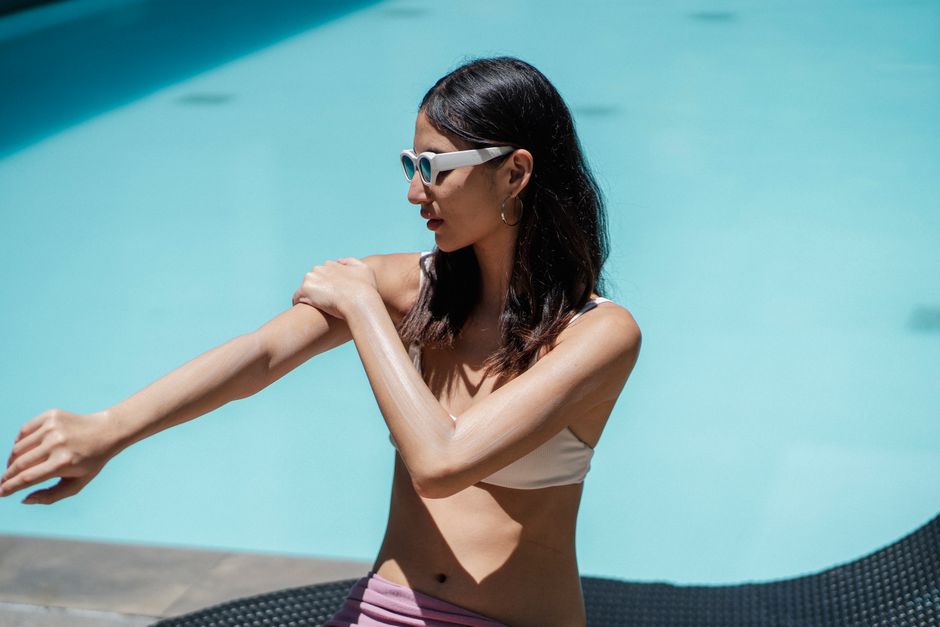
Tanning beds emit mostly UVA radiation, and UVA penetrates deeper into the hair shaft than UVB does. The single most effective way to protect your hair in a tanning bed is to physically cover it. A close-fitting cotton cap, a silk scarf, or a purpose-made hair wrap blocks essentially all UV exposure to the scalp and strands. Leave-in products and UV filters can help at the margins, but no topical product matches the protection of simply covering your hair.
How To Protect Hair In A Tanning Bed From Damage
Coverage is the foundation. Everything else is secondary.
A snug cotton beanie, a silk scarf wrapped close to the scalp, or a disposable plastic cap all work. The key is that the fabric or material sits between your hair and the light source with no gaps. Loose wraps leave exposed sections, and those sections take the full dose.
If you use a towel, fold it so the thickness is consistent. A single-layer towel can let meaningful UV through, especially if the fabric is thin or light-colored. Dark, tightly woven fabric blocks more.
Some salons provide disposable caps. If yours does not, bring your own. It takes seconds to put on and removes the entire question of UV hair damage during the session.
For people who want to tan their scalp or part line — this is a common reason people skip the cap — the trade-off is direct UV exposure to both hair and skin. Scalp skin is thin and sun-sensitive. The hair loss risk and skin cancer risk both apply.
Does UV Light From a Tanning Bed Actually Damage Hair?
Yes. UVA and UVB both degrade hair, but they do it differently.
UVB mostly attacks the outer cuticle layer. It breaks down the protein structure and lifts the cuticle scales, which is what makes hair feel rough and look dull. UVA penetrates deeper into the cortex — the inner bulk of the hair shaft — where it damages melanin and keratin. This is the mechanism behind the well-documented lightening effect: UVA oxidizes melanin pigment, which is why hair gets lighter after sun or tanning bed exposure even without chemical bleach.
Beyond color, UV exposure breaks disulfide bonds in the hair. Those bonds are what give hair its strength and shape. When they break, hair loses tensile strength, becomes more porous, and splits more easily. This is established photochemistry, not speculation.
What is less clear is how much damage a typical tanning session causes compared to, say, a day at the beach. Tanning beds concentrate UVA in a short window, and the dose to exposed hair can be substantial. But individual hair type, prior chemical treatment, and session length all change the outcome. The general direction is not in dispute: repeated UV exposure weakens hair over time.
Why Bleached, Colored, or Chemically Treated Hair Is More Vulnerable
Chemical treatments strip the cuticle and break internal bonds before UV ever reaches the hair. That leaves the shaft starting from a weaker position.
Bleached hair has already lost much of its melanin and cuticle integrity. UV exposure then accelerates the same damage pathways. The result is faster color fade, more breakage, and a rougher texture. Hair that has been relaxed, permed, or repeatedly colored behaves similarly.
Natural, untreated hair is not immune. It just has more structural reserve before damage becomes visible. Virgin dark hair can still lighten and weaken under repeated UV exposure, it simply takes longer.
If your hair is already damaged, a tanning bed session without coverage adds insult to injury. This is one of the few areas where the practical advice is unambiguous: cover it.

Do UV-Protective Hair Products Work?
Some do, but the evidence is limited and the protection is partial.
Leave-in conditioners and oils can reduce moisture loss and add a physical barrier. Products labeled with UV filters — ingredients like benzophenone derivatives or certain plant-derived antioxidants — may reduce some oxidative damage in laboratory testing. Whether they meaningfully protect human hair during a real tanning session is not well established.
No topical product blocks UV the way fabric does. A spray or serum might reduce damage at the margins. It will not prevent it. Treat these products as a supplement to coverage, not a replacement.
One practical note: some oils and leave-ins can make hair more prone to heat damage if you use a tanning bed with fans or heat. And heavy product buildup can attract dust and make the scalp feel uncomfortable under a cap. Keep it simple.
If you want to use a UV-protective spray, apply it before putting on your cap. It may help the hair that sits closest to the edges. It will not help hair that is fully covered, because no light reaches it.
What About the Scalp and Hairline?
The scalp is skin, and it burns. A tanning bed delivers UVA and UVB to any exposed scalp, and the part line, temples, and hairline are common burn sites.
If you cover your hair, you also cover your scalp. That is one of the practical benefits of a cap or scarf — it solves both problems at once. If you leave hair uncovered to tan the scalp, you are exposing thin, sun-sensitive skin to concentrated UV. The long-term skin cancer risk from tanning bed use is well documented and applies to the scalp like any other exposed area.
For people with thinning hair or a receding hairline, the exposed scalp area is larger. That means more UV reaches both skin and the remaining hair. Coverage matters more, not less.
Practical Steps Before, During, and After a Session
Good habits reduce cumulative damage. None of them replace covering your hair.
- Before: Apply a leave-in conditioner or UV-protective product if you use one. Detangle gently to avoid breakage when you put on and remove the cap.
- During: Wear a close-fitting cotton cap, silk scarf, or disposable cap. Make sure no sections of hair are sticking out.
- After: Remove the cap gently. Rinse or wash with a mild shampoo if you used heavy product. Follow with a conditioner to restore moisture.
- Between sessions: Limit frequency. Cumulative UV exposure is what drives most hair and skin damage, not any single session.
- If hair is already damaged: Skip chemical treatments and heat styling until it recovers. Damaged hair does not repair itself, but you can stop making it worse.
Deep conditioning and protein treatments can improve the feel and manageability of UV-damaged hair. They do not rebuild the internal structure that UV has broken. Think of them as damage control, not repair.
Does SPF for Hair Exist and Does It Matter?
Products marketed as “hair sunscreen” or “UV hair protection” exist. The evidence that they prevent meaningful damage during tanning bed use is thin.
Part of the problem is formulation. Hair is not skin. Products that sit on the surface of the shaft do not absorb UV the way sunscreen absorbs into skin. They can coat the hair and provide some physical blocking, but the protection factor is not standardized the way SPF is for skin. There is no equivalent rating system for hair products.
Some research suggests that certain antioxidants and UV filters reduce oxidative stress on hair fibers in lab conditions. Whether that translates to real-world protection during a tanning session has not been well studied. The honest position: these products may help a little, and they are unlikely to hurt, but they are not a substitute for covering your hair.
If you are going to spend money on hair protection for tanning, spend it on a good cap or scarf first.
Frequently Asked Questions
Can I tan my scalp without damaging my hair?
You can tan exposed scalp skin, but you cannot protect the hair on that area from UV at the same time. Any hair left uncovered will receive the full UV dose and can weaken or lighten over repeated sessions.
Does a regular cotton cap protect hair in a tanning bed?
A tightly woven cotton cap blocks essentially all UV from reaching covered hair. The key is a snug fit with no exposed sections, since any hair sticking out takes the full dose.
How long does it take for tanning beds to damage hair?
There is no established timeline, because damage depends on hair type, prior chemical treatment, session length, and how often you tan. What is clear is that damage accumulates with repeated exposure rather than appearing after one session.
Can UV-damaged hair be repaired?
No. Once UV breaks bonds inside the hair shaft, that structure does not regenerate. Conditioners and protein treatments can improve how damaged hair feels and behaves, but they do not restore its original strength.
