
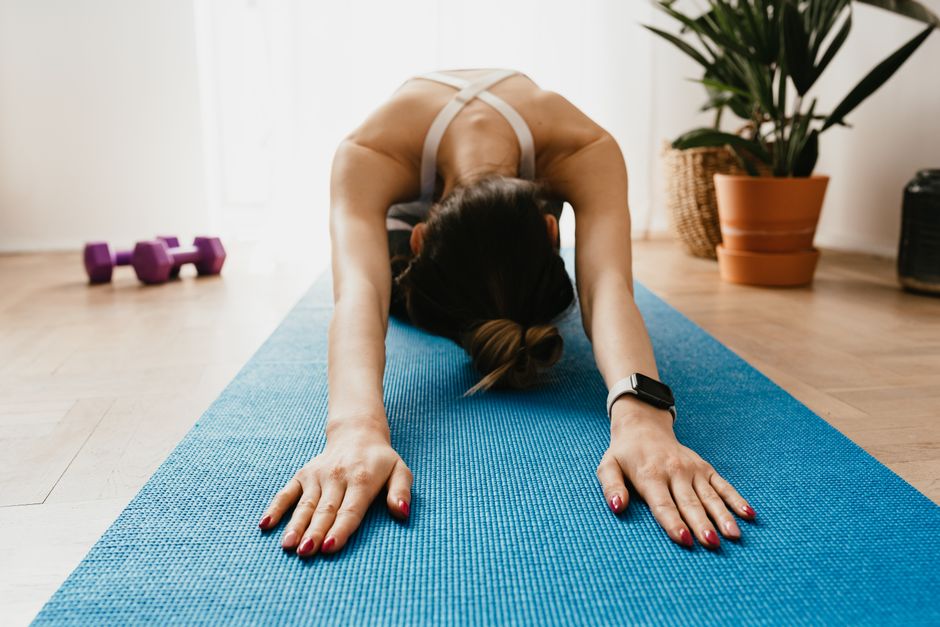
Yoga is one of the most accessible forms of movement there is. You do not need to be flexible, young, or athletic to start. The core of a beginner’s practice is simple: learn a handful of foundational poses, breathe steadily while you hold them, and build a routine you can repeat a few times a week.
That is the whole idea. Everything else — the different styles, the props, the studios — is detail you can add over time. What matters first is showing up on your mat and moving in a way that feels controlled and pain-free.
What Is Yoga, Exactly?
Yoga is a practice that combines physical postures, breathing techniques, and focused attention. The physical side is what most Western classes emphasize, but the tradition itself is broader and older than the stretching-and-posing version many people picture.
The word comes from a Sanskrit root meaning to join or unite. In its traditional forms, yoga is a discipline aimed at training the body and mind together. Modern studio yoga usually borrows the postures and breathwork while leaving most of the philosophy aside. That is fine for a beginner. You can practice the movement and still get real physical benefit.
What makes yoga different from, say, a standard gym workout is the attention to breath and alignment. You are not just moving weight. You are moving slowly, holding positions, and coordinating each movement with your breathing. That combination is part of why it feels different from lifting or running.
What Are the Most Common Beginner Yoga Styles?
Most beginner-friendly classes fall into a few broad categories. The names can be confusing because studios use them loosely, but the general differences are real.
Hatha is a slow, general term for classes that hold poses for a while. It is usually the gentlest entry point.
Vinyasa links poses together in a flowing sequence that moves with the breath. It tends to be faster and more physically demanding.
Iyengar focuses on precise alignment and often uses props like blocks, straps, and bolsters. It can be a good fit if you want detailed instruction.
Yin involves holding poses for several minutes at a time, targeting connective tissue. It is slow and quiet.
Restorative uses props to support the body in comfortable positions. It is more about relaxation than effort.
There are also heated styles, sometimes called hot yoga, practiced in a warm room. Heat adds cardiovascular demand and raises the risk of dehydration and overheating. If you have heart conditions, are pregnant, or take medications that affect sweating or blood pressure, talk to a clinician before trying a heated class.
How Do You Start a Beginner Yoga Practice at Home?
You can start with nothing more than a mat and about 15 to 20 minutes. A short, consistent practice beats a long one you do once.
Pick a time you can protect. Morning works for some people because it happens before the day fills up. Evening works for others. The specific time matters less than the consistency.
Begin with a warm-up, move through a few foundational poses, and finish with a few minutes of quiet rest. That structure — warm up, work, cool down — is standard across most styles and helps reduce injury risk.
Here is a simple starting sequence you can repeat:
- Seated breathing for one to two minutes
- Cat-cow to warm the spine
- Downward-facing dog
- Standing forward fold
- Low lunge on each side
- Warrior I and Warrior II on each side
- Child’s pose
- Seated forward fold
- Lying twist, then a few minutes resting flat
Move slowly. If a pose hurts — not stretches, but hurts — back off or skip it. Sharp pain is a signal to stop, not push through.





What Equipment Do You Actually Need?
A mat is the only real requirement, and even that is optional on a carpeted floor. Everything else is a comfort or support tool.
| Item | What it does | Needed? |
|---|---|---|
| Yoga mat | Grip and cushioning | Helpful |
| Blocks | Bring the floor closer in standing and seated poses | Optional |
| Strap | Extends reach for tight hamstrings or shoulders | Optional |
| Bolster | Support in restorative poses | Optional |
| Blanket | Padding for knees and hips | Optional |
Props are not a sign of weakness. They let you hold a pose with good alignment instead of forcing a shape your body is not ready for. A stack of books can stand in for a block. A belt or towel can stand in for a strap.
How Often Should a Beginner Practice?
Two to three sessions a week is a reasonable starting point for most healthy adults. Consistency matters more than duration or intensity.
A short practice you repeat regularly will do more than a long session once a month. If you are new to movement in general, start with one or two sessions a week and add more as your body adapts.
Some people practice daily. Others do it a few times a week alongside other exercise. There is no single correct frequency, and no established guideline sets an exact number. The general principle from exercise science applies here: some activity is better than none, and more is better up to a point that your recovery can handle.
If you feel unusually sore, tired, or irritable, that is a sign to ease off. Rest is part of the practice.
Is Yoga Safe, and Who Should Be Careful?
For most healthy adults, yoga is a low-risk form of physical activity. Injuries do happen, but they are usually linked to pushing too hard, poor instruction, or pre-existing conditions.
The most common yoga injuries involve the wrists, shoulders, lower back, hamstrings, and knees. Many are avoidable with good form and patience. A beginner who tries to force a deep backbend or a full split on day one is asking for trouble.
Certain groups should check with a clinician first:
- People with uncontrolled high blood pressure or heart conditions
- People with recent surgery, fractures, or joint injuries
- Pregnant women, especially in heated classes or deep twists
- People with glaucoma or certain eye conditions, because some inverted poses raise pressure inside the eye
- People with osteoporosis or spinal conditions, who should avoid deep forward folds and twists
This is not a complete list, and it is not medical advice. If you have a health condition, ask your doctor whether yoga fits your situation and which poses to modify.
What Are the Real Benefits — and What Is Overhyped?
Yoga improves flexibility, balance, and muscular strength, particularly in the core and upper body. Those effects are well documented.
Research also suggests yoga can help reduce perceived stress and improve sleep quality in some people. Studies on chronic low back pain have found yoga can reduce pain and improve function in some patients, though results vary and it is not a cure. Some evidence indicates modest improvements in blood pressure and heart rate variability, but the effect sizes are generally small and inconsistent across studies.
What yoga is not: a replacement for medical treatment. It does not cure disease, reverse chronic conditions, or substitute for medication. Claims that it detoxifies the body or balances hormones in a specific way are not supported by clinical evidence. The body detoxifies itself through the liver and kidneys. No pose changes that.
It is also not a weight-loss method on its own. Some styles burn calories, but the amounts are modest compared to cardio or strength training. If weight loss is your goal, yoga can be part of a broader plan, not the whole plan.
The honest summary: yoga is a genuinely useful form of movement with real, modest benefits for flexibility, strength, balance, and stress. It is not a miracle practice, and no credible evidence supports treating it as one.
How Do You Breathe and Move Safely as a Beginner?
Breath is the thread that holds a yoga practice together. The general rule is to move on the breath, not against it.
In most styles, you inhale as you lengthen or open, and exhale as you fold or contract. If you cannot breathe smoothly in a pose, that is a signal you have gone too far. Ease back until the breath is steady again.
Never hold your breath to force a position. Straining while holding your breath raises blood pressure and increases injury risk. If a teacher cues a breath pattern that feels wrong for your body, you can ignore it and breathe normally.
Alignment matters too. Keep joints in their natural range, avoid locking your knees, and protect your lower back by engaging your core in forward folds and backbends. If you are unsure whether your form is right, a few sessions with a qualified instructor can help. Look for someone with recognized training and experience teaching beginners.
Frequently Asked Questions
Do I need to be flexible to start yoga?
No. Flexibility is a result of practice, not a requirement for it. Beginners can use props and modified poses to work within their current range.
How long does a beginner yoga session need to be?
Fifteen to 20 minutes is enough to start. Consistency across the week matters more than the length of any single session.
Can yoga help with back pain?
Some studies suggest yoga can reduce pain and improve function in people with chronic low back pain, though results vary. It is not a substitute for medical evaluation if pain is severe or persistent.
Is hot yoga safe for beginners?
It can be, but the heat raises the risk of dehydration and overheating. People who are pregnant or have heart conditions should talk to a clinician before trying it.
