
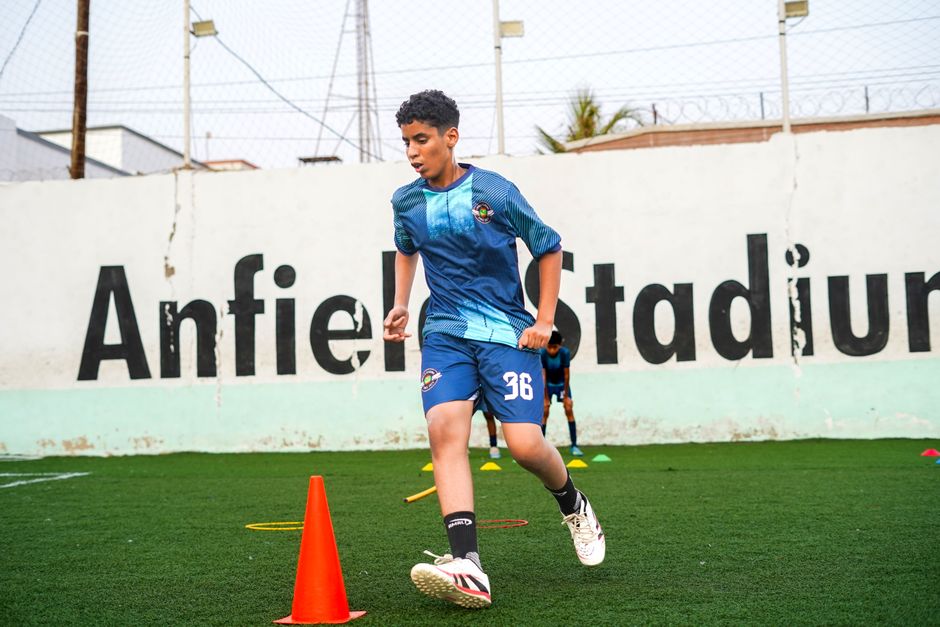
You can improve at soccer alone. The catch is that solo practice has to be deliberate rather than just time spent with a ball. Players who get better on their own set a specific target for each session, use repetition to build touch and control, and add fitness and game-watching work that a wall or a small space can support. What solo practice cannot fully do is teach you to read live opponents — so the smart approach combines it with team play when you can get it.
How To Practice Soccer Alone And Actually Improve?
Improvement comes from three things: enough repetitions to build touch, enough intensity to build fitness, and enough feedback to correct mistakes. Solo practice can deliver all three if you structure it.
The reason many players plateau is that they practice without a target. Kicking a ball against a wall for twenty minutes feels productive. It becomes productive when you decide what you are trying to fix — first touch, weak foot, turning under pressure — and repeat that specific action until it feels automatic.
Skill acquisition research consistently shows that focused, repeated practice with feedback beats unfocused volume. You do not need a coach standing next to you to create feedback. A wall tells you if your touch was too heavy. A cone tells you if your pass was off line. Your own standards tell you the rest.
What Can You Realistically Improve Practicing Alone?
You can make real gains in ball mastery, first touch, passing accuracy, shooting technique, and aerobic fitness. These are individual skills that depend on your own coordination and repetition, not on another player.
What solo work builds well:
- Close control. Dribbling in tight spaces, changing direction, keeping the ball within a step of your feet.
- First touch. Receiving a ball from a wall and setting it where you want it on the first contact.
- Weak foot. The single biggest gap for most amateur players, and the easiest to work on alone.
- Striking technique. Learning to strike through the ball cleanly with the laces, inside, and outside of the foot.
- Conditioning. Repeated sprints, interval running, and ball-based fitness work.
What solo practice does not replace is decision-making against a live opponent. Reading when to pass, when to hold, and where space is opening happens at game speed with real defenders. Solo work builds the tools. Games teach you when to use them.
What Equipment Do You Actually Need?
A ball, a wall, and a small flat space cover most solo training. You do not need a full field or expensive gear to improve touch and technique.
A solid wall is the most useful training partner you have. It returns the ball at the speed you played it, which means it gives you honest feedback on weight and accuracy. Any flat wall works — a garage, a school, a handball court.
A few cones or markers help you create gates and targets. Shoes matter for striking work: wear cleats on grass and flat-soled shoes on hard surfaces so you do not slip. Beyond that, extra equipment is optional. Fancy training aids do not replace repetitions.





How Should You Structure a Solo Session?
Warm up first, then work from simple to complex, and finish with something that raises your heart rate. A session built this way covers touch, technique, and fitness without wasting time.
A simple structure that works for most players:
- Warm-up (5–10 minutes). Light jogging, dynamic movement, and easy ball touches to get your body ready.
- Technical block (15–20 minutes). One or two specific skills. Weak-foot passing against the wall. First-touch control. Turns and changes of direction.
- Striking or finishing (10–15 minutes). Shooting into a target, or long passing to a spot. Focus on clean contact, not power.
- Conditioning (10 minutes). Sprints, shuttle runs, or fast footwork with the ball.
- Cool-down (5 minutes). Easy movement and stretching.
Keep the technical block focused. Working on one skill for fifteen focused minutes beats scattering across five skills for three minutes each. Repetition is what builds the skill.
How Do You Use a Wall to Train Touch and Passing?
The wall is the best solo training tool because it forces you to control a moving ball and pass it back accurately, over and over. Use it to build first touch, one-touch passing, and both feet.
Start with two-touch passing: receive the ball, then pass it back. Focus on a clean first touch that sets the ball slightly to the side so your next pass is easy. As you improve, move to one-touch passing, where you redirect the ball back without stopping it.
Then add constraints. Pass only with your weak foot. Pass and then turn before the ball returns. Receive with one foot and pass with the other. These small rules mimic the demands of a game, where you rarely get to stand still and take a comfortable touch.
One clarification worth knowing: a wall returns the ball at the speed you sent it, so it rewards good weight and punishes heavy touches immediately. That instant feedback is exactly what makes it useful. Treat every return as a live ball you have to control.
How Do You Improve Your Weak Foot Alone?
Use your weak foot for everything for a set period of each session. Deliberate repetition on the weaker side is the most direct way to close the gap between your two feet.
Most players avoid their weak foot because it feels clumsy. That discomfort is the signal you are training the right thing. Start with simple passes against the wall using only the weak foot. Then move to weak-foot dribbling, weak-foot shooting, and weak-foot first touch.
Do not expect quick results. Coordination on a non-dominant side takes weeks of consistent work to feel natural — that is normal, not a sign you are failing. The players who improve fastest are the ones who accept the awkward phase and keep going.
How Can You Improve Fitness Alone?
Soccer fitness is about repeated bursts of effort with short recovery, not steady jogging. Solo conditioning should mimic that pattern with intervals and ball-based work.
Interval running — hard efforts followed by short recovery — trains the same energy systems the game demands. You can also build fitness with the ball: fast footwork, repeated sprints to a cone and back, or high-tempo dribbling drills. These raise your heart rate while keeping your touch sharp.
Regular aerobic work still matters for recovery between efforts, but it should not be your only conditioning. Mix in shorter, harder efforts to prepare for the stop-start nature of a match.
How Do You Stay Motivated Training Alone?
Set small, measurable goals and track them. Motivation holds up better when you can see progress rather than just feel like you worked hard.
Pick one target for the week — say, twenty clean weak-foot passes in a row, or ten accurate long passes to a target. Measure it at the start and again at the end. Visible progress is the most reliable fuel for solo training.
Training with a plan also helps you avoid the trap of doing the same comfortable drill every session. Comfort is not the goal. Slight difficulty, repeated until it becomes easy, is where improvement happens.
Frequently Asked Questions
Can you really get better at soccer by practicing alone?
Yes, for individual skills like touch, weak foot, passing accuracy, and fitness. Solo practice cannot fully replace game experience against live opponents, so combine it with team play when possible.
How long should a solo soccer session be?
Most players get good value from 45 to 60 minutes, including warm-up and cool-down. Shorter, focused sessions done consistently beat long, unfocused ones.
What is the best solo soccer drill?
Wall passing with both feet is one of the most effective because it builds first touch, passing accuracy, and weak-foot control at the same time. There is no single best drill — the best one targets your specific weakness.
How often should you practice soccer alone to improve?
A few focused sessions per week, done consistently, will produce noticeable improvement over time. Consistency matters more than the length of any single session.
