
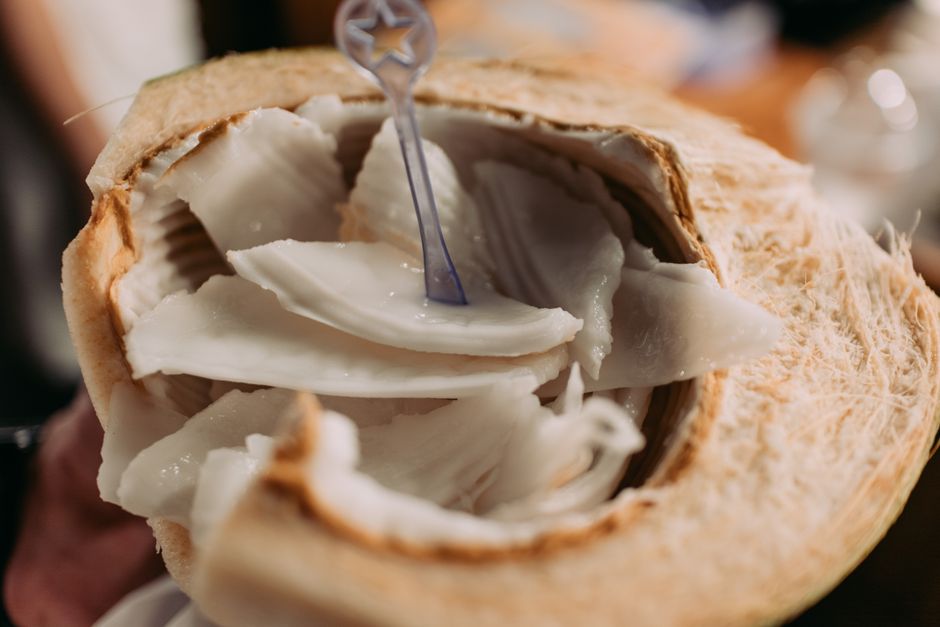
Opening a coconut without losing its water comes down to two things: draining the liquid through a hole before you crack the shell, and cutting along the shell’s natural seam instead of smashing the middle. A young green coconut holds the most water, and the cleanest method is to slice a flat opening at the pointed top with a heavy knife, pour the water into a glass, then crack the empty shell. A mature brown coconut works the same way — find the three “eyes,” pierce the softest one, drain the water, then split the shell.
How To Open A Coconut Without Spilling The Water?
The reliable method is to open a small hole first, drain the water, and only then break the shell. Trying to crack a full coconut in one blow is what causes the spill. The water needs somewhere to go before the shell splits.
For a green coconut, lay it on its side and cut off the top with a heavy, sharp knife in short downward strokes, angling the blade away from your hand. You are removing a cone-shaped cap, not chopping the middle. Once you see the white flesh and the hollow center, tip the coconut over a glass.
For a brown coconut, set it on a stable surface and locate the three round marks at one end. Two are hard. One is softer. Push a clean screwdriver, a sturdy skewer, or a nail through the soft one. Invert the coconut over a glass and let it drain. If nothing comes out, try one of the other two.
Once the water is out, you can crack the shell however you like. There is nothing left to spill.
Why does coconut water spill so easily when you crack the shell?
A coconut is a sealed container. The water sits inside the hollow center under no pressure, but the shell has almost no give. When you strike the shell hard, it splits suddenly, and the liquid inside keeps moving in the direction the force pushed it. That is simple physics, not bad luck.
The shell itself is thick and fibrous, and the water fills the space around the flesh. A single hard blow tends to open a wide, unpredictable crack rather than a controlled one. The water escapes through that crack before you can catch it.
There is a second reason. A coconut has three germination pores at one end — the “eyes.” In a fresh coconut these are sealed. In an older one, one or more may have softened or cracked. A coconut that has been sitting for weeks can leak on its own before you touch it. If you pick one up and it feels light for its size, or you can hear the water sloshing loosely, it has likely already lost some liquid.
What is the difference between a green coconut and a brown coconut?
They are the same fruit at different stages. A green coconut is young, harvested early. A brown coconut is mature, with the outer husk dried and the flesh thickened.
The water content changes a lot between the two. Young green coconuts hold more water and less flesh. As the coconut matures, the water is gradually replaced by the developing solid endosperm — what we call coconut meat. A fully mature brown coconut may have very little water left and a thick layer of flesh.
For drinking, the green coconut is the better choice. For cooking, baking, or extracting coconut milk, the brown one is what you want.





What is the softest eye on a coconut and how do you find it?
The three “eyes” are the germination pores at the stem end of the coconut. They are the points where a seedling would emerge. In a fresh coconut they are all sealed. In a mature one, one is usually softer than the other two.
To find it, hold the coconut with the pointed end up and look for three round marks arranged in a triangle. Press each one with your thumb or a skewer. The softest one will give slightly. That is the one to pierce.
If all three feel equally hard, you can drill through any of them with a clean screwdriver. The water will still drain. The softness is a convenience, not a requirement.
Do you need special tools to open a coconut?
No. A heavy chef’s knife, a cleaver, or a sturdy screwdriver and a hammer will do the job. A machete is traditional in coconut-growing regions, but it is also the tool most likely to cause a serious cut if you are not experienced with it.
What matters more than the tool is the technique. Short, controlled strokes beat big swings. A stable cutting board beats holding the coconut in your hand. And a towel wrapped around the base of the coconut can keep it from rolling while you work.
Some kitchen stores sell a coconut opener — a small metal punch or a dedicated stand. These work, but they are not necessary. A clean screwdriver does the same thing.
Is coconut water good for you?
Coconut water is mostly water with some naturally occurring electrolytes, mainly potassium. According to USDA nutritional data, one cup of coconut water contains roughly 600 milligrams of potassium and about 45 calories. It also contains small amounts of sodium, magnesium, and calcium.
That potassium content is higher than most sports drinks. But the evidence that coconut water improves hydration or athletic performance better than plain water or a standard electrolyte drink is limited. Some small studies suggest it can rehydrate people after moderate exercise about as well as a sports drink. Larger, higher-quality trials comparing it directly are scarce.
For everyday hydration, water is fine. Coconut water is a reasonable choice if you like the taste and want some potassium. It is not a medical treatment, and it is not a substitute for an oral rehydration solution in cases of serious dehydration from illness.
One caution: coconut water is high in potassium. People with kidney disease or those taking medications that raise potassium levels should talk to their doctor before drinking it regularly. No clinical guidelines currently exist for how much coconut water is safe for people with impaired kidney function.
How do you store coconut water after opening?
Fresh coconut water starts to ferment quickly once exposed to air. Refrigerate it in a sealed container and drink it within a day or two. After that, it may taste sour or fizzy, which means it has begun to spoil.
Bottled coconut water is pasteurized and lasts much longer — check the label for the expiration date. Once opened, it should also be refrigerated and consumed within a few days, following the same general food safety guidance as other opened beverages.
If you are not planning to drink the water right away, you can freeze it in an ice cube tray. Frozen coconut water keeps for several months.
Frequently Asked Questions
Can you open a coconut without a knife?
Yes, if you only want the water. Push a clean screwdriver, skewer, or nail through the softest of the three eyes and drain the liquid into a glass. You will still need a heavy tool to crack the shell afterward if you want the flesh.
How do you know if a coconut still has water inside?
Pick it up and shake it. A coconut with water makes a faint sloshing sound and feels heavy for its size. A coconut that feels light or makes no sound has likely lost most of its water.
Is the water in a brown coconut safe to drink?
Yes, if the coconut is fresh and the water smells and tastes clean. Water from a coconut that smells sour, looks cloudy, or tastes fermented should be discarded.
What is the easiest way to crack a coconut after draining it?
Hold the drained coconut in a towel and tap around its equator with the back of a heavy knife or a hammer, rotating it as you go. The shell will eventually split along a seam. Once the water is already out, a messy crack does not matter.
