
Nitrogen dioxide (NO₂) is a reddish-brown gas produced mainly by burning fuel at high temperatures. It irritates the airways and is linked to asthma flare-ups and other breathing problems. To measure it, you generally choose between real-time instruments that read NO₂ continuously and lab-based methods that collect a sample first and analyze it later. Each approach trades off cost, accuracy, and convenience.
How To Measure Nitrogen Dioxide In Air Methods Compared
There is no single best method. The right choice depends on what you need to know, how precise the answer must be, and how much you can spend.
Broadly, methods fall into three families: direct-reading instruments, sample-and-analyze lab methods, and passive samplers. Direct-reading tools give you numbers in the moment. Lab methods give you the most reliable numbers but take time. Passive samplers give you an average over days or weeks at very low cost.
| Method | How it works | Time to result | Best for | Main limits |
|---|---|---|---|---|
| Chemiluminescence | NO₂ converted to NO, reacts with ozone, emits light | Continuous (real time) | Regulatory monitoring, research | Expensive, bulky, needs power |
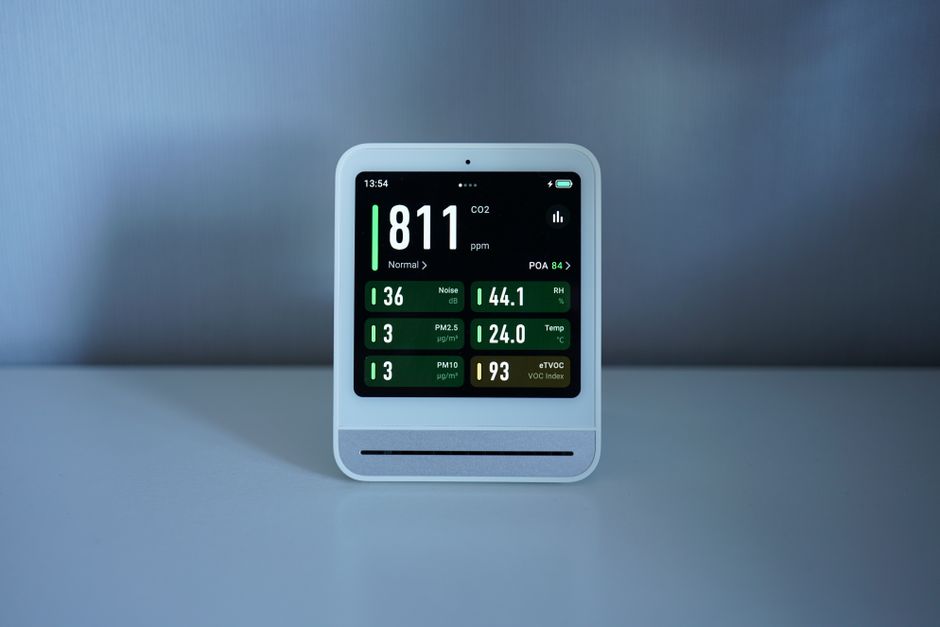
| Electrochemical sensor | Gas reacts at an electrode, produces a current | Continuous (real time) | Personal and indoor monitoring | Drifts, cross-sensitivity to other gases |
| Passive (diffusion) sampler | Gas diffuses onto a treated surface over days | Days to weeks | Long-term averages, large surveys | No short-term peaks, needs lab analysis |
| Colorimetric tube | Gas changes a reagent’s color; length read by eye | Minutes | Quick spot checks | Low precision, operator-dependent |
If you are trying to understand your own exposure at home, a low-cost electrochemical sensor or a passive sampler is realistic. If you are producing data that must hold up to regulatory or scientific review, chemiluminescence remains the reference standard.
What Is Chemiluminescence and Why Is It the Reference Method?
Chemiluminescence is the method that national monitoring networks have relied on for decades. It measures NO₂ indirectly, by converting it to nitric oxide (NO) and then measuring the light given off when that NO reacts with ozone.
The reaction is well understood. NO reacts with ozone to produce nitrogen dioxide in an excited state, which releases a photon as it settles. A detector counts those photons. The signal is proportional to the amount of NO present, and by extension to the NO₂ that was converted.
What makes it the reference method is its sensitivity and stability. It can detect NO₂ at the very low concentrations found in clean outdoor air, and it holds calibration well over long runs. The trade-offs are real: the instruments are large, costly, and require trained operators, regular calibration, and a reliable power supply. That is why they sit in fixed monitoring stations rather than in people’s homes.
How Do Electrochemical Sensors Work for Personal Monitoring?
Electrochemical sensors are the technology inside most wearable and low-cost air monitors. They are small, battery-friendly, and give near-instant readings.
Inside the sensor, NO₂ diffuses through a membrane and reacts at an electrode. That reaction produces a small electrical current. The current is proportional to the gas concentration, so the device converts it into a number you can read on a screen.
The appeal is obvious. You can carry one, wear one, or place several around a home or school. But the accuracy story is more complicated than the marketing suggests.
These sensors drift over time and respond to other gases besides NO₂, including ozone and some volatile organic compounds. Temperature and humidity also shift their output. Many low-cost monitors use mathematical corrections to compensate, but the corrections vary in quality. Studies that compare these devices against reference instruments often find reasonable agreement on average, with larger errors at low concentrations and during rapid changes.
For spotting broad patterns — like whether a kitchen or a busy road produces higher readings — they can be useful. For precise exposure measurement, they are not a substitute for reference-grade equipment.





How Do Passive Samplers Measure NO₂ Over Time?
Passive samplers are the simplest method in principle. They contain no pump and no power. A small badge or tube holds a surface treated with a chemical that captures NO₂ as it diffuses in from the surrounding air.
You leave the sampler in place for a set period — typically days to weeks — then seal it and send it to a lab. The lab extracts the captured NO₂ and measures it, usually by colorimetry or a related technique. The result is an average concentration over the whole exposure period.
That averaging is both the strength and the limitation. Because the sampler collects over time, it cannot tell you about short peaks, like the burst of NO₂ when a gas stove first ignites. What it does give you is a reliable long-term average, and it does so cheaply enough that researchers can deploy hundreds of samplers across a city at once.
For someone wanting to know whether one room tends to have higher NO₂ than another over a month, passive sampling is a sensible and cost-effective choice.
What About Colorimetric Tubes and Other Quick Checks?
Colorimetric detector tubes give you a rough reading in minutes. You break the ends of a sealed glass tube, use a hand pump to draw a fixed volume of air through it, and watch a color change. The length of the stained section corresponds to the concentration.
They are handy for a fast, on-the-spot check and need no electricity. The catch is precision. Results depend on how carefully the operator uses the pump and reads the color, and the tubes are better at indicating “high” versus “low” than at delivering an accurate number. For anything where the exact figure matters, a tube is not the tool.
How Do You Choose Between These Methods?
The decision comes down to three questions: how precise, how fast, and how much you can spend.
- Need regulatory-grade accuracy? Chemiluminescence is the standard. Nothing else matches it for sensitivity and reliability.
- Want real-time readings you can act on? An electrochemical sensor is the practical option, with the understanding that its numbers carry more uncertainty.
- Want a trustworthy long-term average on a budget? Passive sampling delivers that, as long as you do not need to see peaks.
- Need a rough number right now? A colorimetric tube works, but treat the result as approximate.
One point that often gets missed: comparing readings from different methods is harder than it looks. A passive sampler’s weekly average and a sensor’s instantaneous reading are measuring different things, so they will not match even when both are working correctly. If you plan to compare, make sure you are comparing like with like.
Where Does Nitrogen Dioxide Come From Indoors?
Outdoor NO₂ comes mostly from vehicle exhaust and fuel combustion. Indoors, the main source is unvented gas appliances — gas stoves, ovens, and space heaters. A gas burner can produce a noticeable spike in NO₂ each time it is used.
This matters because people spend most of their time indoors. A sensor placed near a gas stove will often read higher than one in a bedroom, and passive samplers in kitchens tend to show higher averages than those in living rooms. Good ventilation reduces indoor concentrations, though the effect depends on how much outside air actually moves through the space.
If you are measuring NO₂ at home, think about where the source is before you decide where to place your monitor. A reading from the wrong spot tells you little.
What Are the Limits of Low-Cost Monitors?
Low-cost monitors have made air quality measurement far more accessible. They have also created a lot of overconfidence in their numbers.
The evidence on their accuracy is mixed. Some devices perform reasonably well under stable conditions. Others show large errors, especially at the low concentrations typical of clean indoor air. Because NO₂ health concerns often involve long-term exposure at low levels, this is exactly where accuracy matters most.
A reasonable approach is to treat a low-cost monitor as a screening tool. It can tell you whether one location tends to be higher than another, or whether a change in habits shifts the readings. It should not be treated as a precise measurement. If a number needs to be defensible, it needs a reference method or a lab-analyzed sample.
Frequently Asked Questions
What is the most accurate way to measure nitrogen dioxide?
Chemiluminescence is the reference method used by regulatory monitoring networks, offering the highest sensitivity and stability. It requires expensive equipment and trained operators, which limits it to fixed stations and research settings.
Can I measure nitrogen dioxide at home?
Yes, using a low-cost electrochemical sensor or a passive sampler. Sensors give real-time readings but carry more uncertainty, while passive samplers provide a reliable average over days or weeks.
Why do different NO₂ monitors give different readings?
Different methods measure different things — a sensor captures an instant while a passive sampler averages over time. Sensor drift, cross-sensitivity to other gases, and temperature effects add further variation.
Do gas stoves increase indoor nitrogen dioxide?
Yes. Unvented gas burners produce NO₂, and concentrations can rise noticeably during cooking. Ventilation reduces indoor levels, though the effect depends on airflow.
