
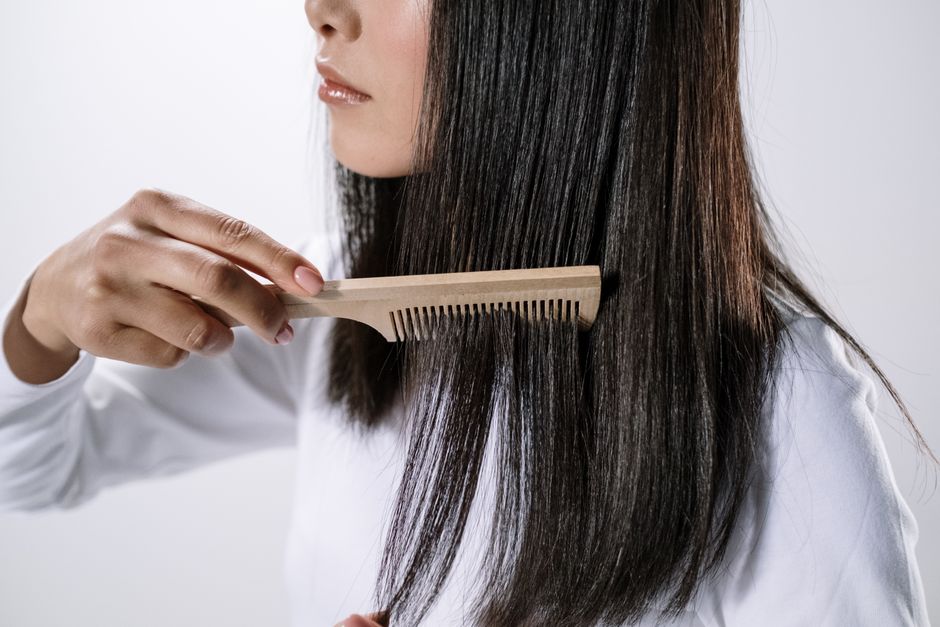
Turning straight hair curly is not about changing your hair’s natural structure permanently. The shape of your hair follicle determines if hair grows straight or curly, and that does not change. What you can change is how your hair looks and behaves. The right techniques, products, and tools can create curls that last from a few hours to a few days. This guide explains what works, what does not, and what the evidence actually shows.
Can You Really Make Straight Hair Curly?
Yes, but only temporarily. The shape of your hair shaft is fixed by genetics. Straight hair grows from round follicles. Curly hair grows from oval or asymmetrical follicles. No product or tool can reshape your follicle.
What you can do is restructure the bonds inside each hair strand. Heat tools break hydrogen bonds. Chemical treatments break disulfide bonds. Both methods let you reshape the hair temporarily or semi-permanently. The curls last until the bonds reform or the hair grows out.
This is not the same as having naturally curly hair. Curly hair starts curling at the follicle. Your curls will start where you apply the tool or chemical. Understanding this difference stops you from expecting permanent results from temporary methods.
How To Make Straight Hair Curly With Heat Tools
Heat tools are the most reliable method for creating curls on straight hair. Curling irons, wands, and flat irons all work by breaking hydrogen bonds in the hair cortex. When the hair cools, new bonds form in the curled shape. The curls last until humidity or washing reforms the original bonds.
Research published in the Journal of Cosmetic Science found that heat styling above 180 degrees Celsius effectively restructures hair bonds. Lower temperatures create weaker curls that fall faster. Higher temperatures damage the cuticle and cause breakage over time.
The technique matters more than the tool. For uniform curls, wrap small sections around the barrel and hold for 8-10 seconds. For beach waves, twist sections loosely and release. Let curls cool completely before touching them. Touching warm hair pulls out the shape and reduces curl longevity.
Heat protectant spray is not optional. The American Academy of Dermatology states that heat protectants reduce moisture loss and prevent brittleness. Without protection, repeated heat styling causes split ends and dullness. Apply protectant to damp hair before blow-drying and again before curling.
What Does Research Say About Chemical Curling Methods?
Chemical relaxers and perms work by breaking disulfide bonds in the hair and reforming them in a new shape. A perm uses ammonium thioglycolate to break these bonds, then a neutralizer to reset them in a curled position. This is the only method that creates curls lasting until the hair grows out.
Evidence from the International Journal of Trichology shows that perms effectively curl straight hair. However, the same research notes that perms cause significant cuticle damage. The hair becomes more porous, drier, and more prone to breakage. Results vary widely based on hair type, product strength, and application technique.
Home perm kits exist, but professional application is strongly advised. Incorrect timing or product strength can over-process the hair, causing breakage or uneven curl patterns. Some people report allergic reactions to thioglycolate. A patch test 48 hours before treatment is standard practice.
As of 2026, there is no clinical evidence that any oral supplement or topical serum permanently changes straight hair to curly. Claims about biotin or keratin supplements creating curls are not supported by research. These products improve hair health but do not alter follicle shape or bond structure.

What About No-Heat Methods for Making Hair Curly?
No-heat methods like braiding, twisting, or using flexi rods create curls without thermal damage. These methods work by bending the hair shaft while it dries. The hydrogen bonds reform in the bent shape, holding the curl until humidity or washing resets them.
Research on hair bond mechanics shows that wet-setting produces softer, less defined curls than heat styling. The curls also fall out faster because hydrogen bonds are weaker than the bonds formed by heat or chemicals. For straight hair, no-heat curls typically last 4-8 hours in normal humidity.
Some people report success with overnight methods like braiding damp hair or using foam rollers. These methods work best on hair that has some natural wave or texture. Very straight, fine hair often struggles to hold no-heat curls at all. Adding a styling product with hold, like mousse or gel, improves longevity.
A common misconception is that salt sprays create curls. Salt sprays add texture and grit, which can make hair appear wavier. They do not curl straight hair. They dry the hair out, which can actually increase frizz and make styling harder.
How To Make Straight Hair Curly: Step-by-Step Routine
Building a routine that works requires matching the method to your hair type and your expectations. Here is a practical approach based on what the evidence supports.
| Hair Type | Best Method | Expected Duration | Key Consideration |
|---|---|---|---|
| Fine, straight | Curling iron (1-inch barrel) | 4-8 hours | Use mousse before blow-drying for grip |
| Medium, straight | Perm (professional only) | 3-6 months | Requires regular deep conditioning |
| Thick, straight | Flat iron curls | 6-12 hours | Higher heat needed, use protectant |
| Wavy (slightly textured) | No-heat braiding | 6-10 hours | Works best with damp hair and gel |
Start with clean, dry hair. Product buildup weighs hair down and prevents curls from holding. Use a clarifying shampoo once a week to remove residue. Follow with a lightweight conditioner only on the ends. Heavy conditioners flatten curls.
Apply a heat protectant and a styling product before curling. Mousse or volumizing spray adds grip. Curls need friction to hold their shape. Slippery hair from silicone-based products causes curls to fall out faster.
Section hair into 1-inch squares. Curl each section away from the face for a natural look. Hold the iron for 8 seconds, then release. Pin the curl to your scalp with a clip while it cools. This sets the shape and extends hold time. Remove pins after 10 minutes.
Finish with a light-hold hairspray. Heavy sprays weigh curls down. Avoid touching or brushing curls after styling. Brush breaks up curl patterns and creates frizz.
What To Avoid When Trying To Curl Straight Hair
Several viral methods do not work and can damage hair. Knowing what to skip saves time and prevents frustration.
- Bendy straws or pipe cleaners. These create tiny, tight curls that look unnatural on straight hair. They also tangle easily and cause breakage when removed.
- Overnight headbands or scarves. Wrapping wet hair around a headband and sleeping on it rarely produces uniform curls. The results are usually messy and fall out within an hour.
- Vinegar rinses. Apple cider vinegar does not curl hair. It can remove product buildup and improve shine, but it has no effect on bond structure. Claims about “activating curls” are not backed by evidence.
- Hair typing charts that promise curl transformation. No amount of product changes your hair type from 1A (straight) to 3A (curly). Hair type is genetic. Products enhance what you have, not create what you do not.
- Over-washing or under-conditioning. Stripping natural oils makes hair dry and brittle. Dry hair breaks more easily when curled. Proper moisture balance is essential for curl longevity.
The most common mistake is using too much product. Layering gel, mousse, oil, and hairspray creates buildup that weighs curls down. One or two products are enough. Less is more when styling straight hair.
Frequently Asked Questions
Frequently Asked Questions
How long do curls last on straight hair?
Heat-styled curls typically last 4 to 12 hours depending on your hair type, humidity, and products used. Perms last 3 to 6 months until the hair grows out.
Can I perm my straight hair at home safely?
Home perm kits are available but professional application is safer because incorrect timing can cause breakage or uneven results. A patch test is essential to check for allergic reactions.
Does mousse help straight hair hold curls?
Yes, mousse adds texture and grip that helps curls hold longer. Apply it to damp hair before blow-drying for best results.
What temperature should I use to curl straight hair?
Use 350-400 degrees Fahrenheit for most hair types. Fine hair needs lower heat around 300 degrees. Always use a heat protectant spray.
