
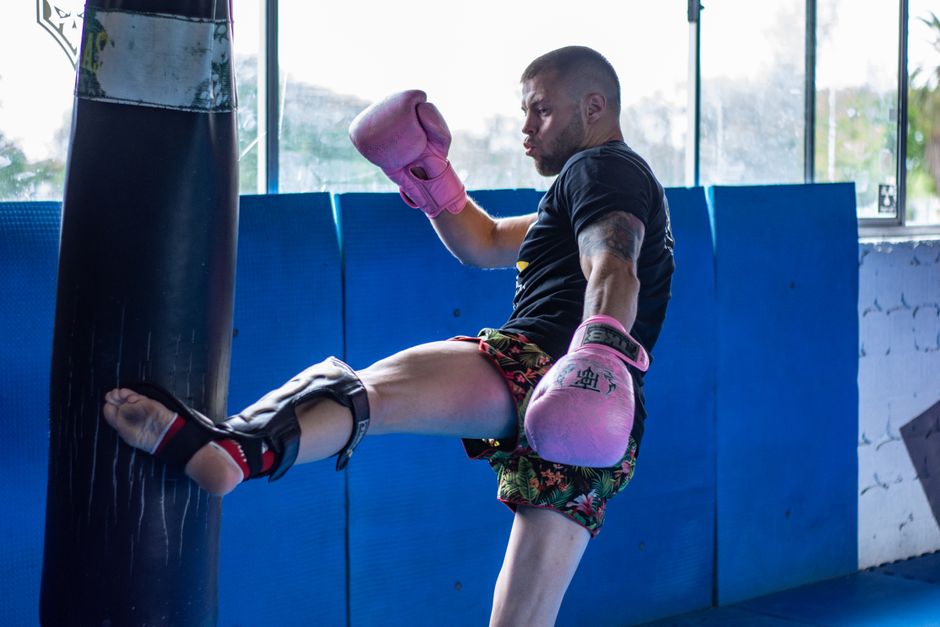
Kickboxing combines punches, kicks, and defensive movements from a stable stance. To start, stand with your feet shoulder-width apart, your weaker foot forward, and your hands up near your chin. From this position, you throw straight punches, round kicks, and learn to block or slip incoming strikes. The entire system works together — your stance feeds your offense, and your defense keeps you safe enough to keep fighting.
What Is the Correct Kickboxing Stance?
The stance is the foundation of everything else in kickboxing. If your stance is wrong, your punches will lack power and your kicks will feel off balance.
Stand with your feet about shoulder-width apart. If you are right-handed, place your left foot forward and your right foot back. This is called a southpaw stance if you are left-handed. Your weight should be slightly on the balls of your feet, not your heels. Keep your knees bent slightly so you can move quickly in any direction.
Your hands should be up near your cheekbones. Your chin should be tucked down toward your chest. Your elbows should cover your ribs. This position protects your head and your body at the same time. The back heel should be lifted off the ground just a little — this lets you pivot when you kick or punch.
Research published in the Journal of Sports Sciences found that experienced kickboxers maintain a narrower stance with more weight on the front foot compared to beginners. Beginners tend to stand too wide and flat-footed, which slows down their movement.
How Do You Throw Basic Punches in Kickboxing?
Kickboxing uses four main punches. The jab, the cross, the hook, and the uppercut. Each one starts from your stance and uses your whole body, not just your arm.
The jab comes from your front hand. It is a straight punch that extends directly toward your target. Your front shoulder rotates forward as you throw it. The jab is not a power punch — it is used to measure distance, disrupt your opponent’s rhythm, and set up harder strikes.
The cross comes from your back hand. This is your power punch. As you throw it, pivot your back foot and rotate your hips forward. Your back shoulder should come all the way through. The American Council on Exercise notes that the cross generates more force than any other punch because it uses the legs and hips.
The hook is thrown with either hand in a horizontal arc. Your elbow stays bent at about 90 degrees. Pivot on the same-side foot as the hand throwing the hook. The uppercut comes from below, traveling upward toward the chin. Bend your knees slightly and drive up through your legs as you throw it.
A common mistake beginners make is reaching with punches instead of stepping into range. Keep your punches compact. If you have to fully extend your arm to reach, you are too far away.
How Do You Throw Kicks Correctly?
Kicks in kickboxing are different from kicks in karate or taekwondo. They are designed to be practical and powerful, not flashy. The roundhouse kick is the most common kick you will use.
To throw a roundhouse kick with your rear leg, pivot on your standing foot. Lift your knee first, then rotate your hips over and extend your shin toward the target. You should make contact with your shin, not your foot. Hitting with your foot risks breaking small bones in your ankle or foot.
The front leg roundhouse is faster but less powerful. You lift your front knee and snap the kick without pivoting as much. This kick is good for interrupting your opponent’s attack or scoring points in a sparring match.
The front kick, sometimes called a teep, is a push kick. You lift your knee and extend your foot forward into your opponent’s midsection. This kick is used to control distance and stop an advancing opponent. The side kick is less common in kickboxing but still useful. You turn your body sideways and drive your heel straight out.
A study in the Journal of Strength and Conditioning Research found that experienced kickboxers generate significantly more force with rear leg kicks than front leg kicks. The difference comes from the extra hip rotation and weight transfer available with the rear leg.





What Are the Core Defensive Techniques?
Defense in kickboxing is not about dodging everything. It is about reducing the damage of what lands and creating opportunities to counterattack.
The most basic defense is keeping your hands up. This sounds simple, but it is the first thing people forget when they get tired or excited. Your gloves should cover your temples. Your forearms should be angled to deflect punches that slip through.
Blocking is actively using your arms or legs to stop a strike. For a punch to the head, bring your rear hand across your face. For a body punch, drop your elbow down to cover your ribs. For a low kick, lift your shin to meet the incoming kick. This is called checking a kick, and it hurts less than taking the kick on your thigh.
Slipping is moving your head just enough to avoid a straight punch. You bend your knees slightly and tilt your head to the side. Parrying is using your hand to redirect a punch off its path. A small tap on your opponent’s glove can send their punch wide.
Footwork is the most overlooked defensive tool. Moving backward, circling to the side, or stepping off the center line can make punches miss completely. The CDC reports that proper sparring technique, including defensive training, significantly reduces head trauma risk in combat sports.
| Defense Type | When to Use | Common Mistake |
|---|---|---|
| Block | Against hooks and body shots | Dropping hands after blocking |
| Slipping | Against straight punches (jab/cross) | Moving too wide or too slow |
| Parrying | Against predictable jabs | Swatting instead of redirecting |
| Checking | Against low kicks | Checking too late or with the knee |
| Footwork | To control distance at all times | Crossing feet or backing up in a straight line |
How Do You Combine Punches, Kicks, and Defense?
Kickboxing is not about doing one thing at a time. You need to blend offense and defense into a continuous flow. This is the hardest part to learn, and it takes months of practice to feel natural.
Start with simple two-strike combinations. Jab and cross. Then add a kick. Jab, cross, rear roundhouse kick. The key is that each strike sets up the next one. The jab makes your opponent react, the cross forces them to cover up, and the kick lands while they are still protecting their head.
Defense should happen between your strikes, not after you finish a combination. After you throw a jab, your hand should return to your face immediately. After you kick, your foot should land back in your stance, not somewhere wide. This is called returning to your stance, and it is what separates controlled fighters from wild ones.
Some people report that shadowboxing in front of a mirror helps them see where their defense breaks down. This is a widely used training method, though strong evidence on its effectiveness over other drills is limited. What is clear from sports science research is that deliberate practice — repeating specific movements with feedback — improves coordination faster than just sparring for hours.
What Are Common Mistakes Beginners Make?
Most beginners make the same errors. Knowing them ahead of time can save you weeks of frustration.
Dropping your hands when you kick is the most common mistake. Your body naturally wants to balance by swinging your arms backward. You have to fight this instinct and keep your hands up. If your hands drop, your opponent has a clear path to your chin.
Telegraphing your strikes is another big problem. You might drop your shoulder before you throw a cross, or look at where you intend to kick. Experienced fighters can read these cues. Keep your upper body relaxed and your eyes on your opponent’s chest, not their fists or feet.
Not pivoting on your feet is a technical error that kills power. If you throw a cross without rotating your back foot, you are only using your arm. The same goes for kicks — if your standing foot does not pivot, your hips cannot rotate through.
Overcommitting to strikes is dangerous. If you throw a punch or kick with your full weight and miss, you are off balance and vulnerable. Throw with control, even when training hard. Reserve full power for the moment you are certain your strike will land.
As of 2026, there is no clinical evidence that any single training method works best for everyone. The most effective approach is consistent practice with feedback from a qualified instructor. Online videos can help, but they cannot correct your form in real time.
Frequently Asked Questions
How long does it take to learn kickboxing stance and basic strikes?
Most people learn the basic stance and four core punches in two to three sessions. Kicks take longer because they require hip flexibility and balance.
Do I need to be flexible to kick in kickboxing?
You do not need to be extremely flexible for basic kicks. Hip mobility helps, but consistent stretching over several weeks will improve your range of motion.
Is kickboxing safe for beginners with no fighting experience?
Yes, when taught properly with controlled sparring and protective gear. A qualified instructor will start you on technique before introducing contact.
What equipment do I need to start training kickboxing?
You need hand wraps, boxing gloves, and a mouthguard at minimum. Shin guards are recommended once you start kicking pads or a heavy bag.
