
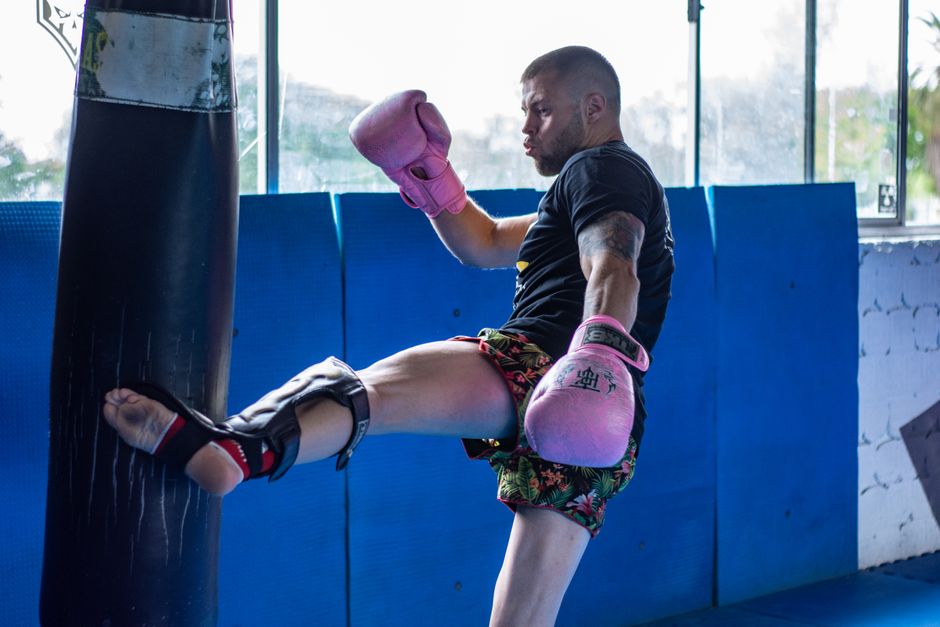
Kicking a punching bag correctly starts with your stance and ends with your hip. Beginners should master the rear-leg roundhouse kick first, focusing on turning the standing foot, rotating the hips, and striking with the shin. Keep your hands up, your guard tight, and your eyes on the bag. Start slow. Speed and power come later.
What Is The Correct Stance For Kicking A Punching Bag?
Your stance is the foundation of every kick. Stand with your weaker side forward. If you are right-handed, that means your left foot is in front. Your feet should be about shoulder-width apart. Your rear heel should be lifted slightly off the ground.
Keep your knees slightly bent. Your hands should be up near your chin, palms facing each other. This is your fighting stance. It is not a static position. You should feel balanced and ready to move in any direction.
When you kick, you do not kick from this exact stance. You shift your weight and pivot. But the stance is where every kick starts. If your stance is sloppy, your kick will be sloppy. Practice standing in this position until it feels natural.
How Do You Throw A Basic Roundhouse Kick?
The roundhouse kick is the most common kick beginners learn on a heavy bag. It is powerful, practical, and teaches the mechanics you will use for other kicks.
Start in your fighting stance. Step your front foot slightly to the outside, about 6 to 12 inches. This clears your hip and gives your rear leg room to swing. Your weight shifts to your front leg.
Now pivot on your front foot. Your heel should turn toward the bag. This is not a small turn. Your foot should rotate nearly 180 degrees as your hips rotate forward. The pivot is what generates power. Without it, you are just swinging your leg.
As you pivot, drive your rear knee forward and upward. Your knee leads the kick. Your shin follows. The striking surface is the lower third of your shin, not your foot. Striking with the shin protects your toes and ankle.
Your arms drop slightly as you kick, but only on the same side as your kicking leg. Your opposite hand stays up near your face. This is called keeping your guard. Many beginners drop both hands. That is a mistake.
Follow through. Do not stop at the bag. Your hip should rotate fully, and your kick should travel through the target. Then bring your leg back down to your stance. Do not let it drop heavily. Control the return.
How To Kick A Punching Bag Correctly For Beginners?
The single most common beginner error is kicking with the foot instead of the shin. Your foot has small bones that break easily. Your shin is a large, dense bone designed to absorb impact. Always strike with the shin.
The second most common error is forgetting to pivot. If your standing foot stays flat, your hips cannot rotate. Your kick becomes a lifting motion rather than a swinging strike. This reduces power and strains your knee.
Keep your knee slightly bent at the moment of impact. A locked knee transfers the full force of the impact directly into your joint. A bent knee allows your leg to absorb some of the shock naturally.
Do not lean backward when you kick. Beginners often lean away from the bag to avoid the impact. This throws off your balance and reduces power. Keep your torso upright or lean slightly forward into the kick.
Strike the bag at the right height. For a low kick, aim for the thigh level of an imaginary opponent. For a body kick, aim for the midsection of the bag. Do not aim at the very bottom or top of the bag. The bag swings unpredictably at those points.





What Is The Correct Way To Hit The Bag?
The bag should swing slightly when you hit it, not wildly. A bag that swings violently means you are pushing rather than striking. A good kick snaps through the target. Think of hitting through the bag, not at the bag.
Make contact with the flat part of your shin, not the sharp edge. The flat surface distributes the impact across a larger area. This protects your bone and makes the strike more solid.
Your toes should be pointed down at the moment of impact for a roundhouse kick. This position extends the shin and creates a clean striking surface. If your toes point sideways, you risk hitting with the top of your foot.
Breathe out as you kick. Holding your breath tenses your muscles and reduces speed. Exhale sharply at the moment of impact. This also tightens your core, which protects your spine during the rotation.
How Do You Avoid Hurting Your Feet Or Shins?
Shin pain is normal for beginners. Your shin is not used to impact. It will adapt over time, but you should build up gradually. Start with light kicks against the bag. Increase power over several weeks.
Do not kick the bag with bare shins at full power on your first day. This is how people develop deep bruises and even small fractures. Wear shin guards if you have them. If you do not, start at about 30 percent power.
Your feet are more fragile than your shins. If you accidentally kick with the top of your foot, you can strain the tendons or break small bones. This is why the shin is the correct striking surface. It is not a preference. It is a safety measure.
Check the bag before you kick. A heavy bag should be firm but not rock hard. If the bag is overstuffed or has been sitting in a cold garage, it can be dangerously hard. Some gyms have bags that are too dense for beginners. If the bag does not give at all when you press on it, be careful.
How Many Repetitions Should Beginners Do?
Quality matters more than quantity. Ten well-executed kicks are better than fifty sloppy ones. Your body needs time to learn the movement pattern. Rushing through repetitions only reinforces bad habits.
A reasonable starting point is three rounds of ten kicks per leg. Rest one minute between rounds. This gives you enough volume to build muscle memory without exhausting yourself.
Pay attention to your standing leg. The pivot motion strains the ankle and knee of your standing leg. If you feel sharp pain in your standing knee, stop. Some soreness is normal. Sharp pain is not.
Do not train kicks every day. Your shins and joints need recovery time. Two to three sessions per week is enough for beginners. Your body adapts during rest, not during training.
What Mistakes Should Beginners Avoid?
Do not chase the bag. The bag swings after each kick. Wait for it to settle before kicking again. Chasing a moving bag teaches you to kick off balance.
Do not drop your guard completely. Your non-kicking hand should stay near your face throughout the kick. This is a hard habit to build because it feels unnatural. But it is essential for real self-defense situations.
Do not kick with a straight leg from the start. Your knee should bend as it drives forward, then extend at the moment of impact. A straight leg kick is slow and puts stress on your knee joint.
Do not neglect your lead leg. Most beginners only practice rear-leg kicks. The lead leg kick is different. It uses less hip rotation but is faster and harder to see coming. Practice both legs and both sides.
Do not hold the bag for someone else if you are also learning. Holding a heavy bag requires experience. You need to brace your body correctly or you can injure your back. Let an experienced partner hold the bag while you learn.
Frequently Asked Questions
Should I wear shoes when kicking a heavy bag?
Bare feet or boxing shoes are both acceptable. Socks are dangerous because they make your standing foot slide during the pivot.
How long does it take to learn a proper roundhouse kick?
Most beginners develop a functional roundhouse kick within four to six weeks of consistent practice. Full mastery of power and timing takes several months.
Is it normal for my shins to hurt after kicking a bag?
Mild soreness is normal as your shins adapt to impact. Sharp pain, bruising that spreads, or pain that lasts more than a few days is not normal and should be evaluated.
Can I kick the bag if I have knee problems?
You should consult a healthcare professional first. The pivot motion places significant rotational stress on the standing knee and the kicking knee.
