
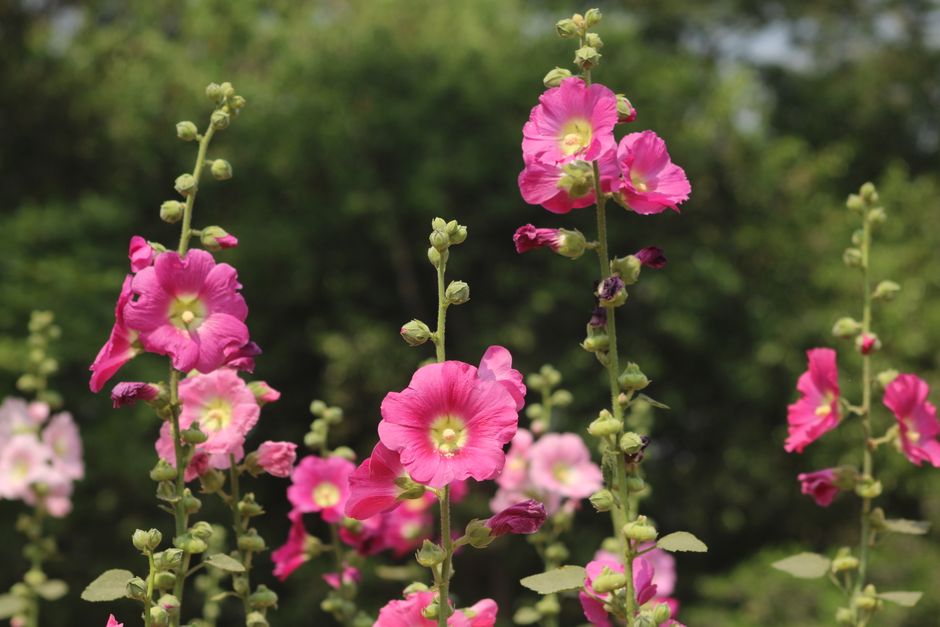
Hollyhocks fall over because their flower spikes are tall, top-heavy, and catch wind, while the stems themselves are often too weak to hold that weight upright. The reliable fixes are staking each spike, planting them where they are sheltered from strong wind, and choosing shorter or sturdier varieties. You cannot make a hollyhock stand on its own through fertilizer or water alone.
Why Do Hollyhocks Fall Over So Easily?
Hollyhocks are tall, and height is the whole problem. Many varieties grow flower spikes well above head height, and that spike carries a column of large, saucer-shaped blooms. The plant is essentially a long lever with a heavy load at the top.
The stem is herbaceous. It is not woody like a tree trunk. It is a fleshy, hollow-ish stalk that has to support all that weight and catch whatever wind hits it. A gust hitting a tall spike creates leverage at the base, and the stem bends or snaps.
There is also a disease factor. Hollyhocks are prone to rust, a fungal problem that shows up as orange-brown spots on the leaves. When rust is severe, leaves drop and the plant loses vigor. A weakened plant tends to have weaker stems. So some flopping is not just physics. It is a sign the plant is struggling.
One thing worth knowing: a hollyhock that flops over is usually not dying. It is just doing what a tall, soft-stemmed plant does when nothing holds it up. The fix is mechanical support, not a rescue mission.
How To Keep Hollyhocks From Falling Over
The single most effective method is staking. A stake placed early, before the plant needs it, gives the stem something to lean against as it grows.
Timing matters more than technique. If you wait until the plant is already flopping, you are trying to straighten a bent stem, and that often breaks it. Put the stake in when the plant is still short and the stem is flexible.
- Use a stake tall enough to reach most of the way up the mature flower spike.
- Push it into the ground a few inches away from the crown so you do not spear the root system.
- Tie the stem to the stake with soft material. Garden twine, strips of old cloth, or soft plant ties work. Wire or thin string can cut into the stem.
- Tie loosely. The stem needs room to sway slightly. A stranglehold damages tissue.
- Add ties as the spike grows, spacing them up the stem rather than putting one tie at the top.
For a group of hollyhocks, a different approach works well. Instead of staking each plant, drive stakes around the whole clump and run twine between them in a grid or loop. The plants grow up through the support and lean on it as a group. This is faster when you have many plants.
Grow-through grid supports, the kind sold for perennials, also work. You place them over the plant while it is small, and the stems grow up through the openings. These are less visible than individual stakes.
Does Planting Location Stop Hollyhocks From Flopping?
Location reduces the problem but does not solve it alone. Wind is the main force that knocks hollyhocks down, so a spot sheltered from prevailing wind helps.
A position against a fence, wall, or the side of a building gives some protection. So does planting them among other tall, sturdy plants that break the wind. A dense bed absorbs wind energy better than an exposed single plant.
But shelter has a limit. Even in a calm spot, a tall spike with heavy blooms can lean under its own weight. And a wall that blocks wind also blocks airflow, which can make rust worse. There is a tradeoff here, and it is worth being honest about it: shelter helps, but it is not a substitute for support.
Soil also plays a role. Hollyhocks in loose, rich, well-watered soil can grow fast and tall with soft stems. Some growers find that plants in leaner, well-drained soil grow a bit shorter and sturdier. This is a general gardening observation rather than a tested rule, so treat it as a tendency, not a guarantee.





Do Shorter Varieties Stay Upright Better?
Yes. Shorter hollyhock varieties flop less because there is less leverage working against the stem. If you have fought flopping for years, variety choice is worth more than any staking trick.
Standard hollyhocks are the tall ones, often reaching well above six feet. Dwarf and compact types stay much shorter. The tradeoff is that you get a smaller plant and often smaller flowers. Some people find the shorter types lose the dramatic cottage-garden look they wanted in the first place.
There is also a biennial-versus-perennial factor. Common hollyhocks are often grown as biennials or short-lived perennials. They put energy into a tall flower spike, set seed, and decline. That life cycle means the plant is not building a strong permanent framework the way a shrub does.
If you want tall hollyhocks, accept that staking is part of the deal. If you want low maintenance, choose a shorter type and still plan to stake in windy spots.
What About Pruning and Deadheading?
Removing spent flowers can reduce the load on the spike. As blooms fade and go to seed, they add weight. Deadheading, or cutting off faded flowers before they set seed, keeps the spike lighter.
This is a modest effect, not a fix. A tall spike with fresh blooms at the top is still top-heavy. Deadheading helps at the margins.
Cutting the whole plant back is a different decision. Some growers cut the flower spike back after the first flush to encourage a second round of blooms on a shorter plant. Whether this works well depends on the variety and your climate, and results vary. It is a common practice, not a guaranteed one.
One caution: do not cut into the crown or main stem structure when deadheading. Cut the flower stem above a leaf node. Damaging the base of the plant invites rot and disease.
Does Rust Make Hollyhocks Fall Over?
Rust can contribute to flopping, but it is usually not the main cause. Rust is a fungal disease that causes orange-brown pustules, mostly on the undersides of leaves. In severe cases, leaves yellow and drop.
When a plant loses most of its leaves, it has less ability to photosynthesize and support itself. A heavily rusted plant may look weak and floppy. But the flopping is usually the tall stem plus wind, with rust as a compounding factor.
Managing rust is about airflow and sanitation. Space plants so air moves between them. Water at the base rather than overhead. Remove and discard infected leaves rather than leaving them on the ground. Some gardeners report that certain varieties resist rust better than others, though resistance varies by region and conditions.
Be careful not to overstate what any single measure does. Rust control is a management practice, not a cure, and it will not make a tall hollyhock stand up on its own.
Common Mistakes That Make Hollyhocks Flop More
Most flopping problems come down to a few avoidable mistakes.
- Staking too late, after the stem has already bent or snapped.
- Tying too tight, which damages the stem and can cause it to break at the tie point.
- Over-fertilizing with nitrogen, which pushes soft, fast, weak growth. Nitrogen drives leafy green growth, not stem strength.
- Planting in an exposed, windy spot with no shelter or companion plants.
- Ignoring rust until the plant is defoliated and weak.
The nitrogen point is worth a closer look. Gardeners often reach for fertilizer when a plant looks weak, assuming it needs feeding. For a floppy hollyhock, more nitrogen usually makes things worse. It encourages rapid, soft growth that is even less able to hold itself up. If you feed at all, go easy.
None of these mistakes are dramatic on their own. Together they turn a manageable plant into one that spends the season on the ground.
When Should You Just Let Them Lean?
Sometimes leaning is fine. Hollyhocks growing against a fence or among other plants can lean naturally without looking messy. If the blooms stay off the ground and the plant looks healthy, you may not need to do anything.
The problem is when the spike lies flat on the soil. Blooms touching wet ground rot faster, and the plant becomes more vulnerable to slugs and disease. That is when support matters most.
If a stem has already snapped, you can often cut it back to a leaf node and let the plant send up new growth, though a second full spike in the same season is not guaranteed. Whether it regrows depends on the variety, the timing, and how much season is left.
Frequently Asked Questions
Why do my hollyhocks keep falling over?
They fall over because tall flower spikes are top-heavy and catch wind, while the soft stems cannot always hold the weight. Without support, a tall hollyhock often leans or snaps in a strong gust.
What is the best way to stake hollyhocks?
Place a tall stake early, while the stem is still short and flexible, and tie the stem to it loosely with soft material at several points. Staking after the plant has already bent is much less effective and risks breaking the stem.
Do shorter hollyhock varieties stay upright without staking?
Shorter varieties flop less because there is less height and weight working against the stem, but they can still lean in exposed, windy spots. Variety choice reduces the problem rather than eliminating it.
Does fertilizer help hollyhocks stand up straight?
No. Fertilizer, especially high-nitrogen types, tends to push soft, fast growth that is weaker and more likely to flop. Stem strength comes from the plant’s structure, not from feeding.
