
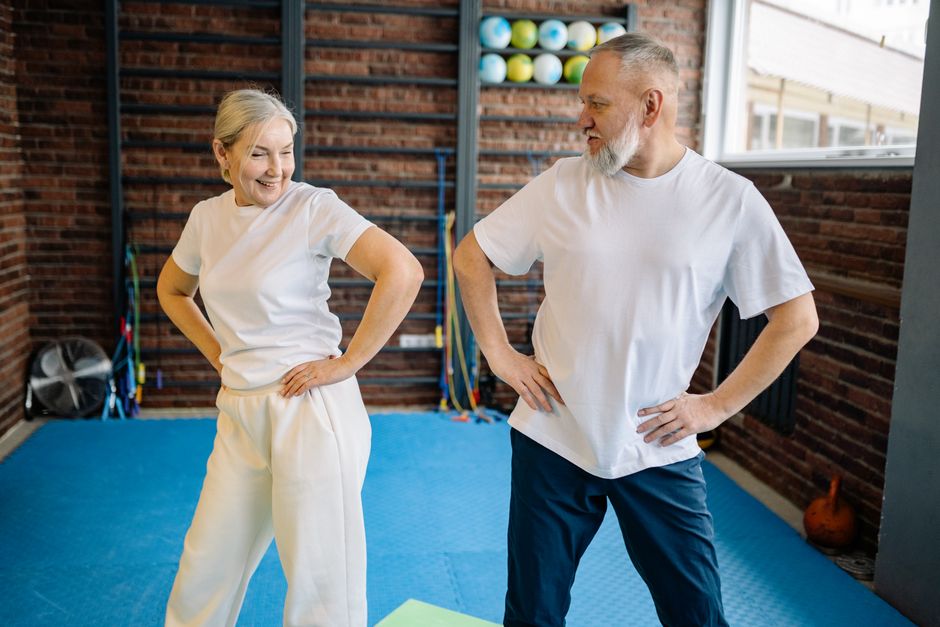
Your hips carry you through every step, stair, and squat for your entire life, and unlike a knee or shoulder, they rarely announce themselves until something is wrong. Keeping hips healthy comes down to three everyday habits: loading the joint with the right kinds of movement, eating in a way that protects bone and muscle, and getting enough quality sleep so your body can repair the tissue you stress during the day. Exercise keeps the muscles around the hip strong and the joint mobile, diet supplies the raw materials for bone and cartilage, and sleep is when much of that repair actually happens.
What Actually Makes Up a Healthy Hip?
The hip is a ball-and-socket joint. The rounded head of the thigh bone sits inside a socket in the pelvis, and the whole thing is wrapped in some of the strongest cartilage and ligaments in the body. It is built for both stability and a wide range of motion.
What keeps it working is not just the joint itself. It is the system around it:
- Bone — the socket and the thigh bone need to stay dense and strong.
- Cartilage — the smooth lining that lets the surfaces glide without friction.
- Muscles — the glutes, hip flexors, and deep rotator muscles that move and stabilize the joint.
- Tendons and bursae — the connective tissue and fluid-filled sacs that cushion movement.
Hip problems usually trace back to one of these. Osteoarthritis wears down cartilage. Osteoporosis weakens bone. Muscle weakness and inactivity leave the joint less supported. That is why the three pillars below matter so much — they each target a different part of the system.
How Does Exercise Keep Hips Healthy?
Movement is the single most important thing you can do for your hips. Cartilage has no blood supply of its own. It gets nutrients by being loaded and unloaded — squeezed and released as you move. A hip that never moves loses that nourishment.
Exercise does two jobs at once. It strengthens the muscles that support the joint, and it keeps the joint itself mobile. Both matter, and they are not the same thing.
The types of movement that help most
Three categories of activity support hip health, and a good routine includes all three:
- Strength training for the glutes, hips, and core. Squats, lunges, step-ups, and hip bridges load the joint and build the muscles around it.
- Weight-bearing cardio like walking, hiking, or stair climbing. This stresses bone in a way that helps maintain density.
- Mobility work such as gentle stretching or controlled hip circles. This maintains range of motion, especially as you age.
The general physical activity guidelines for adults in the United States call for at least 150 minutes of moderate-intensity aerobic activity per week, plus muscle-strengthening activity on two or more days per week. That is a reasonable foundation for hip health, though it is a general recommendation rather than one written specifically for the hips.
Why strength matters more than stretching as you age
Many people assume flexibility is the key to healthy hips. Strength is usually the bigger factor. Weak gluteal muscles are commonly found in people with hip pain, and the muscles around the hip tend to weaken with age if they are not challenged. Building them back takes deliberate resistance training.
One clarification worth making: you cannot “stretch” arthritis out of a hip, and aggressive stretching into a painful range can make some hip conditions worse. If a movement causes sharp pain, that is a signal to stop, not to push through.
Does Diet Really Affect Hip Health?
Diet affects the hip in two main ways: through bone density and through the muscle and tissue that support the joint. There is no single food that protects hips, but the overall pattern of eating matters.
Bone-building nutrients
Bone is living tissue that is constantly being broken down and rebuilt. Two nutrients do most of the heavy lifting:
- Calcium — the main mineral in bone. Adults generally need around 1,000 mg per day, rising to about 1,200 mg per day for women over 50 and men over 70. Dairy, fortified plant milks, leafy greens, and canned fish with bones are common sources.
- Vitamin D — needed for calcium absorption. The recommended daily amount is typically 600 to 800 IU for most adults, though many people need more based on blood levels. Your doctor can check this with a blood test.
Protein also matters, and it is often overlooked. Bone is roughly half protein by volume, and muscle is entirely protein. Older adults in particular tend to eat less protein than they need to maintain muscle. Including a protein source at each meal is a practical way to support both bone and muscle.
What the evidence does not support
No specific diet has been shown to prevent hip osteoarthritis. Some research suggests that diets high in anti-inflammatory foods — vegetables, fruits, fatty fish, whole grains — are associated with less joint pain, but the evidence is not strong enough to say diet treats arthritis. Be skeptical of any supplement marketed specifically for “hip health” or “joint renewal.” No large human trials have confirmed that these products rebuild cartilage or reverse joint damage.





How Does Sleep Affect Your Hips?
Sleep is when your body does most of its tissue repair. During deep sleep, the body releases growth hormone and other signals that drive the rebuilding of muscle, bone, and connective tissue. Cut sleep short, and you cut into that repair window.
The relationship runs both directions. Poor sleep is common in people with chronic hip pain, and poor sleep can also make pain feel worse by lowering your pain threshold. It becomes a loop — pain disrupts sleep, and lost sleep makes the pain harder to tolerate.
Sleep position and hip comfort
How you sleep can affect how your hips feel in the morning. Side sleeping with a pillow between the knees keeps the hips level and reduces strain on the joint. Back sleeping with a pillow under the knees takes pressure off the front of the hip. Stomach sleeping tends to rotate the hips and is generally the least comfortable for people with hip issues.
If you wake with stiff hips, a few minutes of gentle movement in the morning can help. Stiffness after rest is a normal feature of osteoarthritis, and it usually eases with activity rather than rest.
How To Keep Hips Healthy With Exercise, Diet And Sleep Together
The three pillars reinforce each other, and that is the point. Exercise builds the demand for repair. Diet supplies the materials. Sleep provides the time and the hormonal signals to actually do the repair. Skip one, and the other two work less well.
Here is how they connect in practice:
- Strength training creates micro-stress in muscle and bone, which triggers rebuilding — but only if you eat enough protein and sleep enough to recover.
- Calcium and vitamin D support bone, but bone responds to load. Without weight-bearing activity, the minerals have less to work with.
- Sleep supports muscle recovery and pain tolerance, which makes it easier to stay active the next day.
For most adults, a workable routine looks like this: move your hips through their full range most days, strength train the legs and glutes two or more times a week, eat protein and calcium-rich foods regularly, keep vitamin D in a normal range, and protect your sleep. None of these is dramatic on its own. Together they are what keeps a hip functioning over decades.
When Should You See a Doctor About Hip Pain?
Some hip discomfort is normal after unusual activity and settles within a few days. Other signs point to something that needs medical attention.
See a doctor if you have:
- Pain that lasts more than a few weeks or keeps getting worse
- Pain that wakes you at night or stops you from walking normally
- Sudden severe pain, especially after a fall
- Inability to bear weight on the leg
- Hip pain accompanied by fever
- Numbness, tingling, or weakness in the leg
Hip pain is not always a hip problem. Pain felt in the hip can come from the lower back, the sacroiliac joint, or the bursa, and the causes are treated differently. That is one reason a proper exam matters — the location of the pain does not always reveal the source. A clinician can help sort out whether the issue is the joint itself, the soft tissue around it, or referred pain from the spine.
This article is informational and is not a substitute for medical advice. If you have persistent hip pain, a diagnosis is the first step, and treatment depends on what is actually causing it.
Frequently Asked Questions
What is the best exercise for hip health?
Strength training for the glutes and legs, combined with weight-bearing activity like walking, is the most effective approach. Mobility work helps maintain range of motion but does not replace strength training.
Can diet alone prevent hip problems?
No. Diet supports bone and muscle, but it cannot replace the mechanical loading that joints and bones need from movement. The two work together rather than separately.
Does sleep position affect hip pain?
It can. Side sleeping with a pillow between the knees keeps the hips aligned, and back sleeping with a pillow under the knees reduces strain. Stomach sleeping tends to rotate the hips and is often the least comfortable.
When should hip pain be checked by a doctor?
See a doctor if pain lasts more than a few weeks, worsens over time, wakes you at night, or comes with numbness, weakness, or fever. Sudden severe pain or inability to bear weight needs prompt attention.
